What Is a Dedicated Development Team: Unlocking Scalability


Scaling a mobile or web application can reveal just how complex software delivery becomes as your team grows. For tech startup founders and product managers with ambitious goals, the challenge lies in assembling a dedicated development team that operates as a truly integrated extension of your organization. With clear role definitions and focused collaboration, these teams drive projects forward efficiently and adapt to evolving business needs. Discover how the right team structure and methodology enable smart scaling without sacrificing quality or speed.
Table of Contents
- Core Concept of Dedicated Development Teams
- Types and Key Roles in Dedicated Teams
- How Dedicated Teams Operate and Integrate
- Cost Benefits and Financial Implications
- Common Mistakes and How to Avoid Them
Key Takeaways
| Point | Details |
|---|---|
| Dedicated Development Teams Enhance Collaboration | Dedicated teams promote closer integration with clients, fostering effective communication and deep understanding of project needs. |
| Specialized Skill Sets Drive Project Success | Team members with tailored expertise contribute to innovative solutions, ensuring high-quality outcomes. |
| Flexible Structure Provides Scalability | Organizations benefit from the ability to quickly adapt teams to changing needs without long-term commitments. |
| Proactive Management Prevents Common Pitfalls | Clear role definitions and continuous skill development are essential for overcoming structural and communication challenges. |
Core Concept of Dedicated Development Teams
A dedicated development team represents a strategic approach to building software solutions by assembling a specialized group of professionals entirely focused on delivering a specific project or product. Unlike traditional outsourcing models, these teams operate as an extended part of your organization, providing consistent expertise and deep understanding of your technological ecosystem.
The core characteristics of dedicated development teams include:
- Full-time commitment to a single project or client
- Direct communication and seamless integration with client’s internal processes
- Specialized skill sets tailored to specific technological requirements
- Long-term collaboration and deep product knowledge
Dedicated development teams function most effectively when they embrace collaborative methodologies like Agile and Scrum. These frameworks enable teams to work with enhanced coordination, reducing role confusion and promoting incremental, evidence-based delivery of software solutions.
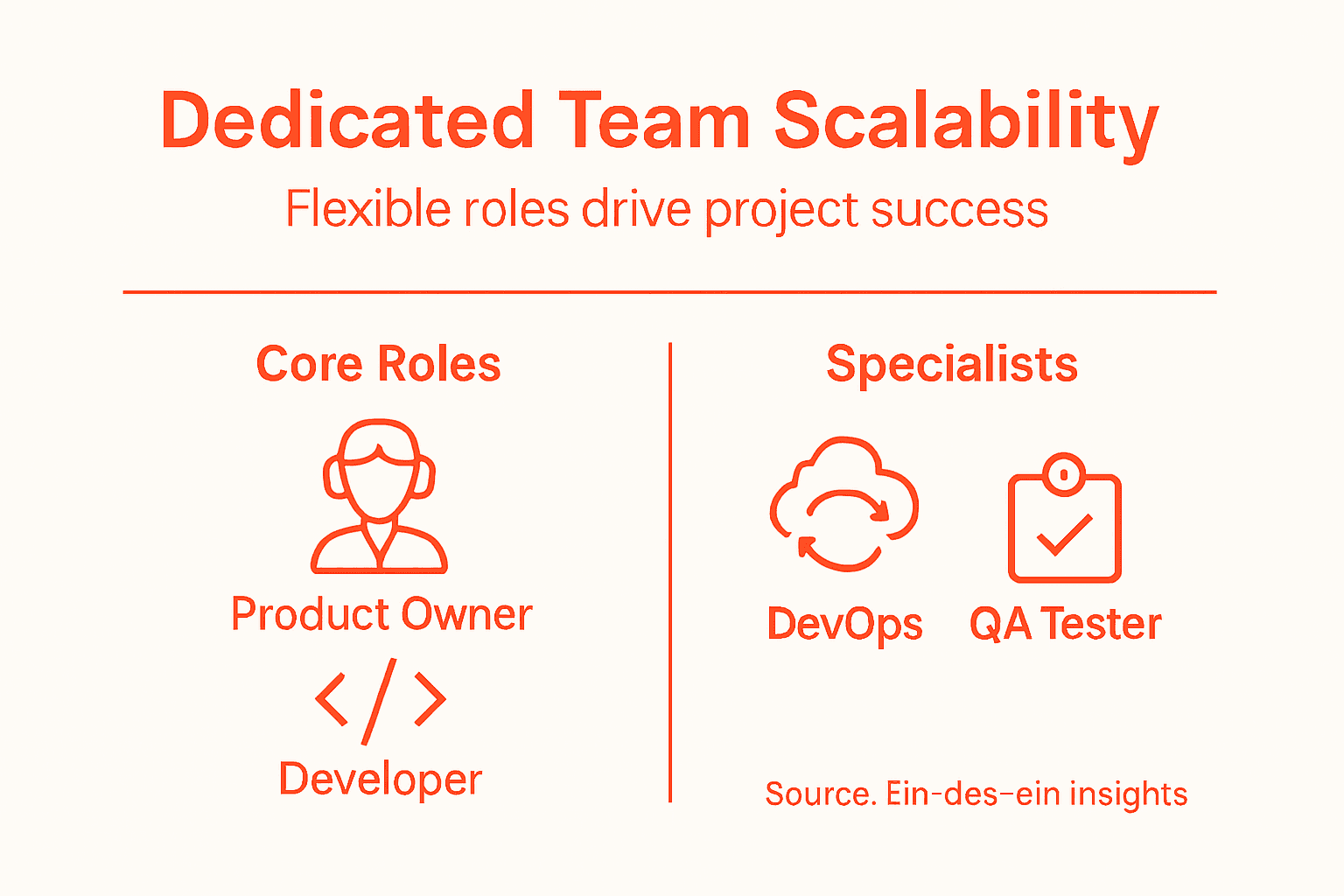
The team structure typically includes key roles that ensure comprehensive project management and technical execution:
- Developers with specific technological expertise
- Product Owner defining strategic vision
- Scrum Master facilitating team processes
- Quality Assurance specialists
- UX/UI designers
Advantages of dedicated development teams extend beyond traditional hiring models by providing flexibility, scalability, and access to specialized talent without long-term employment commitments. They allow organizations to rapidly scale technical capabilities while maintaining high-quality standards.
Pro tip: When forming a dedicated development team, prioritize cultural fit and communication skills alongside technical expertise to ensure smooth collaboration and project success.
Types and Key Roles in Dedicated Teams
Dedicated development teams comprise a complex ecosystem of specialized professionals, each playing a critical role in delivering successful software projects. Scrum team structures typically focus on three core accountabilities that form the foundation of collaborative and efficient product development.
The primary roles in dedicated development teams include:
- Product Owner: Responsible for maximizing product value
- Developers: Technical professionals delivering product increments
- Scrum Master: Process facilitator and organizational change agent
- Quality Assurance Specialists: Ensuring software quality and performance
- UX/UI Designers: Creating user-centered design experiences
Team role dynamics reveal distinct responsibilities that contribute to project success. The Product Owner serves as the strategic visionary, translating business requirements into a clear product roadmap. Developers transform these requirements into functional software, while Scrum Masters remove organizational impediments and promote continuous improvement.

Dedicated teams can be structured in various configurations depending on project complexity and organizational needs:
Here’s a summary of how different dedicated team structures impact project outcomes:
| Team Structure Type | Best Use Case | Key Business Impact |
|---|---|---|
| Cross-functional Agile | Complex multi-discipline projects | Faster delivery, flexibility |
| Specialized tech-focused | Deep tech expertise projects | Innovation, technical quality |
| Hybrid remote/on-site | Global or distributed teams | Wider talent access, resilience |
| Product-specific unit | Long-term product development | Strong domain knowledge |
| Scalable elastic | Rapid expansion needs | Adaptability, cost efficiency |
- Cross-functional Agile teams
- Specialized technology-focused teams
- Hybrid remote and on-site teams
- Product-specific dedicated units
- Scalable elastic teams
Effective dedicated development teams prioritize clear communication, shared accountability, and continuous learning to deliver exceptional results.
Beyond traditional roles, modern dedicated teams often incorporate emerging specialists like DevOps engineers, data scientists, and cloud infrastructure experts to address complex technological challenges and drive innovation.
Pro tip: Implement regular skill-sharing sessions and cross-training opportunities to enhance team versatility and maintain a dynamic, adaptable workforce.
How Dedicated Teams Operate and Integrate
Dedicated development teams function as complex organizational systems, carefully designed to transform project inputs into successful technological outputs. Teams operate through interconnected processes that balance technical expertise, communication strategies, and collaborative dynamics to achieve strategic objectives.
The operational framework of dedicated teams typically involves three critical phases:
- Input Phase: Resource allocation and project scoping
- Throughput Phase: Task execution and collaborative problem-solving
- Output Phase: Delivering project increments and measuring performance
Organizational Integration requires deliberate strategies to align team capabilities with broader business goals. Successful team integration demands careful navigation of interpersonal dynamics, understanding cultural nuances, and establishing clear communication channels.
Key integration mechanisms for dedicated teams include:
- Regular cross-functional meetings
- Transparent performance tracking
- Shared digital collaboration platforms
- Continuous skill development programs
- Aligned performance metrics
Effective dedicated teams create a seamless bridge between specialized technological expertise and organizational strategic objectives.
Modern dedicated development teams leverage advanced communication technologies and agile methodologies to maintain flexibility, ensuring they can rapidly adapt to changing project requirements and technological landscapes.
Pro tip: Develop a comprehensive onboarding process that emphasizes both technical skills and cultural alignment to accelerate team integration and productivity.
Cost Benefits and Financial Implications
Dedicated development teams represent a strategic financial investment that extends far beyond traditional hiring models. Benefits realization management demonstrates that organizations can achieve significant economic advantages through carefully structured team development strategies.
The financial benefits of dedicated development teams include:
- Reduced recruitment and training costs
- Lower overhead expenses compared to full-time in-house teams
- Predictable and scalable workforce expenditures
- Enhanced productivity and project delivery efficiency
- Minimized risk of project failures
Investing in team performance yields substantial long-term economic returns. Companies can expect improved strategic alignment, decreased operational waste, and higher employee engagement when implementing dedicated development team models.
Key financial considerations for organizations include:
- Initial investment in team formation
- Ongoing talent development costs
- Technology and collaboration infrastructure expenses
- Performance measurement and optimization investments
- Potential cost savings from increased efficiency
Dedicated development teams transform fixed labor costs into flexible, value-driven technological capabilities.
Modern organizations recognize that the true financial value of dedicated teams lies not just in cost reduction, but in their ability to drive innovation, accelerate time-to-market, and create competitive technological advantages.
Pro tip: Develop comprehensive metrics that track both direct financial savings and indirect value creation when evaluating dedicated team investments.
Common Mistakes and How to Avoid Them
Dedicated development teams encounter numerous potential pitfalls that can significantly undermine their effectiveness and project outcomes. Team performance challenges often stem from fundamental structural and communication issues that can be systematically addressed through proactive management strategies.
The most frequent mistakes in dedicated development teams include:
- Lack of clear role definitions
- Insufficient team training
- Poor communication channels
- Inconsistent performance tracking
- Neglecting continuous skill development
Leadership mistakes can dramatically impact team dynamics and project success. Managers frequently struggle with overcoming personal biases, maintaining objective perspectives, and creating environments that foster collaborative problem-solving.
Critical strategies for avoiding common dedicated team mistakes involve:
To help avoid common pitfalls, here’s a comparison of mistake prevention strategies versus their organizational effects:
| Strategy | Typical Mistake Prevented | Positive Organizational Outcome |
|---|---|---|
| Comprehensive onboarding | Role confusion | Smooth integration, clear responsibilities |
| Transparent communication | Misunderstandings | High trust, faster decision-making |
| Continuous learning programs | Skill gaps | Greater versatility, ongoing innovation |
| Performance measurement framework | Inconsistent progress | Reliable delivery, measurable improvement |
| Regular feedback mechanisms | Productivity stagnation | Improved morale, proactive problem solving |
- Implementing comprehensive onboarding programs
- Establishing transparent communication protocols
- Creating clear performance measurement frameworks
- Encouraging continuous learning opportunities
- Developing robust feedback mechanisms
Successful dedicated teams transform potential obstacles into opportunities for growth and innovation.
Technological teams must remain adaptable, recognizing that mistake prevention is an ongoing process requiring constant refinement of team structures, communication methods, and individual skill sets.
Pro tip: Conduct quarterly team health assessments to proactively identify and address potential performance barriers before they become systemic challenges.
Unlock Scalability with a Dedicated Development Team from Ein-des-ein
If you are looking to build a dedicated development team that offers full-time commitment, specialized skills, and seamless integration for your project, Ein-des-ein can help you organize and manage your offshore development team to maximize efficiency and innovation. The article highlights common challenges like poor communication, unclear roles, and integration difficulties that often prevent dedicated teams from reaching their full potential. With over 80 skilled professionals experienced in technologies such as Node.js, React, and UX/UI design, we provide tailored solutions that align technology with your business objectives.

Discover how partnering with Ein-des-ein gives you access to a scalable, high-quality team that drives digital transformation while reducing recruitment and operational costs. Visit our full-cycle web development services to unlock your business growth potential today. Don’t wait—build a dedicated development team designed to elevate your product delivery and accelerate your time-to-market now.
Frequently Asked Questions
What is a dedicated development team?
A dedicated development team is a specialized group of software professionals who work full-time on a specific project or product, acting as an extended part of your organization to deliver consistent expertise and deep understanding of your technological ecosystem.
What are the key roles in a dedicated development team?
Key roles in a dedicated development team typically include a Product Owner, Developers, Scrum Master, Quality Assurance specialists, and UX/UI Designers, each contributing to effective project management and technical execution.
How do dedicated development teams integrate with existing organizations?
Dedicated development teams integrate with organizations through regular cross-functional meetings, transparent performance tracking, shared digital collaboration platforms, and continuous skill development, aligning their capabilities with broader business goals.
What are the cost benefits of using dedicated development teams?
Using dedicated development teams can result in reduced recruitment and training costs, lower overhead expenses, predictable workforce expenditures, enhanced productivity, and minimized project risks, making them a financially sound investment for organizations.
Recommended
- Dedicated Software Development Team | Hire Dedicated Development Team | Ein-des-ein
- Team as a Service and How Businesses Can Benefit From It – Ein-Des-Ein blog
- 13 Tips on How to Successfully Manage a Development Team – Ein-Des-Ein blog
- Accelerated business growth: What it is and ways to accelerate growth – Ein-Des-Ein