Custom Web Apps: 30% Faster Delivery, 72% Efficiency Boost


Many entrepreneurs believe custom web applications are too expensive for startups and small businesses. This misconception overlooks how tailored solutions reduce long-term costs while boosting operational efficiency and scalability. Custom web apps align perfectly with your unique workflows, integrate seamlessly with existing systems, and support sustainable growth. This guide reveals why custom applications empower startups and SMEs to compete effectively in digital markets.
Table of Contents
- Understanding Custom Web Applications
- Why Choose Custom Web Applications: Tailored To Your Business Needs
- Integration With Existing Systems
- Common Misconceptions About Custom Web Applications
- Leveraging Dedicated Teams For Development
- Scalability And Flexibility Advantages
- Empower Your Startup With Custom Web Development Solutions
- Frequently Asked Questions About Custom Web Applications
Key Takeaways
| Point | Details |
|---|---|
| Cost efficiency | Custom apps reduce total ownership costs by up to 40% over five years compared to licensed software. |
| Operational gains | 72% of SMEs report improved efficiency through custom app integration with existing systems. |
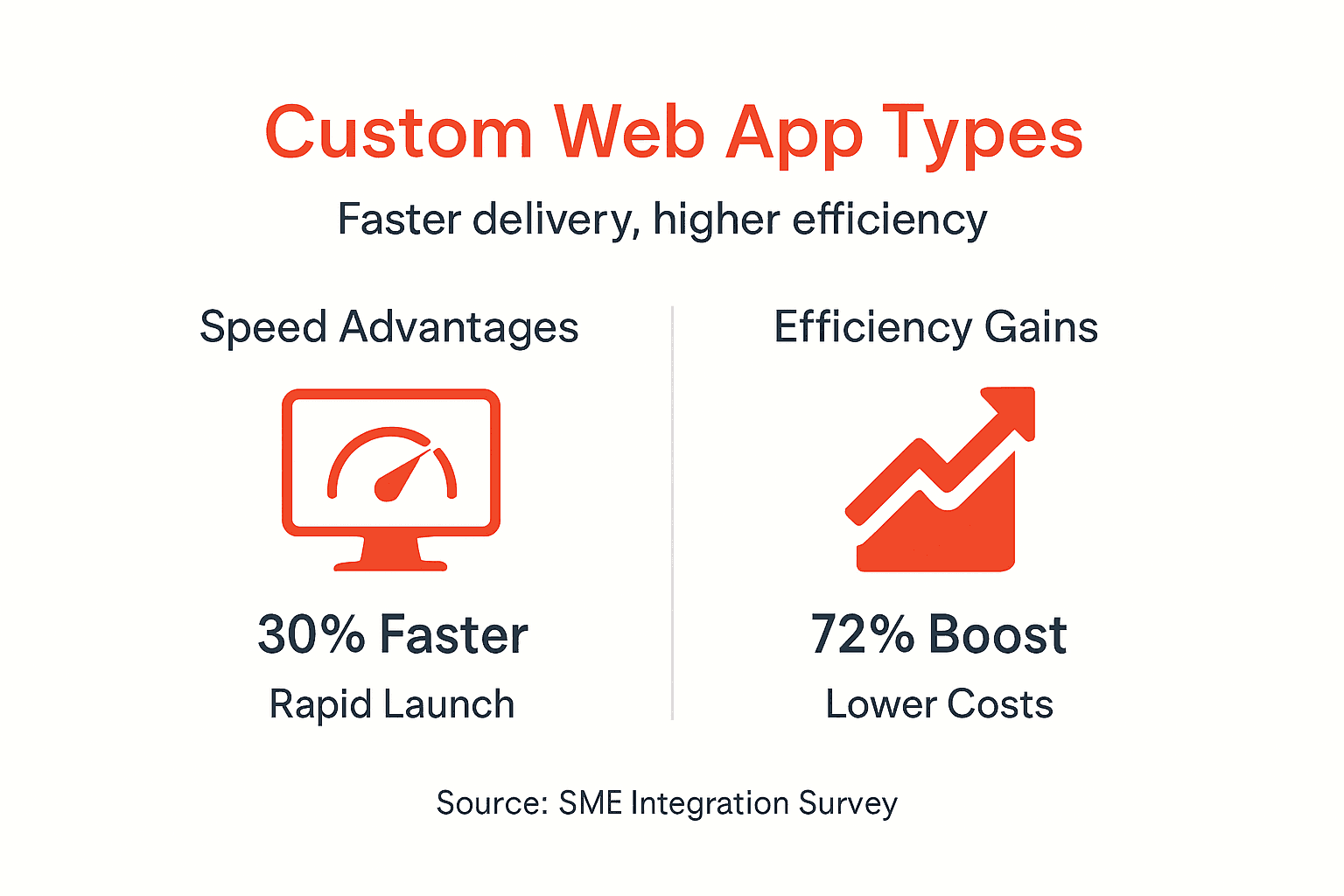
| Speed advantage | Dedicated offshore teams accelerate development by 30%, reducing time to market significantly. |
| Scalability focus | Custom solutions handle up to 5x user growth without performance degradation. |
| Strategic fit | Tailored apps match your specific business processes rather than forcing workflow changes. |
Understanding Custom Web Applications
Custom web applications are software solutions built specifically for your business requirements. Unlike generic platforms, they address your unique operational challenges and workflow needs. These applications run in web browsers but provide sophisticated functionality tailored to your processes.
The distinction from off-the-shelf software matters significantly. Generic solutions force you to adapt your workflows to their limitations. Custom apps do the opposite, bending technology to fit your established processes. This flexibility extends to integration capabilities, user interface design, and feature priorities.
Startups and SMEs benefit from custom web applications in several key areas:
- Workflow optimization automating repetitive tasks specific to your industry
- System integration connecting disparate tools into unified data ecosystems
- Competitive differentiation through features unavailable in standard platforms
- Customer experience delivering branded interactions aligned with your market positioning
Understanding the types of custom web applications available helps you identify which solutions match your strategic goals. Whether you need customer portals, inventory management systems, or collaborative platforms, custom development ensures technology serves your business rather than constraining it. The alignment between your operational reality and software capabilities drives measurable improvements in productivity and customer satisfaction.
Why Choose Custom Web Applications: Tailored to Your Business Needs
Generic software creates friction when your processes differ from built-in assumptions. You spend resources working around limitations rather than focusing on growth. Custom web applications eliminate this friction by mirroring your actual workflows.
Businesses operate differently even within the same industry. Your competitive advantage often lies in these operational distinctions. Custom applications preserve and amplify these advantages rather than smoothing them away. This alignment translates directly to faster employee adoption and reduced training overhead.
Automation becomes truly effective when it targets your specific bottlenecks. Custom solutions identify repetitive tasks unique to your operation and streamline them. A retail business might automate inventory reordering based on sales velocity patterns specific to their customer base. A service company might automate client communication sequences tailored to their engagement model.
The advantages of custom software for startups extend beyond immediate efficiency gains. Custom applications grow with you, adding features as your market position evolves. You control the roadmap rather than waiting for vendor updates that may never address your needs.
Business-specific design improves outcomes measurably. When interfaces match how your team actually works, errors decrease and speed increases. Custom dashboards surface the metrics you track rather than burying them in generic reporting modules. Integration points connect to the tools you already use rather than forcing platform switches.
Pro Tip: Invest time upfront in detailed requirements gathering. Document your current workflows, pain points, and desired outcomes clearly. This foundation prevents scope creep and ensures your custom application truly addresses critical business needs rather than just replicating existing problems in new software.
Integration with Existing Systems
Most businesses run on multiple software platforms that don’t communicate effectively. Your CRM holds customer data, your accounting system tracks finances, and your project management tool organizes work. Data silos emerge when these systems operate independently, forcing manual data entry and creating inconsistencies.
Custom web applications bridge these gaps by connecting disparate systems into unified workflows. When a sales team closes a deal in your CRM, a custom application can automatically trigger project initiation in your management tool and generate invoices in your accounting system. This seamless data flow eliminates redundant work and reduces human error.

The efficiency gains prove substantial. 72% of SMEs report that integrating existing systems like CRM and ERP with custom web applications significantly improved their operational efficiency and reduced data silos. These businesses spend less time on administrative tasks and more time serving customers.
Integration benefits extend beyond efficiency. Real-time data synchronization provides accurate insights for decision making. When your inventory system talks to your e-commerce platform and accounting software simultaneously, you maintain accurate stock levels and financial projections. Delays and discrepancies that plague disconnected systems disappear.
Successful integration requires planning. Understanding your existing CRM systems for small businesses capabilities helps identify integration opportunities. Modern integration techniques use APIs and webhooks to create robust connections between platforms.
Pro Tip: Map your data flows before development begins. Identify which information needs to move between systems and how frequently. This clarity ensures your custom application creates meaningful connections rather than just technical bridges. Consider how operational efficiency gains from integration compound over time, turning initial development costs into long-term competitive advantages.
Common Misconceptions About Custom Web Applications
Several persistent myths discourage businesses from pursuing custom web applications. Understanding the reality behind these misconceptions helps you make informed technology decisions.
Misconception 1: Custom apps always cost more than off-the-shelf solutions. Initial development costs are higher, but total cost of ownership over five years can be 20-40% lower than constantly licensing and patching off-the-shelf products. You avoid recurring subscription fees, unnecessary features you never use, and expensive customization add-ons.
Misconception 2: Development timelines delay market entry. Modern development practices and dedicated teams actually accelerate delivery. Businesses using offshore development teams reduce time to market by approximately 30%, accessing specialized skills while maintaining momentum.
Misconception 3: Website builders or templates provide enough functionality. Templates work for simple needs but fail as complexity grows. Scaling limitations, security vulnerabilities, and inflexible architectures create expensive problems later. The custom software cost benefits become clearer when you factor in these hidden long-term expenses.
Misconception 4: Custom applications are too complex for small businesses to manage. User-centered design and vendor support make custom apps accessible to non-technical teams. Many custom solutions prove simpler to use than bloated off-the-shelf platforms loaded with features you don’t need.
| Factor | Custom Web App | Off-the-Shelf Software | Website Builder |
|---|---|---|---|
| Initial Cost | Moderate to high | Low to moderate | Very low |
| Long-term TCO | Lower over 5 years | Higher with licensing | Moderate but limited |
| Scalability | Excellent, grows with business | Limited by vendor roadmap | Poor, hits platform limits |
| Security | Tailored, robust controls | Generic, shared vulnerabilities | Basic, template dependent |
| Flexibility | Complete control | Constrained by vendor | Very limited customization |
Understanding these realities helps overcome hesitation about custom development. The patterns clear when examining custom app cost and complexity myths show total ownership costs favor custom solutions for growing businesses.
Pro Tip: Calculate five-year costs including licensing, support, integration, and workarounds when comparing options. Custom development often costs less than repeatedly patching inadequate solutions while delivering superior business fit and competitive advantage.
Leveraging Dedicated Teams for Development
Specialized development teams transform how startups and SMEs approach custom web applications. Rather than hiring full-time developers or relying on generalist agencies, dedicated teams provide focused expertise aligned with your project needs.
Full-cycle development teams handle everything from requirements analysis through deployment and maintenance. This end-to-end capability ensures consistency and accountability. You work with professionals who understand your business context rather than explaining requirements repeatedly to different specialists.
Offshore dedicated teams offer compelling advantages beyond cost savings. You access global talent pools with specialized skills that might be scarce or expensive locally. Businesses utilizing dedicated offshore teams for custom web application development reduce time to market by an average of 30% while accessing specialized skills not always available in-house.
The speed advantage comes from focus and experience. Dedicated teams work exclusively on your project rather than juggling multiple clients. They bring proven processes and technical patterns from previous projects, avoiding common pitfalls that slow inexperienced developers.
Effective collaboration with dedicated teams requires clear practices:
- Establish regular communication schedules with video calls and status updates
- Use project management tools that provide visibility into progress and blockers
- Define clear milestones with measurable deliverables and acceptance criteria
- Create feedback loops that catch issues early rather than at final delivery
- Document decisions and requirements in shared repositories accessible to all team members
Choosing between offshore dedicated development teams and local resources depends on your priorities. Offshore options excel for cost efficiency and specialized skills. Understanding dedicated development team benefits helps match team structure to project requirements.
Pro Tip: Start with a discovery phase before full development. This limited engagement lets you evaluate team fit, communication effectiveness, and technical capabilities with minimal risk. Clear milestones and feedback loops maximize efficiency while ensuring the final product matches your vision and business needs.
Scalability and Flexibility Advantages
Business growth strains technology systems. What works for 50 users often collapses under 500. Custom web applications designed for scalability handle this growth gracefully, supporting up to 5x user load increases without performance degradation.
Scalability planning starts during architecture design. Modular structures allow adding capacity where needed rather than rebuilding entire systems. Database optimization, caching strategies, and load balancing distribute work efficiently as demand increases. These technical foundations prove invisible to users but critical for sustained growth.
Flexibility matters equally. Markets shift, customer needs evolve, and competitive pressures demand new features. Custom applications adapt through iterative development, adding capabilities without disrupting existing functionality. You control the roadmap based on business priorities rather than waiting for vendor updates.
| Capability | Custom Web App | Off-the-Shelf Software | Website Builder |
|---|---|---|---|
| User load scaling | Handles 5x growth smoothly | Limited by license tiers | Hits hard platform limits |
| Feature additions | Unlimited, priority-driven | Dependent on vendor roadmap | Minimal, template-constrained |
| Architecture changes | Fully adaptable | Impossible without migration | No meaningful flexibility |
| Performance optimization | Targeted improvements possible | Generic, one-size-fits-all | No optimization options |
| Technology updates | Controlled, strategic timing | Forced vendor schedule | Automatic, potentially breaking |
Modular architecture enables surgical updates. When you need enhanced reporting, you modify that module without touching payment processing or user management. This isolation reduces risk and development time compared to monolithic systems where changes ripple unpredictably.
The scalable digital solutions approach recognizes that business needs evolve continuously. Building flexibility into initial design costs less than retrofitting later. Future-proofing means choosing technologies and patterns that accommodate growth rather than constraining it.
Iterative development supports this flexibility. Rather than building everything upfront, you launch core features and expand based on user feedback and business results. This approach reduces initial investment while ensuring development efforts target actual needs rather than assumptions. Understanding custom software scalability principles helps you make architectural decisions that support long-term success.
Empower Your Startup with Custom Web Development Solutions
You’ve seen how custom web applications drive efficiency, integrate systems, and scale with growth. Turning these insights into reality requires a development partner who understands startup and SME challenges.
Ein-Des-Ein specializes in delivering custom web development services tailored to your unique business needs. Our team of over 80 professionals builds scalable architectures that grow with your user base and evolving requirements. We handle full-cycle development from requirements analysis through deployment and ongoing support.
Our enterprise application development services create robust solutions that integrate seamlessly with your existing CRM, ERP, and business tools. Whether you need workflow automation, customer portals, or data analytics platforms, we align technology with your strategic goals.
Looking to accelerate development while controlling costs? Hire a dedicated software development team that works exclusively on your project, bringing specialized skills and proven processes that reduce time to market by 30% or more.
Frequently Asked Questions About Custom Web Applications
What is the typical timeframe to develop a custom web application?
Development timelines vary based on complexity and feature scope, typically ranging from three to nine months for most business applications. Using dedicated development teams can reduce this timeframe by approximately 30% through focused expertise and proven development processes. Starting with a minimum viable product approach delivers core functionality faster, with enhancements following based on user feedback.
How do custom web applications improve business security compared to off-the-shelf software?
Custom applications implement security measures tailored to your specific data and compliance requirements rather than generic protections. You control access levels, encryption methods, and audit trails based on actual business risks. This targeted approach often proves more effective than one-size-fits-all security in off-the-shelf platforms, reducing vulnerability to common exploits that affect widely-used software.
Can small businesses manage custom web applications without technical staff?
User-friendly design and comprehensive vendor support make custom applications accessible to non-technical teams. Development partners typically provide training, documentation, and ongoing maintenance services that handle technical complexities. Many small businesses find custom apps simpler to manage than feature-heavy off-the-shelf platforms because the interface and workflows match exactly how they operate.
How do custom web apps adapt to rapid growth?
Custom applications built with modular, scalable architectures accommodate user growth and feature expansion without performance loss. The flexible design allows adding capacity and functionality iteratively based on actual business needs rather than predictions. This adaptability proves essential for startups experiencing rapid market traction or SMEs expanding into new markets.
What are common cost factors beyond initial development?
Ongoing expenses include hosting infrastructure, security updates, feature enhancements, and technical support. However, custom applications often eliminate recurring licensing fees that plague off-the-shelf solutions. Maintenance costs remain predictable and typically lower than repeatedly purchasing add-ons or workarounds for generic software limitations. Planning for these long-term costs during initial budgeting ensures sustainable total cost of ownership.