Why Invest in Custom Web Apps for Growth


Every American founder knows that outgrowing generic software can stall progress just when your startup needs agility most. For tech leaders in North America, custom web apps offer the power to mold technology around unique workflows instead of compromising with one-size-fits-all platforms. In this guide, discover how bespoke custom web applications deliver interactive tools that fit your processes, grow as your business scales, and transform operational efficiency into concrete competitive advantage.
Table of Contents
- Custom Web Apps: Core Definition and Concepts
- Types of Custom Web Applications Explained
- Key Features That Drive Business Results
- Strategic Benefits for Startups and SMEs
- Cost, ROI, and Common Pitfalls Reviewed
Key Takeaways
| Point | Details |
|---|---|
| Custom Web Applications are Tailored Solutions | These applications are specifically designed to meet unique business needs, unlike generic software solutions. |
| Improved Operational Efficiency | Custom web apps automate processes, enhancing productivity and reducing the risk of errors across teams. |
| Scalability and Adaptability | Such applications grow alongside businesses, allowing for seamless integration and accommodating evolving needs without significant overhauls. |
| Strategic Competitive Advantage | Custom solutions provide opportunities for differentiation from competitors by facilitating unique workflows and customer experiences. |
Custom Web Apps: Core Definition and Concepts
A custom web application is software that runs directly in your browser, built specifically for your business’s unique needs. Unlike static websites or generic off-the-shelf tools, custom web apps are interactive platforms that solve complex problems and streamline your exact workflows.
Think of it this way: a website displays information; a web app lets you do work. Custom web applications are software tailored to specific client needs rather than one-size-fits-all solutions that you adapt to fit.
What Sets Custom Web Apps Apart
Custom web apps differ from standard websites in several critical ways:
- Interactive functionality – Users perform transactions, manage data, and solve problems within the application
- No installation required – Access from any device with a browser, no downloads or updates to manage
- Built for your processes – Designed around how your startup actually works, not how generic software thinks you should work
- Scalability by design – Grows with your business without forcing you to switch platforms
Custom web apps address your exact business requirements while improving security, user experience, and operational efficiency in ways off-the-shelf software simply cannot match.
Why They Matter for Startup Growth
Your startup has unique processes. Perhaps you manage customer relationships differently than competitors, or your workflow combines tasks in ways standard tools don’t support. Trying to force your operations into existing software creates friction, wasted steps, and frustrated teams.
Custom web apps eliminate that friction. They integrate seamlessly with your existing systems and evolve as your business requirements change. You’re not adapting to the software—the software adapts to you.
Understanding the distinction between different types of web applications helps you identify which approach fits your growth strategy.
The Development Process
Building a custom web app isn’t about guessing what you need. The process involves structured stages:
- Discovery – Understanding your exact business requirements and pain points
- Design – Creating the user experience and system architecture
- Development – Building the actual application with modern technologies
- Testing – Ensuring functionality, security, and reliability
- Deployment – Launching your app and training your team
Each stage builds on the previous one, ensuring your final product actually solves real problems rather than creating new ones.
Pro tip: During the discovery phase, document your current workflows thoroughly—including the frustrating parts. This directly informs better design decisions and prevents costly rework later.
Types of Custom Web Applications Explained
Not all custom web apps serve the same purpose. Different business models require different architectures, features, and functionality. Understanding which type fits your startup helps you make smarter investment decisions and avoid building the wrong solution.
Enterprise Web Applications
Enterprise web applications handle complex organizational workflows across multiple departments and users. These power HR systems, financial management platforms, project tracking tools, and internal operations.
They typically include:
- Role-based access controls so employees only see relevant data
- Workflow automation that reduces manual tasks
- Advanced reporting and analytics capabilities
- Integration with existing company systems
Enterprise apps demand reliability and security. Your finance team can’t afford downtime, and customer data must stay protected. These applications grow with your organization as headcount increases.

E-Commerce Platforms
Custom e-commerce apps go beyond standard online stores. They handle product management, inventory tracking, payment processing, and customer analytics tailored to your specific sales model.
Whether you sell physical products, digital goods, or subscriptions, a custom platform lets you:
- Customize the shopping experience to match your brand
- Automate inventory updates across channels
- Implement unique pricing or promotional logic
- Integrate with suppliers and fulfillment partners
Off-the-shelf e-commerce tools often force compromises. Custom applications let you compete on experience rather than just price.
SaaS Products
Software-as-a-Service (SaaS) applications deliver value to paying customers through the browser. Think tools for project management, design collaboration, or business analytics that users subscribe to monthly.
SaaS requires:
- Multi-tenant architecture so each customer has isolated data
- Flexible billing and subscription management
- Scalability to handle growth without infrastructure nightmares
- Regular updates and feature releases
Enterprise web applications and SaaS products emphasize automation, integration, and user role customization to enhance operational efficiency across organizations.
Internal Portals
Internal portals facilitate collaboration between your team and external partners—clients, contractors, or vendors. They provide secure access to documents, project updates, and shared resources without exposing your entire system.
Common use cases include:
- Client portals showing project progress and deliverables
- Partner collaboration platforms for shared workflows
- Knowledge bases where teams access documentation
- Resource libraries with controlled access permissions
Internal portals strengthen relationships by giving partners visibility without complexity.
Choosing Your Type
Your business model determines which type you need. A startup managing complex internal processes might begin with enterprise applications. A product-focused company might build SaaS. An online retailer needs custom e-commerce.
Many startups eventually build multiple types. Start with your most pressing need, then expand strategically as you grow.
Here’s a quick comparison of custom web application types and their primary business benefits:
| App Type | Core Purpose | Typical Users | Main Business Benefit |
|---|---|---|---|
| Enterprise | Streamline internal workflows | Employees, managers | Improved process efficiency |
| E-Commerce | Power online sales and operations | Customers, sales teams | Custom shopping experience |
| SaaS | Offer subscription-based digital tools | Paying clients, admins | Recurring revenue, market reach |
| Internal Portal | Enable secure partner collaboration | Clients, vendors, partners | Simplified communication |
Pro tip: Map your current pain points to application types before development begins—this ensures you’re investing in solutions that directly impact your bottom line rather than building features nobody actually uses.
Key Features That Drive Business Results
Not every feature matters equally. The best custom web apps focus on capabilities that directly impact your revenue, efficiency, or customer satisfaction. Generic features waste budget; strategic ones transform operations.
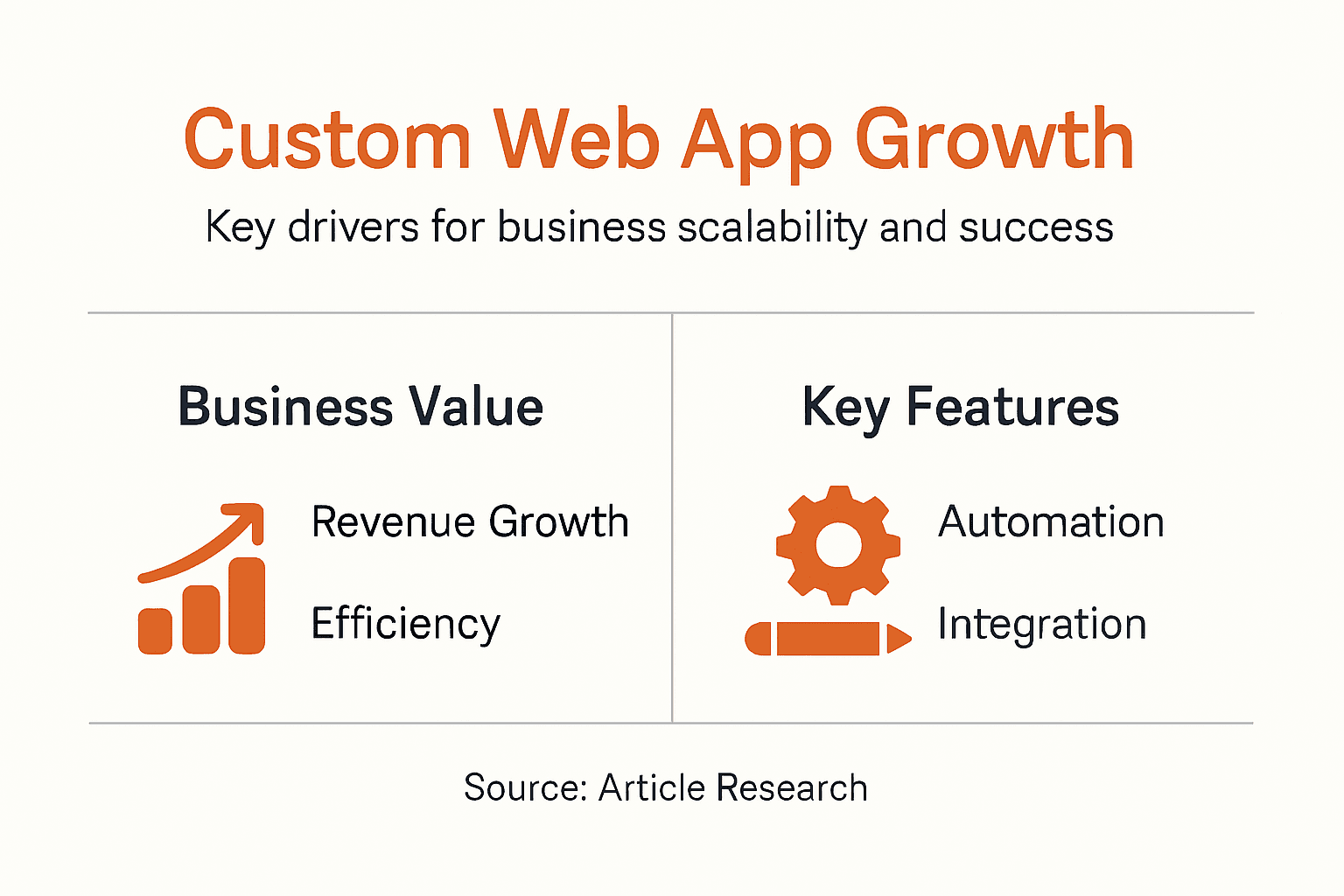
Automation and Workflow Optimization
Automation eliminates repetitive manual tasks that drain your team’s time and introduce errors. Instead of employees copying data between systems or processing forms by hand, your app handles it automatically.
Key automation opportunities include:
- Invoice generation and payment processing
- Customer data synchronization across platforms
- Report generation and scheduled notifications
- Approval workflows that route requests to the right people
Even small automations compound. If your team spends 10 minutes daily on a task, that’s over 40 hours yearly. Automation recovers that time for high-value work.
Real-Time Data and Analytics
Decisions based on outdated information cost money. Custom web apps deliver real-time dashboards showing your business metrics as they happen, not at end of day or end of month.
You gain visibility into:
- Sales pipeline and revenue forecasts
- Customer behavior and engagement patterns
- Operational bottlenecks and resource utilization
- Inventory levels and supply chain status
Real-time analytics enable faster decision-making, helping you respond to market changes before competitors even notice them.
Scalability and Performance
Your app must grow with your business. As you add users, process more transactions, or store more data, performance can’t degrade. Custom applications are built from the ground up to handle growth without expensive rewrites.
Scalability includes:
- Database optimization for millions of records
- Load balancing across multiple servers
- Caching strategies that keep responses fast
- Architecture designed for expansion
Integration with Existing Systems
Your new app doesn’t exist in isolation. Custom software advantages include seamless connection with tools you already use—accounting software, CRM platforms, email systems, or inventory management.
Integration eliminates data silos and manual data entry. Information flows between systems automatically, keeping everything synchronized and current.
Security and Compliance
Custom apps let you implement security matching your actual risk profile, not generic templates. You control authentication methods, data encryption, access permissions, and audit logs.
Security features include:
- Role-based access so users only see authorized data
- Two-factor authentication for sensitive accounts
- Encrypted data transmission and storage
- Compliance with industry regulations (HIPAA, GDPR, PCI)
User Experience That Drives Adoption
Beautiful design isn’t vanity—it directly affects whether people use your app. Confusing interfaces generate support tickets and abandoned workflows. Intuitive design increases adoption and productivity.
Your custom app includes:
- Interfaces designed specifically for your users’ tasks
- Mobile responsiveness for on-the-go access
- Customizable dashboards showing relevant information
- Clear workflows that match your business processes
When people enjoy using your app, adoption increases and ROI improves.
To clarify how key features impact startups, here’s a summary linking features to typical results:
| Feature | Business Impact | Who Benefits |
|---|---|---|
| Automation | Saves time, reduces errors | All employees |
| Real-Time Analytics | Enables quick decision-making | Management, sales |
| Scalability | Supports business growth | Operations, IT teams |
| Integrations | Eliminates manual data entry | Accounting, sales |
| Security & Compliance | Protects sensitive information | Legal, management |
| Custom User Experience | Boosts adoption and productivity | End users, support |
Pro tip: Prioritize the three features that will deliver the most immediate business impact during development, then add others incrementally—this accelerates time-to-value and lets you adjust based on real user feedback.
Strategic Benefits for Startups and SMEs
Startups and small-to-medium enterprises face a unique challenge: you need enterprise-grade capabilities without enterprise-sized budgets. Custom web apps solve this by delivering exactly what you need, nothing more, nothing less.
Competitive Advantage Through Differentiation
Off-the-shelf software levels the playing field. Your competitors use the same tools, the same features, the same workflows. Custom web apps let you compete differently by automating processes competitors handle manually or building features they haven’t imagined.
You gain advantages like:
- Unique customer experiences competitors can’t replicate
- Faster internal workflows than industry standard
- Data-driven decisions based on your specific metrics
- Market responsiveness before competitors catch up
When your app does what generic solutions cannot, you win deals and retain customers longer.
Cost Control and ROI
Building custom doesn’t mean spending unlimited money. You invest in exactly what drives your business forward, not in licensing enterprise features you’ll never use.
Bespoke custom web applications provide startups with flexibility to adapt business processes while controlling costs throughout development. You prioritize features, deploy incrementally, and adjust based on real results.
This approach typically delivers faster return on investment than licensing multiple third-party tools that partially solve your problems.
Flexibility and Rapid Adaptation
Markets change fast. Your business model today might need tweaking next quarter. Custom web apps adapt with your business instead of forcing you to adapt to software limitations.
When you discover new opportunities or face unexpected competition, your app evolves alongside your strategy. No contract renegotiations, no vendor lock-in, no months-long implementation cycles.
Custom web applications enable rapid innovation and precise alignment with unique business requirements essential for early-stage growth.
Seamless Integration with Existing Tools
You’ve already invested in CRM systems, accounting software, or email platforms. Your new web app shouldn’t force you to abandon those investments or manually transfer data between disconnected systems.
Integration benefits include:
- Single source of truth across all platforms
- Automated data flow eliminating manual entry
- Consistent information across your entire tech stack
- Reduced training since employees work in familiar tools
Scalability Built In
Your startup might serve 10 customers today and 1,000 next year. Custom web apps scale with you. Built on modern architecture and cloud infrastructure, they handle growth without performance degradation or expensive infrastructure overhauls.
Scalability means you don’t choose between growth and system stability. You pursue both simultaneously.
Data Security Tailored to Your Risk Profile
SMEs often handle sensitive customer or financial data. Generic software applies one-size-fits-all security. Custom apps implement security matching your actual risk and compliance requirements—GDPR if you serve Europeans, HIPAA if you handle healthcare data, PCI if you process payments.
You control encryption, access permissions, audit logs, and compliance measures instead of accepting whatever a vendor decided for everyone.
Operational Efficiency That Compounds
Small efficiency gains multiply across your team. If your app saves each employee 30 minutes daily, that’s 125 hours monthly recovered for higher-value work. Multiply that across your team and you’ve recovered resources without hiring.
Pro tip: Start with your single biggest operational pain point—the one costing you money or time daily—and build your custom app to solve that first, then layer additional features as you grow and budget allows.
Cost, ROI, and Common Pitfalls Reviewed
Investing in custom web apps requires realistic expectations about cost, timeline, and payback. Understanding what you’re paying for and where pitfalls hide helps you avoid expensive mistakes and achieve genuine returns.
Understanding Development Costs
Custom web app development costs vary dramatically based on complexity, team location, and scope. A simple internal tool might cost $25,000 to $50,000. A sophisticated platform serving thousands of users could reach $200,000 or more.
Costs break down across:
- Planning and discovery – Understanding your requirements thoroughly
- Design – User experience and interface development
- Backend development – Servers, databases, business logic
- Frontend development – Browser interface and user interactions
- Testing and quality assurance – Ensuring reliability and security
- Deployment and training – Launching and teaching your team
Don’t chase the cheapest option. Inexperienced teams build slower, introduce more bugs, and require expensive fixes later. Investing in app development from experienced developers typically delivers better long-term value despite higher upfront costs.
Calculating Real ROI
ROI isn’t just about cost recovery. It’s about measurable business impact: time saved, revenue generated, or costs reduced.
Track concrete metrics:
- Hours per month saved through automation
- Percentage increase in sales or customer retention
- Reduction in manual errors and rework
- Customer acquisition cost improvements
- Employee productivity gains
If your app saves your team 5 hours weekly, that’s 260 hours yearly. At average salary costs, that alone might justify investment in 12-18 months.
Real ROI comes from solving actual problems, not from having technology for its own sake.
Timeline Realities
Quality takes time. A well-built custom app typically requires 3-6 months for moderate complexity. Rushing creates technical debt—shortcuts that cost more to fix later than investing time upfront.
Factors affecting timeline:
- Scope clarity and requirement stability
- Third-party integrations needed
- Team size and experience
- Your availability for feedback and decisions
- Security and compliance requirements
Unrealistic timelines lead to overworked teams, quality problems, and missed deadlines. Better to deliver a solid foundation in 5 months than a fragile rush job in 3.
Common Pitfalls to Avoid
Startups typically stumble in predictable ways:
Unclear requirements – Starting development without defining exactly what you need. Solution: Invest time in discovery before coding starts.
Scope creep – Adding features continuously without adjusting timeline or budget. Solution: Lock scope, then prioritize additions for future phases.
Poor communication – Developers building in isolation without regular stakeholder feedback. Solution: Establish weekly check-ins and clear decision-making processes.
Insufficient testing – Launching buggy software damages credibility. Solution: Budget 20-30% of time for quality assurance.
Ignoring user experience – Building technically perfect apps nobody enjoys using. Solution: Involve actual users early and often.
No maintenance plan – Apps require ongoing updates for security and compatibility. Solution: Budget for post-launch support before launch.
The Hidden Cost: Maintenance
Your app doesn’t stop needing investment after launch. Security patches, dependency updates, feature enhancements, and infrastructure scaling require ongoing budget.
Plan for annual maintenance at 15-20% of initial development cost. This keeps your app secure, performant, and aligned with evolving business needs.
Pro tip: Before starting development, define your success metrics in writing—the specific numbers that would make this investment worthwhile—and review them monthly to ensure you’re tracking toward genuine ROI.
Unlock Your Startup’s Potential with Custom Web Applications
The article highlights key challenges faced by startups and SMEs such as inefficient workflows, lack of scalability, and the need for tailored automation that off-the-shelf software cannot solve. If you recognize these pain points and want to transform them into growth opportunities it is time to consider fully customized digital solutions designed around your unique business needs. Custom web applications drive operational efficiency, real-time insights, and security tailored exactly to your compliance requirements.
Take the leap now by partnering with a proven expert agency like Ein-des-ein that specializes in building scalable custom web apps and organizing dedicated offshore teams to accelerate your development. Whether you need enterprise-grade applications or SaaS products, our skilled team uses cutting-edge technologies such as Node.js, React, and Python to deliver solutions aligned with your business objectives. Start solving your biggest operational pain points today and gain a competitive advantage with full-cycle web development. Visit our website Ein-des-ein to schedule a consultation and bring your vision to life.
Frequently Asked Questions
What are custom web applications and how do they differ from standard websites?
Custom web applications are interactive software solutions designed specifically to meet a business’s unique needs. Unlike standard websites that primarily display information, custom web apps enable users to perform tasks and manage data directly within the application.
Why should startups invest in custom web apps instead of off-the-shelf solutions?
Startups should invest in custom web apps as they are tailored to fit unique business processes, eliminate friction caused by generic software, and provide scalability as the business grows. This ensures better alignment with operational workflows and enhances efficiency and user experience.
What is the development process for custom web applications?
The development process for custom web applications involves several structured stages: Discovery (understanding business needs), Design (creating user experience), Development (building the application), Testing (ensuring functionality and security), and Deployment (launching the app and training users).
What key features should custom web apps include to drive business results?
Custom web apps should focus on key features like automation for workflow optimization, real-time data analytics for informed decision-making, scalability to support growth, seamless integration with existing systems, robust security measures, and a user-friendly experience to encourage adoption.