Why Invest in App Development for Business Growth


Every growing business faces the challenge of doing more with fewer resources, especially when labor shortages or budget limits threaten productivity. Custom app development gives you the power to automate repetitive processes, fill staffing gaps, and provide convenient, on-demand services that truly set you apart. By harnessing democratization through app development, small and medium-sized businesses can compete with larger rivals, adapt quickly, and drive operational efficiency while improving customer engagement. Explore how scalable applications elevate your digital infrastructure and unlock new growth opportunities.
Table of Contents
- What App Development Means For Businesses
- Key Types And Approaches To App Development
- How Apps Drive Engagement And Revenue
- Core Benefits Beyond Traditional Websites
- Costs, Risks, And Measuring ROI
Key Takeaways
| Point | Details |
|---|---|
| App Development Benefits | Custom applications streamline operations, improve customer interactions, and enable data-driven decisions while reducing operational costs. |
| Development Approaches | Businesses can choose from native, cross-platform, or web app development, each with unique strengths and limitations suitable for different needs. |
| Engagement and Revenue | Apps foster direct customer engagement and can create new revenue streams through features like in-app purchases and subscriptions. |
| Cost and ROI Considerations | Businesses must account for both upfront and hidden costs, as well as define clear ROI metrics to measure success post-launch. |
What App Development Means for Businesses
App development for your business is far more than just building software. It’s about creating custom digital tools that solve your specific operational challenges and directly address your growth targets.
At its core, app development enables you to streamline operations by automating repetitive tasks that currently consume your team’s time. Instead of manually managing inventory, processing orders, or tracking customer communications, a well-designed app handles these workflows automatically.
Here’s what custom applications accomplish for growing businesses:
- Automate repetitive processes that drain your team’s productivity and resources
- Improve customer interactions by providing convenient, on-demand access to your services
- Enable data-driven decisions through analytics and reporting built into your applications
- Reduce operational costs by eliminating manual processes and unnecessary staffing needs
- Scale your business without proportionally increasing your overhead
When you invest in app development from ideation to launch, you’re essentially building a competitive advantage. Many SMBs face productivity gaps caused by labor shortages or budget constraints. A custom app can fill these gaps by automating customer engagement, marketing workflows, and operational tasks that would otherwise require expensive specialized hires.
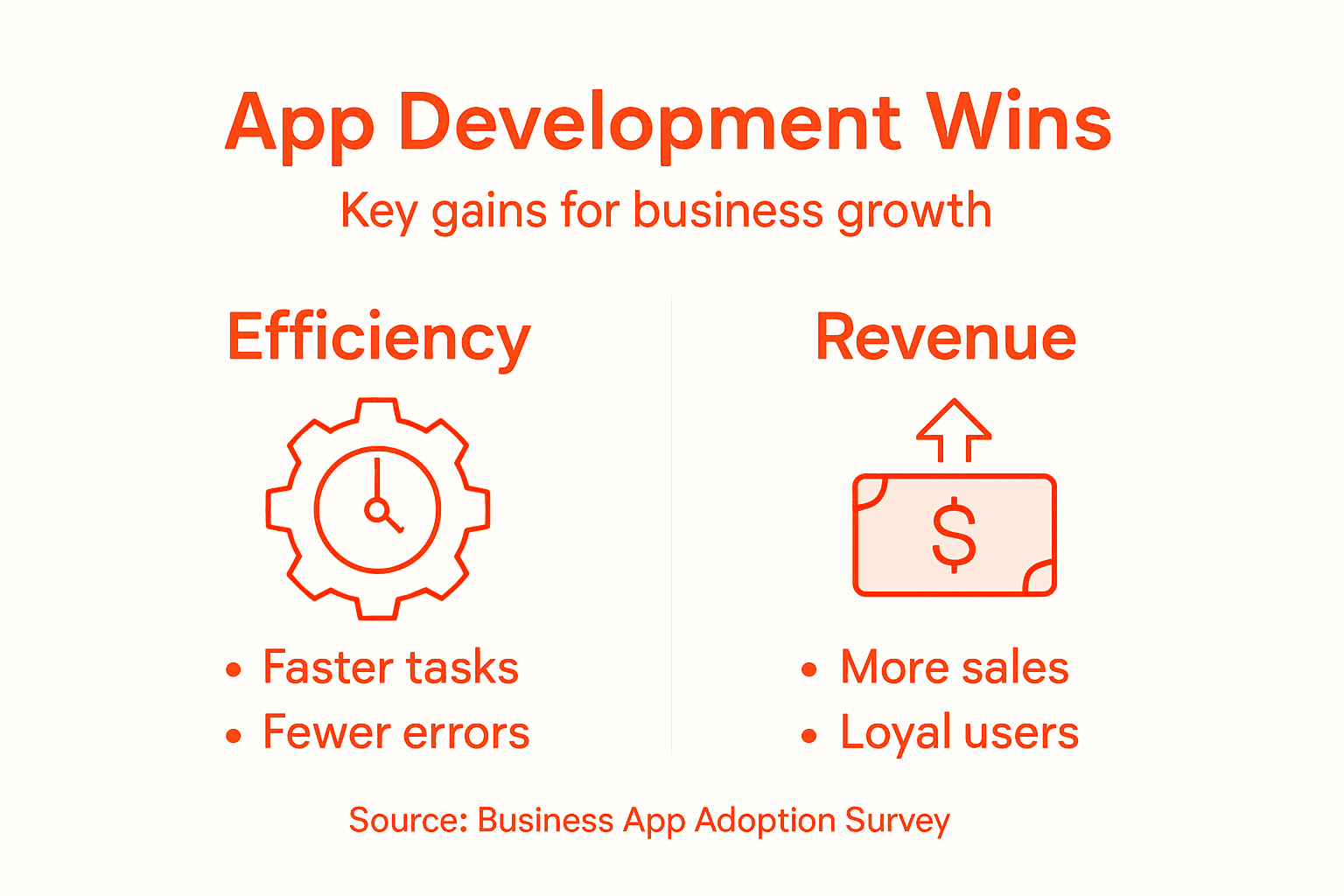
Think of it this way: your competitors may be hiring additional staff to handle growth. You’re investing in technology that handles the same work more efficiently. This democratization through app development allows smaller firms to compete directly with larger organizations.
The real power emerges when you combine app functionality with AI-powered features that enhance marketing automation, content creation, and customer service without requiring dedicated specialists on your payroll.
Custom applications give you the agility to adapt to market changes quickly and scale operations without hiring proportionally larger teams.
Beyond internal efficiency, apps transform how your customers interact with your business. Mobile and web applications provide 24/7 access to your services, reduce friction in purchasing decisions, and create touchpoints that build loyalty.
For product managers and entrepreneurs, this means measuring success differently. You’re not just counting features shipped; you’re tracking whether the app actually reduces operational friction, improves conversion rates, or enables new revenue streams.
Pro tip: Before committing to app development, map exactly which manual processes consume the most time and money in your organization—these are your highest-ROI candidates for automation.
Key Types and Approaches to App Development
Your business has multiple pathways to app development, and choosing the right one depends on your budget, timeline, target audience, and technical requirements. Understanding these approaches helps you make informed decisions about where to invest.
The main app development approaches include:
- Native app development builds separate applications for iOS and Android using platform-specific languages and tools
- Cross-platform development creates a single codebase that runs on multiple platforms, reducing development time and cost
- Web applications function through browsers, eliminating the need for device-specific installation
- Progressive web apps combine web functionality with app-like features and offline capabilities
Native apps deliver the highest performance and best user experience on their respective platforms. When you choose iOS vs Android app development, you’re optimizing for that ecosystem’s specific strengths and user base.
Cross-platform solutions like React Native or Flutter let you write code once and deploy everywhere. This approach speeds up time-to-market and reduces development costs significantly, making it ideal for startups with limited budgets.
Web apps work instantly without downloads or app store approvals. They’re perfect for customer-facing tools where accessibility matters more than advanced device features.
Here’s a side-by-side comparison of major app development approaches to guide your decision:
| Approach | Strengths | Limitations | Ideal For |
|---|---|---|---|
| Native | Top performance and UX | Higher cost, longer development | High-end, platform-specific |
| Cross-platform | Faster deployment, lower cost | Slightly lower performance | Startups, MVPs, budget cases |
| Web Application | No install, broad access | Limited hardware integration | Customer tools, quick access |
| Progressive Web App | Offline use, app-like feel | Still browser-dependent features | Hybrid user experiences |
Your choice between native, cross-platform, and web approaches should align with your user’s expectations, not your preference for technology.
Beyond these technical approaches, consider your development strategy. You can build in-house with your own team, hire a dedicated development team through outsourcing, or partner with an agency like Ein-Des-Ein that handles everything end-to-end.
Each approach has tradeoffs. In-house teams give you control but require hiring and infrastructure investment. Dedicated offshore teams offer scalability and cost efficiency. Agencies provide expertise across industries but less direct control over daily decisions.
The latest mobile app development trends emphasize AI integration, enhanced security, and seamless user experiences across devices. Your chosen approach should accommodate these evolving expectations.
Small teams often underestimate complexity. A successful app requires not just coding, but strategic planning around user flows, backend infrastructure, security protocols, and scalability from day one.
Pro tip: Map your business goals first, then choose the development approach that best serves those goals—not the other way around. Technology choices should follow strategy, never lead it.
How Apps Drive Engagement and Revenue
Apps are powerful engagement engines. They create direct channels between your business and customers, operating 24/7 without geographic boundaries or time constraints.

Unlike websites that customers visit occasionally, apps live on their devices. This proximity drives habit formation and repeated interactions. Every notification, update, or new feature brings users back.
Here’s how apps transform customer relationships:
- Real-time communication keeps customers informed about orders, offers, and updates instantly
- Personalized experiences use data to show relevant content to each user
- Location-based features enable proximity marketing and location-aware services
- Seamless transactions reduce friction in purchasing decisions
- Push notifications re-engage dormant users with timely, targeted messages
Apps also create new revenue streams. Digital payments and subscriptions built into apps generate recurring income. In-app purchases, premium features, and value-added services expand your monetization options beyond traditional product sales.
Consider engagement as the foundation of revenue. Users who return frequently spend more and stay longer. Apps that understand user retention strategies outperform competitors significantly.
When users interact with your app regularly, you gain behavioral data. This data reveals what features matter, when users engage most, and which paths lead to conversions. Armed with these insights, you optimize iteratively.
Every interaction your app captures generates insights that drive better decisions and stronger engagement cycles.
Mobile apps also reduce operational friction. Customers no longer need to call support, visit websites, or wait for email responses. They find answers within your app instantly.
For revenue specifically, apps enable multiple monetization approaches. Subscription models create predictable recurring revenue. Freemium models let users try before committing. Advertisement and sponsored content generate income from engagement itself.
But engagement without monetization strategy wastes opportunity. You need intentional design that guides users toward revenue-generating actions while respecting user experience. This balance determines long-term success.
Pro tip: Measure engagement metrics like daily active users, session length, and feature adoption before launching monetization. Strong engagement metrics indicate readiness for revenue models; weak metrics signal design or value problems to solve first.
Core Benefits Beyond Traditional Websites
Websites serve their purpose, but apps deliver a fundamentally different experience. The differences matter more than you might think, especially when competing for attention in crowded markets.
Apps live on user devices. Websites require opening a browser. This seemingly small distinction creates massive behavioral differences. Apps stay accessible with a single tap, while websites require multiple steps to reach.
Here’s what sets apps apart from websites:
- Offline functionality keeps your app working without internet connection
- Push notifications reach users directly, bypassing email and social algorithms
- Native hardware integration accesses device cameras, GPS, microphones, and sensors
- Faster performance delivers instant responsiveness compared to web loading times
- Enhanced security provides deeper device-level protection and authentication
Mobile apps offer native hardware integration capabilities that websites simply cannot match. Your app can leverage GPS for location-based services, access the camera for photo uploads, or use device sensors for health tracking and real-time data collection.
Push notifications represent a game-changer for engagement. Unlike email that gets buried in inboxes, notifications appear directly on user screens. Users see your message instantly and tap to respond immediately.
Offline support is critical in low-bandwidth environments. Your app continues functioning even when internet drops, storing data locally and syncing when connection returns. Websites freeze without connectivity.
Apps bridge digital divides by operating reliably in conditions where websites fail, making your service accessible to more users.
Security depth differs significantly. Apps implement encryption, biometric authentication, and secure device storage that exceed what browsers provide. For sensitive operations like payments or personal data, apps offer superior protection.
Performance speed matters for user satisfaction. Apps load instantly from device storage. Websites download content each time, creating noticeable delays that frustrate users and increase abandonment rates.
Apps also enable more frequent engagement through location-based services and notifications. Users see your app regularly and receive timely messages that drive repeated interactions.
Conversion rates typically improve with apps. The frictionless experience, combined with stored payment information and preferences, makes transactions faster than website checkout processes.
Pro tip: Choose apps when your business requires offline functionality, hardware integration, or frequent push notifications. Choose websites for content-heavy platforms or when audience diversity demands broad device compatibility.
Costs, Risks, and Measuring ROI
App development requires significant investment. Understanding costs upfront prevents budget surprises and helps you evaluate whether returns justify the spending.
Development costs depend heavily on complexity and scope. A simple app with basic features costs differently than an enterprise platform with intricate integrations and custom functionality.
Typical cost ranges break down like this:
- Simple apps ($25,000–$60,000) include basic functionality for iOS or Android
- Mid-complexity apps ($100,000–$300,000) add custom features and cross-platform support
- Enterprise apps ($500,000+) involve complex integrations, security layers, and scalability requirements
But initial development is only part of the picture. Hidden costs including maintenance, hosting, and app store fees can add 30–50% to your budget. Project management, security updates, and bug fixes consume ongoing resources year after year.
Use this reference table to assess hidden and ongoing app costs beyond initial development:
| Cost Category | Typical Examples | Possible Impact |
|---|---|---|
| Maintenance | Bug fixes, updates | 20–40% annual overhead |
| Hosting & Storage | Cloud servers, databases | Scales with user base |
| Compliance & Fees | App store, legal, security | Unplanned expenses |
| User Support | Help desk, customer service | Grows as app scales |
You’ll also face operational risks. Apps fail when poorly designed or inadequately tested. User frustration leads to negative reviews that damage your reputation and reduce downloads.
Security breaches represent serious risks. Customer data breaches destroy trust and trigger legal liability. Investing in security from day one costs less than recovering from a breach later.
ROI measurement separates apps that succeed from those that drain resources without returns.
Measuring ROI requires defining clear metrics before launch. Track operational cost savings, revenue increases, and customer acquisition improvements against your investment.
Consider these ROI factors:
- Operational efficiency gains from automation reducing staff time
- Revenue from direct sales through in-app purchases or subscriptions
- Customer retention improvements shown through repeat purchases
- Reduced support costs when apps enable self-service
- Market expansion reaching customers unavailable through websites
Break-even timelines vary. A simple app serving an existing customer base might break even in 12–18 months. Enterprise apps targeting new markets may require 3+ years to show positive returns.
Many businesses underestimate risk by cutting corners on security, testing, or user experience. These shortcuts create long-term costs exceeding initial savings. Quality investments pay dividends through faster user adoption and stronger engagement.
Don’t measure success by launch date. Track performance metrics continuously and adjust your strategy based on user behavior and revenue data.
Pro tip: Document your ROI baseline before development starts: current costs, revenue, and customer metrics. Compare against post-launch data quarterly to prove value and make data-driven decisions about scaling or pivoting your app strategy.
Unlock Business Growth Through Custom App Development
Businesses striving to automate manual processes, enhance customer engagement, and scale efficiently face complex challenges that require more than off-the-shelf solutions. This article highlights essential pain points such as operational inefficiencies, customer retention struggles, and the need to align development strategies with clear business goals. If you want to transform those challenges into growth opportunities through tailored digital innovation, partnering with an expert agency can make all the difference.
At Ein-Des-Ein, we specialize in delivering full-cycle app development solutions designed specifically to address these exact pain points. From native and cross-platform mobile app development on iOS and Android to custom web applications with seamless UX/UI design, our experienced team crafts scalable software that automates workflows, boosts customer engagement with real-time features, and enables data-driven growth strategies. We also offer dedicated offshore team services, allowing you to build your own development unit without the hassle of hiring and managing locally.
Ready to move beyond theory and start building a custom app that drives real results for your business growth?

Explore how our tailored development services can power your digital transformation journey at Ein-Des-Ein. Contact us now to create scalable, innovative applications that automate your toughest challenges and accelerate success.
Frequently Asked Questions
What are the primary benefits of investing in app development for my business?
Investing in app development can streamline operations, automate repetitive tasks, improve customer interactions, and enhance data-driven decision-making. By doing so, you can reduce operational costs and scale your business efficiently.
How can a custom app improve customer engagement?
Custom apps create direct channels for communication with customers, offering real-time updates, personalized experiences, and seamless transactions. This leads to increased user retention and higher spending over time.
What factors should I consider when choosing an app development approach?
When selecting an app development approach, consider your budget, timeline, target audience, and technical requirements. Options include native app development, cross-platform development, web applications, and progressive web apps.
What are the potential risks associated with app development?
Potential risks include poor design leading to user frustration, security breaches affecting customer trust, and underestimating ongoing maintenance and hidden costs. Proper planning and investment in security and testing are crucial to mitigate these risks.