Build Scalable Web Apps in 2026: Avoid 60% Failures


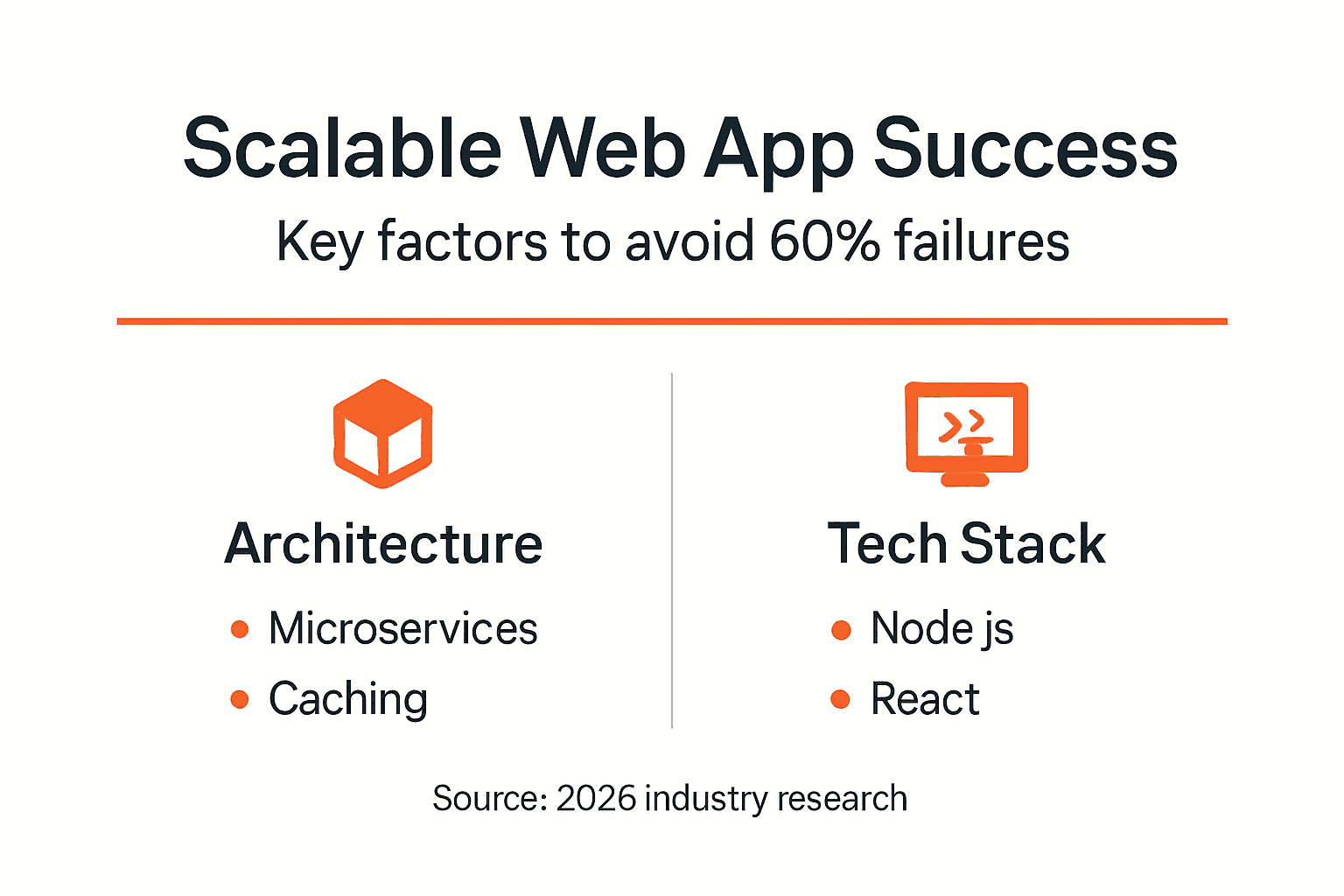
Many startups struggle to keep web apps fast and reliable as users grow. Avoidable architectural mistakes cause up to 60% of scaling failures, draining resources and delaying market growth. This guide offers a clear, step-by-step approach to build scalable web apps, from modular architecture and smart technology choices to team organization and measurable success metrics. You’ll learn practical strategies to prevent common pitfalls and deliver applications that grow with your business.
Table of Contents
- Prerequisites: What You Need Before Building a Scalable Web App
- Step 1: Designing a Modular Scalable Architecture
- Step 2: Selecting Technology Stacks Optimized For Scalability
- Common Mistakes And How To Avoid Them
- Organizing Development Teams For Scalability Success
- Expected Results And How To Measure Success
- Build Your Scalable Web App With Ein-Des-Ein
- Frequently Asked Questions
Key Takeaways
| Point | Details |
|---|---|
| Architecture and technology choices determine scalability success | Modular designs and informed stack selection prevent bottlenecks and costly refactoring. |
| Microservices and caching improve performance under load | Breaking apps into independent services and reducing backend requests enable smooth scaling. |
| Load testing and avoiding premature over-engineering prevent failures | Early validation and focused development keep costs low and delivery fast. |
| Organized teams and offshore options optimize delivery | Clear roles and dedicated offshore teams reduce costs while maintaining quality. |
| Metrics like uptime, latency, and deployment frequency verify results | Tracking performance data ensures your app meets scalability goals. |
Prerequisites: What You Need Before Building a Scalable Web App
Before you start coding, establish the foundational knowledge and resources that support scalable development. Understanding modular architecture principles helps you design systems that grow without major rewrites. Familiarity with asynchronous backends like Node.js enables you to handle high concurrency efficiently. Frontend frameworks such as React provide component-based UI development that scales with your user base.
Access to scalable cloud infrastructure is critical for flexible resource allocation. Platforms like AWS, Azure, or Google Cloud offer auto-scaling and load balancing out of the box. You also need a cross-functional team with backend, frontend, and DevOps specialists who understand scalability requirements. Basic programming knowledge in JavaScript or TypeScript streamlines communication and decision-making across the team.
Here’s what you should have ready:
- Understanding of modular architecture and service-oriented design patterns
- Familiarity with asynchronous programming models and event-driven systems
- Access to cloud infrastructure with auto-scaling capabilities
- Cross-functional team including backend, frontend, and DevOps roles
- Basic proficiency in JavaScript or TypeScript for unified development
Pro Tip: Start with a small proof of concept to validate your architecture choices before committing to full-scale development. This approach catches design flaws early and saves significant refactoring costs later.
Getting these elements in place before you write production code sets you up for success. You avoid the common trap of building fast but building wrong, which leads to expensive rewrites when your user base grows.
Step 1: Designing a Modular Scalable Architecture
Architecture decisions made early determine how well your app handles growth. Adopting microservices allows you to scale components independently, so a bottleneck in one service doesn’t crash your entire application. Each service owns its data and communicates through well-defined APIs, reducing tight coupling that makes scaling difficult.

Implementing caching strategies like CDN for static assets and Redis for dynamic data lowers backend load significantly. When users request the same data repeatedly, serving it from cache reduces database queries and improves response times. Understanding the CAP theorem and its trade-offs helps you balance consistency, availability, and partition tolerance based on your application’s needs. Ignoring these trade-offs in distributed databases can cause critical errors during high-traffic periods.
Choosing NoSQL databases like MongoDB provides flexible horizontal scaling through sharding and replication. These databases handle unstructured data and scale out by adding more nodes rather than upgrading a single server. Start with vertical scaling for cost control, adding CPU and RAM to existing servers, then expand to horizontal scaling by distributing load across multiple servers as demand grows.
Key architectural principles:
- Break monolithic apps into independent microservices for isolated scaling
- Use CDN and Redis caching to reduce backend and database load
- Apply CAP theorem principles to balance consistency and availability
- Select NoSQL databases for flexible data models and horizontal scaling
- Begin with vertical scaling, transition to horizontal as user base expands
| Architecture Component | Scalability Benefit | Implementation Example |
|---|---|---|
| Microservices | Independent scaling of services | User service scales separately from payment service |
| CDN Caching | Reduced latency and backend load | Static assets served from edge locations |
| Redis Caching | Faster dynamic data retrieval | Session data cached in-memory |
| NoSQL Databases | Horizontal scaling through sharding | MongoDB sharding across multiple nodes |
Pro Tip: Design your database schema with future scaling in mind. Use sharding keys that distribute data evenly across nodes to avoid hot spots that degrade performance.
Modular architecture isn’t just about technology. It’s about creating systems where each piece can grow independently, giving you flexibility to respond to changing user demands without rewriting your entire application.
Step 2: Selecting Technology Stacks Optimized for Scalability
Your technology choices directly impact how well your app scales. Node.js offers an event-driven, non-blocking backend ideal for high concurrency scenarios where many users make simultaneous requests. Its single-threaded event loop handles thousands of connections efficiently, making it a strong choice for real-time applications and APIs.
React enables modular frontend UI development through reusable components. This component-based approach makes updates easier and allows you to scale your interface without rewriting large sections of code. React’s virtual DOM minimizes expensive DOM manipulations, improving performance as your UI complexity grows.
NoSQL databases like MongoDB provide flexible data models that adapt to changing requirements without rigid schema migrations. They support horizontal scaling through sharding, distributing data across multiple servers to handle increased load. Integrating load testing tools early validates your scalability assumptions before production deployment, catching bottlenecks when they’re still cheap to fix.
Technology stack recommendations:
- Use Node.js for high-concurrency backend services requiring real-time communication
- Implement React for component-based frontend with efficient rendering
- Choose MongoDB or similar NoSQL for flexible schemas and horizontal scaling
- Integrate load testing tools like Apache JMeter or k6 during development
- Select managed cloud services to reduce infrastructure management overhead
The right stack balances performance, developer productivity, and operational simplicity. You want technologies that scale efficiently but don’t require an army of specialists to maintain. Managed services handle much of the scaling complexity, letting your team focus on building features that drive business value.
Common Mistakes and How to Avoid Them
Many startups fail at scaling because they repeat the same avoidable mistakes. Starting with monolithic architectures creates tight coupling that makes independent scaling impossible. When one component needs more resources, you must scale the entire application, wasting money and limiting flexibility.
Skipping regular load testing leaves performance bottlenecks hidden until production traffic exposes them. By then, you’re firefighting instead of planning. Conduct load tests at every major development milestone to identify weak points early. Poor database indexing and ignoring consistency trade-offs lead to slow queries and data corruption as traffic increases.
Premature over-engineering delays market entry and increases costs without delivering proportional value. You don’t need to handle a million users on day one. Build for your current scale plus reasonable headroom, then iterate as you grow. Balancing consistency and availability per application needs prevents unnecessary complexity.
Avoid these common pitfalls:
- Don’t start with monolithic architectures that couple components tightly
- Conduct load testing at every development milestone, not just before launch
- Optimize database indexing and understand CAP theorem trade-offs for your use case
- Avoid premature over-engineering that delays market entry without clear benefit
- Balance consistency and availability based on actual business requirements
Pro Tip: Use feature flags to roll out new functionality gradually. This approach lets you test scalability with a small user subset before exposing the entire user base, reducing risk and enabling quick rollbacks if issues arise.
Learning from others’ mistakes saves you time and money. Every hour spent planning architecture and testing load pays back tenfold when you avoid emergency scaling rewrites under production pressure.
Organizing Development Teams for Scalability Success
Team structure impacts scalability as much as technology choices. Define clear communication channels and role responsibilities focused on scalability from the start. Backend developers own service architecture and database design. Frontend developers handle UI performance and state management. DevOps specialists manage infrastructure, monitoring, and deployment pipelines.
Using Agile practices enables iterative development and rapid response to scaling needs. Short sprints with frequent releases let you test scalability assumptions in production and adjust quickly. Consider offshore dedicated teams to reduce costs while maintaining quality. Hiring dedicated development teams gives you access to specialized talent at a fraction of local costs.
Ensure collaboration between backend, frontend, and DevOps specialists through daily standups and shared tooling. When these roles work in silos, integration problems surface late and slow delivery. Managing development teams effectively requires clear goals, transparent communication, and shared ownership of scalability outcomes.
Team organization best practices:
- Assign clear ownership of backend, frontend, and infrastructure components
- Implement Agile sprints with frequent releases to validate scalability
- Consider offshore teams for cost-effective access to specialized skills
- Use shared tools and metrics dashboards for cross-functional visibility
- Establish on-call rotations to maintain system reliability as you scale
The right team structure aligns incentives and removes organizational bottlenecks that slow scaling. When everyone understands how their work impacts system performance, they make better decisions without requiring top-down oversight.
Expected Results and How to Measure Success
Measuring scalability requires concrete metrics that reflect user experience and system health. Target 99.9% uptime with response times under 200 milliseconds at peak load. These benchmarks ensure your app remains fast and available even when traffic spikes. Measure throughput and load capacity through regular testing, tracking requests per second your system can handle before degradation.
Track deployment frequency and lead time to identify operational improvements. Frequent deployments indicate a healthy pipeline that adapts quickly to scaling needs. Compare cost savings when using offshore teams versus traditional models. Custom web apps with proper scalability planning deliver measurable efficiency gains and faster time to market.
| Metric | Target | Measurement Method |
|---|---|---|
| Uptime | 99.9% | Monitoring tools tracking availability |
| Response Time | Under 200ms at peak | Load testing and production monitoring |
| Throughput | 1000+ requests/sec | Load testing with realistic traffic patterns |
| Deployment Frequency | Daily or more | CI/CD pipeline metrics |
| Cost per User | Decreasing over time | Infrastructure costs divided by active users |
These metrics tell you whether your scalability efforts deliver real business value. If uptime drops or response times increase as you add users, your architecture needs refinement. Tracking these numbers continuously lets you catch problems early and iterate before they impact revenue.
Build Your Scalable Web App with Ein-Des-Ein
Building scalable web apps requires expertise across architecture, technology, and team management. Ein-Des-Ein offers web development services tailored for startups and growing businesses that need applications built right from the start.

Our custom web applications deliver faster deployment and higher efficiency through proven scalability patterns. We support enterprise-grade solutions ensuring performance and reliability as your user base grows. With over 80 professionals specializing in Node.js, React, and scalable architectures, we help you avoid the 60% failure rate that plagues poorly planned applications. Let’s build something that scales.
Frequently Asked Questions
What is the best starting architecture for startups aiming to scale?
Start with a modular monolith that separates concerns internally but deploys as a single unit. This approach avoids microservices complexity while maintaining clear boundaries. As user load grows, extract high-traffic modules into independent services.
How often should load testing be conducted during development?
Run load tests at every major milestone, typically after completing each sprint or major feature. This cadence catches performance regressions early when they’re cheap to fix. Always test before production releases.
What roles are critical in a scalable web app development team?
You need backend developers for service architecture, frontend developers for UI performance, and DevOps engineers for infrastructure and monitoring. Dedicated teams organized around these roles deliver the best results.
When should a startup consider moving from vertical to horizontal scaling?
Shift to horizontal scaling when vertical scaling costs exceed the operational complexity of distributed systems. This typically happens around 80% utilization of a single server’s capacity. Plan the transition before hitting limits.
How do offshore dedicated teams impact the cost and quality of scalable app development?
Offshore teams reduce development costs by 40 to 60% while maintaining quality through clear communication and proven processes. They provide access to specialized skills that may be scarce or expensive locally, accelerating delivery without sacrificing scalability.