Role of UX/UI Design in Startups: 20% Faster Growth


Many startup founders believe UX/UI design is simply about making products look attractive. This misconception costs companies dearly in user retention and revenue. In reality, UX/UI design encompasses the entire user journey and directly influences business metrics like churn reduction and lifetime value. This guide clarifies what UX and UI truly mean for your startup, how they drive measurable growth, and practical frameworks to implement them for scalable digital products. You’ll learn to align design strategy with business goals and avoid costly mistakes that slow market entry.
Table of Contents
- Introduction To UX/UI Design In Tech Startups
- How UX/UI Influences User Behavior And Business Metrics
- Common Misconceptions About UX/UI Design
- Frameworks And Approaches For Scalable UX/UI Design
- Aligning UX/UI Design With Business Growth Goals
- Practical Guidance For Startup-Level UX/UI Implementation
- Conclusion: The Strategic Value Of UX/UI Design For Startups
- Explore Expert UX/UI Design Services For Scalable Startup Growth
- Frequently Asked Questions About The Role Of UX/UI Design
Key Takeaways
| Point | Details |
|---|---|
| UX/UI drives retention | Strategic design reduces user churn significantly and increases customer lifetime value. |
| Development efficiency | Design frameworks cut time-to-market by approximately 20% while maintaining quality. |
| Misconceptions harm growth | Treating UX/UI as purely aesthetic delays product-market fit and wastes resources. |
| Modular systems enable scale | Reusable components ensure consistency as your product and user base expand. |
| Business metric alignment | Effective UX/UI directly improves acquisition, retention, and revenue KPIs. |
Introduction to UX/UI Design in Tech Startups
User Experience (UX) and User Interface (UI) are distinct yet interconnected disciplines critical to digital product success. UX encompasses the entire user journey, including usability, accessibility, and emotional response to your product. It answers whether users can accomplish their goals efficiently and satisfactorily.
UI focuses on the visual and interactive elements users directly engage with: buttons, typography, color schemes, layouts, and animations. While UX maps the path, UI designs the touchpoints along that path.
For startups building scalable digital solutions, understanding this distinction prevents resource misallocation. UX research identifies user needs before development begins. UI execution makes those solutions visually intuitive and brand-aligned.
Key UX components include:
- User research and persona development
- Information architecture and user flows
- Wireframing and prototyping
- Usability testing and iteration
- Accessibility compliance
Key UI components include:
- Visual design and branding consistency
- Interactive element design
- Responsive layout systems
- Micro-interactions and animations
- Design system documentation
Both disciplines collaborate throughout development. Your UX and UI Design services team must work closely with developers and product managers to ensure technical feasibility meets user needs. This integrated approach accelerates development cycles and reduces expensive rework.
Startups that separate these functions or treat them as afterthoughts face higher bounce rates and slower growth. Strategic UX/UI investment from day one establishes the foundation for sustainable scaling.
How UX/UI Influences User Behavior and Business Metrics
Effective UX/UI design creates measurable impact on startup performance indicators. Good UX/UI leads to higher user retention rates because users accomplish goals without friction. When onboarding flows are intuitive and core features are accessible, users return more frequently.

Retention directly correlates with lifetime value. A user who stays engaged for months generates substantially more revenue than one who churns after the first session. UX improvements that reduce friction in critical conversion paths can increase retention by 15% to 30% in the first quarter alone.
ROI Statistics: UX investments deliver remarkable returns. Studies show ROI as high as 9,900% from strategic UX improvements, with every dollar spent returning up to $100 in increased revenue and reduced support costs.
Churn reduction follows naturally from better experiences. When users encounter confusing navigation, slow load times, or visual inconsistency, they abandon your product for competitors. Addressing these UX issues systematically cuts churn rates significantly.
Key business metrics influenced by UX/UI:
- Acquisition costs: Clear value propositions and intuitive landing pages reduce cost per acquisition by improving conversion rates from marketing campaigns.
- Engagement depth: Well-designed information architecture encourages users to explore additional features, increasing session duration and feature adoption.
- Support burden: Intuitive interfaces decrease support tickets, reducing operational costs and freeing resources for growth initiatives.
- Revenue per user: Streamlined purchase flows and personalized experiences drive higher transaction values and frequency.
For mobile app development, UX quality determines app store ratings and organic discovery. Apps with poor UX receive negative reviews that compound user acquisition challenges. Conversely, delightful experiences generate positive word-of-mouth and social proof.
UI aesthetics alone cannot compensate for poor UX architecture. A beautiful interface on a confusing user journey frustrates users and damages brand perception. Prioritize UX structure first, then layer compelling UI that reinforces your brand identity.
Common Misconceptions About UX/UI Design
Startup leaders often hold beliefs about UX/UI that undermine growth strategies. UX/UI is just about making products look good is perhaps the most damaging misconception. This view reduces strategic design disciplines to cosmetic polish applied after core development.
In reality, UX/UI encompasses the entire user journey and is crucial to usability and business strategy. Visual appeal matters, but functional usability determines whether users achieve their goals and return to your product.
Another common error is believing UI aesthetics drive retention more than UX functionality. Users tolerate less polished visuals if workflows are logical and efficient. They rarely tolerate beautiful interfaces that waste their time or confuse them.
“Design is not just what it looks like and feels like. Design is how it works.” This principle applies doubly to startups where every interaction shapes user perception and retention.
Delaying user research until after launch represents a costly gamble. Many founders assume they understand user needs without validation, building features based on assumptions rather than evidence. This approach leads to product-market fit delays and expensive pivots.
Risks of undervaluing UX/UI:
- Higher development costs: Retrofitting UX improvements after launch costs 10x more than incorporating them during initial design.
- Slower market validation: Without user research, you guess at solutions rather than solving validated problems.
- Increased churn: Users who encounter friction abandon products quickly, requiring constant new user acquisition to maintain growth.
- Competitive disadvantage: Competitors with superior UX/UI capture market share while you iterate on foundational problems.
Pro Tip: Educate leadership and investors early on UX/UI’s strategic role to secure adequate budget and timeline allocation. Demonstrating competitors’ UX advantages and quantifying retention impact helps build internal support.
Some startups believe they can skip professional UX/UI design services by using templates or copying competitors. Templates provide starting points but rarely address your specific user needs or differentiate your value proposition. Copying competitors means you’re always following rather than leading in user experience innovation.
Frameworks and Approaches for Scalable UX/UI Design
Structured design methodologies enable startups to build UX/UI capabilities that scale with growth. Design Thinking and Lean UX represent two complementary approaches suited to startup constraints and agile development cycles.
Design Thinking emphasizes empathy, ideation, and iteration. You deeply understand user needs through research, generate multiple solution concepts, prototype rapidly, and test with real users. This human-centered approach ensures solutions address actual pain points rather than assumed problems.
Lean UX integrates tightly with Agile development, emphasizing rapid iteration and validated learning. Rather than extensive upfront documentation, Lean UX focuses on quick hypothesis testing through minimal viable experiences. You build, measure user response, learn from data, and iterate.
| Aspect | Design Thinking | Lean UX |
|---|---|---|
| Primary Focus | Deep user empathy and creative ideation | Rapid validation and iterative improvement |
| Documentation | Moderate to extensive research artifacts | Minimal, just-enough documentation |
| Timeline | Longer discovery and definition phases | Compressed cycles integrated with sprints |
| Best For | Complex problems requiring innovation | Fast-moving products with frequent releases |
| Validation | User testing on prototypes before build | Continuous testing on production features |
Startups applying UX/UI design frameworks cut development time by 20% while improving quality. This efficiency gain comes from reduced rework and clearer product direction before coding begins.
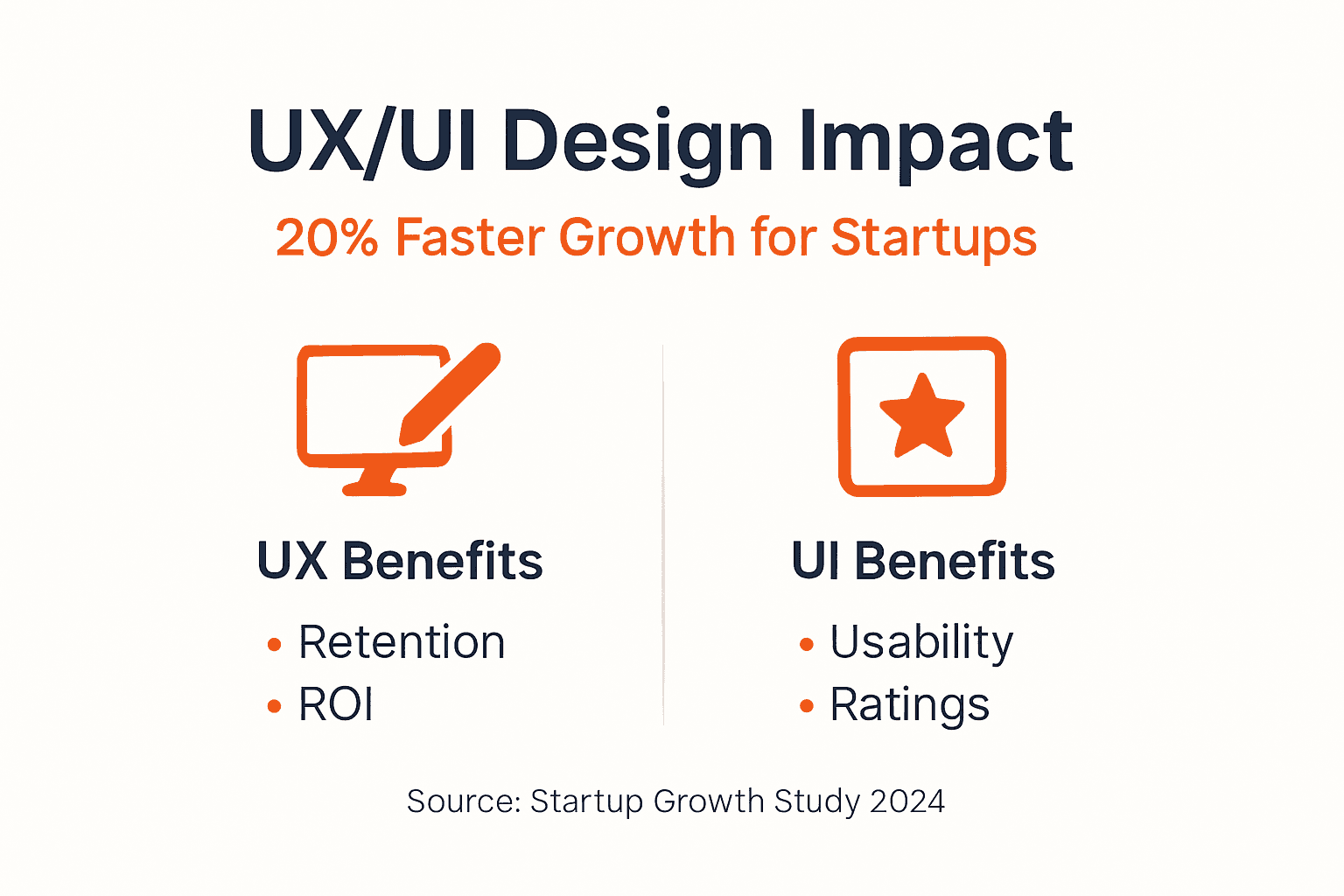
Modular design systems form the foundation for scalable UX/UI. Modular components and reusable design systems enable consistent user experience as startups scale their products. Instead of recreating buttons, forms, and navigation patterns for each new feature, you maintain a component library that enforces consistency.
Why scalable UX/UI requires reusable components:
- Consistency: Users learn patterns once and apply them throughout your product, reducing cognitive load.
- Development speed: Engineers implement features faster using pre-built, tested components rather than custom code.
- Design efficiency: Designers focus on solving new problems rather than recreating solved patterns.
- Quality assurance: Testing standardized components once ensures reliability across all implementations.
- Brand coherence: Visual and interaction consistency reinforces professional brand perception.
Pro Tip: Combine lean iteration with modular design systems to maximize speed without sacrificing quality. Start with core components for your MVP, document them in a simple style guide, and expand the system as you validate new features.
For scalable digital solutions, this systematic approach prevents technical debt and design inconsistency that plague fast-growing startups. Your design system becomes a strategic asset that accelerates every subsequent product release.
Aligning UX/UI Design with Business Growth Goals
Strategic UX/UI alignment transforms design from a cost center into a growth driver. Rather than treating UX/UI as a separate function, integrate it directly with measurable business objectives like user acquisition, retention optimization, and revenue expansion.
Identify KPIs that UX/UI improvements can influence:
- Activation rate: Percentage of new users completing key onboarding actions
- Feature adoption: Usage rates for core product capabilities
- Session frequency: How often users return within defined time windows
- Revenue per user: Transaction value and purchase frequency
- Net Promoter Score: User willingness to recommend your product
Successful startups set specific UX/UI goals tied to these metrics. Instead of vague objectives like “improve user experience,” define targets such as “increase onboarding completion from 45% to 65% within two quarters through UX improvements.”
This specificity enables you to prioritize design work based on business impact. A feature that drives retention deserves more UX investment than one with marginal usage. Data guides resource allocation toward highest-leverage improvements.
Real-world examples demonstrate this alignment. SaaS startups that redesigned complex admin interfaces saw user retention improve by 25% to 40% within six months. E-commerce platforms that streamlined checkout flows reduced cart abandonment by 20% to 35%, directly increasing revenue.
Integrating UX/UI goals early in product planning ensures design considerations shape feature roadmaps rather than reacting to them. When product managers, designers, and engineers collaborate from conception, technical architecture supports optimal user experiences without expensive refactoring.
Benefits of strategic UX/UI investment:
- Competitive differentiation: Superior experiences become defensible moats competitors cannot easily replicate
- Reduced acquisition costs: Word-of-mouth and organic growth supplement paid marketing
- Higher valuation multiples: Investors reward startups with proven user engagement and retention metrics
- Sustainable growth: Retained users provide stable revenue base for expansion
For your startup app development strategy, this means UX/UI considerations influence technology choices, team structure, and funding priorities. Design becomes a strategic partner to engineering and business development rather than a downstream service provider.
Practical Guidance for Startup-Level UX/UI Implementation
Small to medium startups can build effective UX/UI capabilities without enterprise budgets by focusing resources strategically and fostering cross-functional collaboration.
Step 1: Establish dedicated UX/UI roles early, even if part-time or fractional. Assigning design responsibilities to developers or product managers as secondary duties produces inconsistent results. A focused designer brings specialized skills and advocates for user needs in product decisions.
Step 2: Implement lightweight user research processes. You don’t need expensive lab studies to gain insights. Conduct regular user interviews, analyze support tickets for pain points, and use session recordings to observe actual usage patterns.
Step 3: Create a minimal design system documenting core components. Start with buttons, forms, typography, and color palette. Document usage guidelines so engineers implement consistently without constant designer involvement.
Step 4: Integrate UX/UI reviews into development workflows. Brief design critiques during sprint planning and retrospectives catch issues before they reach production, reducing rework costs.
Step 5: Prioritize UX debt alongside technical debt. Dedicate sprint capacity to addressing known usability issues systematically rather than letting them accumulate indefinitely.
Pro Tip: Invest in user research early to improve product-market fit and avoid costly pivots. Spending 10% to 15% of development time on research typically saves 30% to 40% in rework by validating direction before building.
Cross-disciplinary collaboration amplifies UX/UI effectiveness. When designers understand technical constraints and engineers appreciate user needs, teams find creative solutions balancing both priorities. Regular collaborative sessions foster this mutual understanding.
The Apiway startup case study demonstrates successful implementation. By establishing UX/UI as a core discipline from inception and maintaining close designer-developer collaboration, Apiway delivered intuitive automation tools that users adopted rapidly, accelerating growth and market validation.
For resource-constrained startups, consider fractional UX/UI support or design partnerships that provide expertise without full-time overhead. This approach works particularly well during MVP development when design needs are intensive but not yet continuous.
As you scale, transition from generalist designers to specialized UX researchers, interaction designers, and UI designers who deepen capabilities in their domains. This specialization supports increasingly sophisticated product experiences that differentiate you from competitors.
Conclusion: The Strategic Value of UX/UI Design for Startups
UX/UI design represents a strategic investment that directly influences startup success metrics. Effective design improves user retention by reducing friction and creating satisfying experiences that encourage repeat engagement. Development frameworks that integrate UX/UI early cut time-to-market while improving product quality.
The business impact extends beyond user satisfaction to measurable outcomes: lower acquisition costs through word-of-mouth, higher lifetime value through retention, and improved conversion rates through optimized flows. These metrics compound over time, creating sustainable competitive advantages.
For scalable digital products, modular design systems and user-centered frameworks enable consistent experiences as your user base and feature set expand. You avoid the technical debt and usability issues that plague startups that defer design considerations.
UX/UI is not merely a design task completed before launch. It’s an ongoing strategic discipline that evolves with your product and market. Startup leaders who recognize this reality and allocate resources accordingly position their companies for sustained growth and market leadership.
Explore Expert UX/UI Design Services for Scalable Startup Growth
Building exceptional user experiences requires specialized expertise and systematic approaches that many early-stage startups lack internally. Partnering with experienced professional UX/UI design services accelerates your path to product-market fit while avoiding common pitfalls that drain resources.
Ein-des-ein specializes in creating scalable design solutions tailored to startup constraints and growth trajectories. Our team combines strategic UX research with compelling UI execution to deliver products users love and recommend. We’ve helped startups reduce time-to-market, increase retention rates, and establish design systems that scale with growth.
Whether you need custom web applications for startups or comprehensive mobile app development guidance, our integrated approach ensures design and development work seamlessly together. We can also help you organize dedicated offshore teams that extend your capabilities cost-effectively.
Reach out to discuss how strategic UX/UI investment can accelerate your startup’s growth trajectory and competitive positioning.
Frequently Asked Questions About the Role of UX/UI Design
What measurable benefits can a startup expect from investing in UX/UI design?
Startups typically see 15% to 30% retention improvement and 20% faster development cycles within the first year. ROI can reach 9,900% through increased revenue and reduced support costs.
How early should startups incorporate UX/UI in their product development?
Integrate UX/UI from initial concept validation, before writing code. Early research and prototyping reduce expensive pivots and rework by 30% to 40% compared to retrofitting design later.
What are the main differences between UX and UI in terms of impact on user retention?
UX architecture determines whether users accomplish goals efficiently, directly driving retention. UI aesthetics influence perception but cannot compensate for poor UX structure.
Can small startups afford dedicated UX/UI teams, and what alternatives exist?
Fractional designers or design partnerships provide expertise without full-time costs. Even part-time dedicated design resources outperform assigning design to developers as secondary responsibilities.
How does modular design support product scalability?
Reusable component libraries ensure consistency across features, accelerate development, and reduce quality assurance burden. Teams implement new features 40% to 60% faster using established design systems.
Why do some startups fail despite having attractive interfaces?
Visual appeal alone cannot overcome confusing user flows or misaligned features. Success requires UX research validating that you’re solving real user problems, not just making solutions look good.