How to improve UX design for product success in 2026


Too many tech products launch with UX flaws that frustrate users and damage engagement metrics. Product managers and UX designers often struggle to bridge the gap between business objectives and user needs, resulting in products that miss the mark. This guide provides a structured, research-backed approach to improving UX design through proven frameworks, iterative testing, and strategic alignment that drives measurable product success.
Table of Contents
- Understanding The Problem: Align UX With Business Goals
- Preparing The Foundation: Apply Design Thinking And The Double Diamond Model
- Execution: Design For Real-World Use And Edge Cases
- Verification: Test, Iterate, And Refine For Continuous Improvement
- Enhance Your UX With Ein-Des-Ein’s Expert Design Services
Key takeaways
| Point | Details |
|---|---|
| Strategic alignment | Synchronizing UX strategies with business goals prevents conflicting priorities and strengthens outcomes. |
| Framework adoption | Design thinking and the Double Diamond model provide structured pathways for discovery and solution validation. |
| Edge case planning | Designing for real-world complexity and user errors creates more robust, satisfying experiences. |
| Iterative refinement | Continuous testing cycles with user feedback reduce launch risks and improve product-market fit. |
Understanding the problem: align UX with business goals
Misalignment between business stakeholders and UX teams creates a destructive dynamic where UX and business sides fight instead of collaborating. When these groups operate in silos, products suffer from conflicting priorities that confuse users and waste development resources. Business teams push features that drive immediate revenue while UX designers advocate for user-centered approaches that may require longer timelines.
This tension reduces product effectiveness because neither perspective dominates strategically. Business goals without user validation create features nobody wants. UX decisions without business context ignore market realities and sustainability requirements.
Successful teams foster collaboration through shared metrics and regular communication rituals. Establish joint success criteria that measure both user satisfaction and business performance. Create transparency around user research findings and business constraints so both sides understand trade-offs. The impact of UX/UI design on startup growth demonstrates how strategic alignment accelerates market adoption.
Pro Tip: Schedule monthly cross-functional workshops where UX designers present user insights alongside product managers sharing business metrics. This builds mutual understanding and surfaces alignment opportunities early.
Preparing the foundation: apply design thinking and the Double Diamond model
Design thinking provides a human-centered framework that prevents teams from jumping to solutions based on untested assumptions. The approach guides teams through five interconnected stages: empathize with users, define core problems, ideate multiple solutions, prototype concepts rapidly, and test with real users. This process replaces guesswork with validated learning.
The Double Diamond model structures this exploration into four distinct phases. The Double Diamond approach helps teams dig deep before creating solutions, addressing the common pitfall of solving wrong problems efficiently. The first diamond focuses on problem space through Discover and Define phases. The second diamond addresses solution space through Develop and Deliver phases.
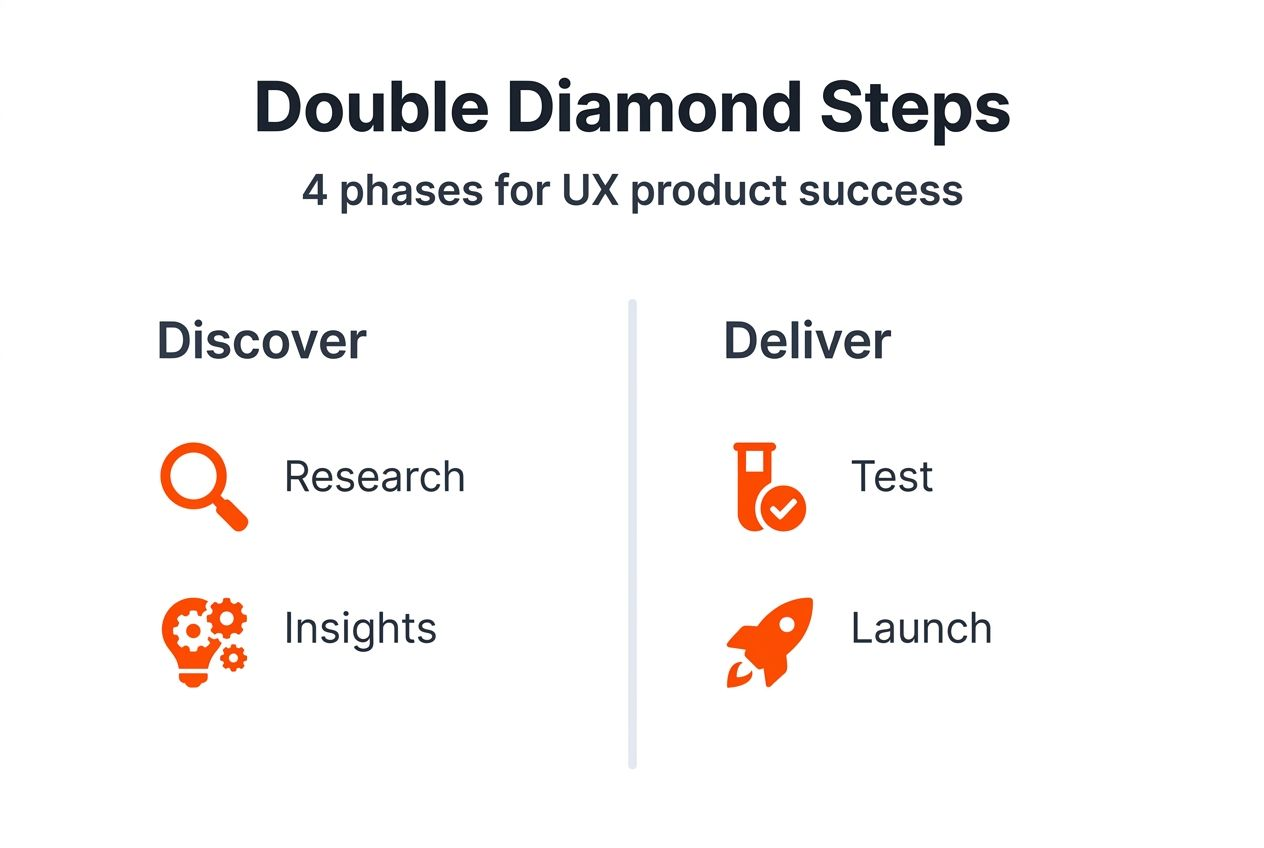
| Phase | Focus | Key Activities | Outcome |
|---|---|---|---|
| Discover | Problem exploration | User research, market analysis, stakeholder interviews | Broad understanding of user context |
| Define | Problem articulation | Synthesis, insight generation, opportunity framing | Clear problem statement |
| Develop | Solution generation | Ideation, prototyping, concept testing | Multiple solution concepts |
| Deliver | Solution refinement | Implementation, testing, iteration | Validated final solution |
This structured divergence and convergence prevents premature optimization. Teams explore widely during Discover and Develop phases, generating diverse perspectives and options. They converge during Define and Deliver phases, making informed decisions based on evidence rather than opinions. Understanding why product discovery matters helps teams allocate appropriate time for exploration before committing resources.
Pro Tip: Run design thinking workshops with engineers, marketers, and support staff alongside designers. Cross-functional participation surfaces technical constraints and market realities early, preventing costly revisions later.
Execution: design for real-world use and edge cases
Most designers optimize for ideal user scenarios, creating interfaces that work beautifully under perfect conditions but break down in reality. Designers should not design for perfect scenarios but instead anticipate the messy complexities of actual user behavior. Edge cases represent real user experiences that happen less frequently but cause disproportionate frustration when unaddressed.

Edge cases fall through cracks because teams prefer not considering uncomfortable scenarios. A form might work perfectly with standard inputs but crash when users enter special characters. An onboarding flow might guide new users smoothly but provide no recovery path when someone accidentally skips a critical step.
Designing for complexity requires anticipating variable contexts and diverse behaviors:
- Analyze support tickets and user complaints to identify recurring edge case patterns that indicate design gaps
- Test with extreme data conditions like unusually long text entries, missing information, or corrupted files
- Consider accessibility scenarios including keyboard-only navigation, screen readers, and cognitive limitations
- Simulate poor network conditions, slow devices, and interrupted processes that mirror real-world constraints
- Map user journeys that include errors, changes of mind, and non-linear paths through your product
Applying user-friendly app principles means designing clear error states, helpful recovery mechanisms, and graceful degradation when things go wrong. Edge cases become opportunities to demonstrate thoughtfulness and build user trust.
Verification: test, iterate, and refine for continuous improvement
The test phase creates a feedback loop that transforms assumptions into knowledge. Testing refines solutions and deepens understanding by exposing gaps between designer intentions and user reality. Many teams treat testing as a final validation checkpoint, but effective teams embed continuous testing throughout development cycles.
Iterative refinement reduces launch risks by catching problems when they are cheap to fix. Each testing cycle provides data that informs the next round of improvements, creating a progressive enhancement model. Products aligned with actual user needs through repeated validation achieve stronger market fit than those built on untested assumptions.
Implement systematic testing through these structured steps:
- Define specific learning objectives for each test cycle rather than vague goals like “see if users like it”
- Recruit participants matching your target user profiles including demographic and behavioral characteristics
- Create realistic task scenarios that mirror how users would naturally interact with your product
- Observe without intervening, noting where users hesitate, make errors, or express confusion
- Collect both qualitative feedback through interviews and quantitative metrics like task completion rates
- Synthesize findings into prioritized improvements focusing on high-impact issues first
- Implement changes rapidly and test again to verify improvements actually solve identified problems
Following a comprehensive software development process embeds these verification steps naturally into sprints and milestones. Testing becomes a rhythm rather than an event, enabling teams to course-correct continuously based on user evidence.
Enhance your UX with Ein-Des-Ein’s expert design services
Transforming UX strategies into successful products requires both design expertise and technical execution capabilities. Many teams excel at identifying improvements but struggle with implementation complexity.
Ein-Des-Ein’s specialized UX/UI design services help product teams translate user insights into polished interfaces that drive engagement and satisfaction. Our team of over 80 professionals combines design thinking with technical depth across web development and mobile app development platforms. We bridge the gap between design vision and production reality, ensuring your improved UX strategies become market-ready products that achieve business objectives while delighting users.
FAQ
How can product managers contribute to improving UX design?
Product managers ensure UX strategies align with business objectives by facilitating prioritization discussions that balance user needs with resource constraints. They coordinate cross-functional teams, removing blockers that prevent designers from accessing user feedback or implementing validated improvements effectively.
What are practical ways to incorporate edge cases in UX testing?
Use analytics tools to identify rare but recurring user behaviors that indicate edge case scenarios worth testing. Involve diverse user groups including those with accessibility needs, simulate error conditions like network failures, and test with extreme data inputs during usability sessions.
How does iterative testing improve digital product success?
Iterative testing enables continuous refinement based on real user feedback rather than assumptions, reducing risks of costly launch failures. Each testing cycle validates whether changes actually solve user problems, ensuring development efforts align with user expectations and market demands.
What is the difference between design thinking and the Double Diamond model?
Design thinking provides five interconnected stages focusing on empathy and experimentation throughout the process. The Double Diamond model structures work into four distinct phases with clear divergence and convergence points, making it easier to manage exploration versus decision-making activities.
Why do many tech products launch with UX flaws?
Teams often skip thorough discovery phases due to timeline pressures, jumping directly to solution building without validating user problems. Misalignment between business stakeholders and UX designers creates competing priorities that compromise user experience in favor of feature velocity.