Master web development trends in 2026 for startup growth


AI tools have tripled developer productivity in 2026, yet many startup founders still believe AI will replace their development teams entirely. This guide explores how AI-first workflows, meta-frameworks, performance optimization, Zero Trust security, mobile-first design, and automated design-development handoffs directly fuel scalable growth. You’ll discover actionable strategies to align cutting-edge web development with your business expansion goals.
Table of Contents
- AI-first Development: Transforming Productivity And Innovation
- Meta-frameworks And Component-based Architecture: Foundations For Scalability
- Performance-first Web Development: SEO And User Engagement Benefits
- Security And Zero Trust: New Standards For Web Applications
- Mobile-first Design And Accessibility: Meeting User Expectations
- Bridging Design And Development: Continuous Automated Handoffs
- Common Misconceptions About AI In Web Development
- Conclusion: Aligning Web Development Trends With Startup Growth Strategies
- Explore Expert Web Development Services For Scalable Growth
- Frequently Asked Questions About Web Development Trends In 2026
Key takeaways
| Point | Details |
|---|---|
| AI productivity gains | AI shortens onboarding by 30% and shifts developers to strategic architecture roles. |
| Meta-frameworks for scalability | Over 75% of professional projects use meta-frameworks, cutting maintenance costs by 25%. |
| Performance drives SEO | Core Web Vitals optimizations reduce bounce rates by 20% and boost retention 15-25%. |
| Zero Trust security | Continuous verification reduces breach risk by 50%, protecting startup data. |
| Mobile-first engagement | Mobile-first design increases user engagement by 30% and expands market reach. |
AI-first development: transforming productivity and innovation
AI tools have evolved to scaffold entire full-stack applications, shifting developer roles to architects overseeing AI agents. Instead of writing repetitive code, your team focuses on system design, user experience refinement, and innovation. This transformation accelerates feature delivery and cuts time-to-market dramatically for startups competing in fast-moving markets.

AI integration automates mundane tasks like boilerplate generation, test creation, and code refactoring. Developers spend more time solving complex business problems and less on syntax errors. This shift improves coding accuracy and development speed, allowing startups to iterate faster based on user feedback. The result is a leaner development cycle aligned with agile business needs.
Onboarding time can be reduced by up to 30% with AI-assisted code exploration tools. New team members quickly understand existing codebases through AI-generated documentation and contextual guidance. For startups scaling teams rapidly, this means faster ramp-up and immediate productivity contributions. You can expand development capacity without sacrificing quality or momentum.
Startups deploying AI-first workflows report faster feature releases and reduced operational costs. AI handles routine tasks while human developers drive strategic decisions and architectural choices. This collaboration model maximizes efficiency without eliminating the human judgment essential for product success. Companies like Scholarcy demonstrate how AI augmentation accelerates complex academic research platforms.
Key AI-first development benefits for startups:
- Automated scaffolding and boilerplate code generation save hours weekly
- Enhanced code quality through AI-assisted review and refactoring
- Faster debugging with intelligent error detection and resolution suggestions
- Reduced onboarding friction for new developers joining your team
- Strategic focus on architecture and user experience instead of syntax
Pro Tip: Start with AI tools for documentation and code review to build team familiarity before expanding to full scaffolding workflows. This gradual adoption reduces resistance and builds confidence in AI collaboration.
Meta-frameworks and component-based architecture: foundations for scalability
Meta-frameworks like Next.js and Nuxt simplify routing, bundling, and configuration compared to traditional frameworks. Over 75% of new professional web projects adopt meta-frameworks in 2026 because they streamline developer experience and accelerate deployment. For startups, this means less time wrestling with tooling and more time building features that differentiate your product.
Component-based architecture enables modularity and reusability, cutting maintenance costs by 25%. When you build UI components as self-contained units, updates become isolated and testing becomes simpler. Startups benefit from codebases that adapt smoothly to growth without escalating technical debt. Reusing components across features ensures consistent user experiences and speeds delivery cycles.
Meta-frameworks handle server-side rendering, static site generation, and API routes out of the box. This reduces the need for separate backend infrastructure in early stages, lowering hosting costs and complexity. Startups can launch faster with fewer resources while maintaining professional-grade performance and SEO capabilities. The framework’s opinionated structure guides best practices without limiting flexibility.
The table below compares traditional frameworks with meta-frameworks for startup contexts:
| Aspect | Traditional Frameworks | Meta-Frameworks |
|---|---|---|
| Configuration | Manual setup required | Pre-configured defaults |
| Routing | Custom implementation | Built-in file-based routing |
| SEO optimization | Additional tooling needed | Server-side rendering included |
| Developer onboarding | Steeper learning curve | Faster with conventions |
| Scalability | Requires custom architecture | Designed for growth |
Adopting meta-frameworks positions your startup to build scalable web apps in 2026 while avoiding common failures. The structured approach reduces misconfiguration risks and ensures your codebase follows industry standards. As your team grows, new developers contribute faster thanks to familiar patterns and comprehensive documentation.
Component reuse facilitates faster updates and consistent UX across your application. When design systems align with component libraries, changes propagate efficiently without repetitive manual work. Startups gain agility to respond to market feedback and pivot features without rebuilding from scratch.
Key meta-framework advantages for startups:
- Reduced time-to-market with pre-built routing and rendering solutions
- Lower maintenance costs through modular component architecture
- Improved SEO performance with server-side rendering capabilities
- Easier team scaling with standardized development patterns
- Future-proof technology stack aligned with industry trends
Performance-first web development: SEO and user engagement benefits
Optimizing Core Web Vitals reduces bounce rates by up to 20% and directly impacts Google SEO rankings. Faster load times create better first impressions and keep users engaged longer. For startups competing for visibility, performance optimizations translate to measurable growth in organic traffic and conversion rates.
Core Web Vitals optimizations lead to 15-25% uplift in user retention and 10-20% reduction in bounce rates. These metrics prove that performance isn’t just technical polish but a core business driver. When users experience snappy interactions and instant page loads, they trust your brand more and return frequently.
Performance-first development prioritizes metrics like Largest Contentful Paint, First Input Delay, and Cumulative Layout Shift from project inception. Building with performance budgets prevents bloat and ensures every feature addition considers speed impact. Startups benefit from applications that feel responsive even as functionality expands, maintaining competitive advantage through measured improvements.
The data below shows performance impact on key business metrics:
| Metric | Improvement | Business Impact |
|---|---|---|
| Load time reduction | 1 second faster | 7% increase in conversions |
| Bounce rate | 20% decrease | Higher page views per session |
| User retention | 15-25% increase | Lower customer acquisition costs |
| SEO ranking | Top 3 positions | 10x more organic traffic |
Faster applications increase user engagement over 15% across mobile and desktop platforms. Mobile users especially expect instant responses, and delays trigger immediate abandonment. Startups targeting mobile-first audiences must prioritize performance to capture and retain users in competitive markets.
Investing in custom web apps built for performance pays dividends through improved retention and lower bounce rates. Every millisecond saved compounds into better user experiences and stronger business outcomes. Performance optimization becomes a growth strategy, not just a technical requirement.
Performance optimization priorities for startups:
- Implement lazy loading for images and components to reduce initial load
- Minimize JavaScript bundle sizes with code splitting and tree shaking
- Use CDN delivery for static assets to decrease latency globally
- Optimize database queries and API responses to speed data retrieval
- Monitor Core Web Vitals continuously to catch regressions early
Pro Tip: Set performance budgets during initial development and enforce them through automated testing. This prevents future performance debt and keeps your application fast as features accumulate.
Security and zero trust: new standards for web applications
Zero Trust architecture requires continuous verification of all access, reducing breach risk by up to 50%. Traditional perimeter security fails in modern distributed environments where users, APIs, and microservices interact across networks. Startups must adopt Zero Trust principles from day one to protect sensitive data and maintain customer trust as applications scale.
Security must be integrated throughout the development lifecycle through DevSecOps practices. Automated security scanning, dependency monitoring, and vulnerability assessments catch issues early when fixes cost less. Embedding security into your CI/CD pipeline ensures every code change meets security standards before reaching production.
Startups face increasing threat vectors as they scale and attract attention from malicious actors. Early security investments prevent costly breaches that damage reputation and trigger regulatory penalties. Building security foundations during initial development avoids expensive retrofits and technical debt accumulation.
Zero Trust enhances user trust and compliance adherence for startups handling regulated data. Customers expect robust protection of their information, and demonstrating security commitments differentiates your brand. Compliance with standards like GDPR, HIPAA, or SOC 2 becomes achievable when security is architectural, not an afterthought.
Essential security practices for startup web applications:
- Implement multi-factor authentication for all user and admin access
- Encrypt data in transit and at rest using industry-standard protocols
- Conduct regular penetration testing and security audits
- Monitor application logs for anomalous behavior and potential breaches
- Maintain up-to-date dependencies to patch known vulnerabilities
Adopting scalable web application architectures that include security by design protects your startup as you grow. Security and scalability must evolve together to support business expansion without introducing new risks.
Mobile-first design and accessibility: meeting user expectations
Mobile user engagement has risen 30% due to mobile-first design principles that prioritize touch interactions and smaller screens. Most users now access web applications primarily on mobile devices, making mobile-first the baseline rather than an enhancement. Startups designing for mobile first capture larger audiences and deliver superior experiences across all devices.
Design decisions are increasingly based on real mobile usage patterns and data analytics. Understanding how users navigate on smartphones informs information architecture, button sizing, and content prioritization. This data-driven approach creates intuitive interfaces that reduce friction and increase task completion rates.
Accessibility compliance is now mandatory baseline for inclusive digital products. Standards like WCAG 2.1 Level AA ensure applications work for users with disabilities, expanding your addressable market. Accessible design benefits everyone through clearer navigation, better contrast, and keyboard-friendly interactions that improve overall usability.
Mobile-first design improves UX consistency across devices by establishing core functionality on constrained screens first. Progressive enhancement adds features for larger displays without breaking mobile experiences. Startups avoid the pitfall of desktop-centric designs that feel cramped or broken on phones.
Startups capture larger markets with mobile-optimized, accessible applications that meet diverse user needs. Expert mobile app development strategies help founders implement these principles effectively from launch.
Mobile-first and accessibility best practices:
- Design touch targets at least 44×44 pixels for easy mobile interaction
- Use responsive typography that scales appropriately across screen sizes
- Ensure sufficient color contrast ratios for text readability
- Implement semantic HTML and ARIA labels for screen reader compatibility
- Test on actual mobile devices, not just browser emulators
Bridging design and development: continuous automated handoffs
Continuous automated design-to-development handoffs eliminate error-prone manual translation work. Automated handoffs can reduce manual errors by up to 40% and improve deployment speed by 25%. Design files become living documentation that developers reference directly, ensuring pixel-perfect implementation without guesswork.
Design files serve as the single source of truth for development teams, reducing miscommunication. When designers and developers work from synchronized specifications, discrepancies disappear and iterations happen faster. Startups benefit from tighter collaboration that accelerates product delivery and maintains design integrity.
Integration tools export design tokens, component specifications, and style guides directly into code repositories. Developers spend less time measuring spacing or matching colors and more time implementing functionality. This automation improves code quality and consistency across the application.
Startups gain agility through reduced back-and-forth between design and development teams. When workflows integrate seamlessly, feedback cycles shorten and products reach users faster. Teams can iterate based on real usage data instead of waiting weeks for design revisions.
Automation tools enhance collaboration between UX/UI designers and developers by creating shared workflows. Projects like PQM demonstrate how automated handoffs maintain quality while accelerating complex application development.
Benefits of automated design-development workflows:
- Faster implementation with direct export of design specifications
- Consistent UI through automated design token generation
- Reduced miscommunication between design and engineering teams
- Easier updates when design systems evolve
- Shorter feedback loops for iterative improvements
Common misconceptions about AI in web development
AI will not replace developers but assist them, enhancing focus on architecture and user experience. AI tools serve as collaborators rather than replacements, shifting developer tasks towards higher-value design and oversight. Your team remains essential for strategic thinking, problem-solving, and understanding business context that AI cannot replicate.
Effective AI use requires structured inputs and human oversight for quality output. AI generates suggestions based on patterns, but developers must evaluate relevance, security, and maintainability. Blindly accepting AI-generated code introduces risks and technical debt that undermine long-term scalability.
Performance optimization is crucial for business success, not just technical teams. Many founders assume performance is solely an engineering concern, but it directly affects revenue, user retention, and market competitiveness. Treating performance as a business priority ensures resources align with growth objectives.
Mobile-first design delivers measurable engagement benefits beyond aesthetics. Some startups view mobile optimization as optional polish, missing the 30% engagement increase mobile-first approaches provide. Prioritizing mobile ensures you meet users where they are and capture market opportunities.
Understanding AI’s role helps startups adopt it strategically without overreliance. Balanced integration leverages AI strengths while preserving human judgment and creativity. This pragmatic approach maximizes productivity gains without sacrificing quality or innovation.
Clearing AI misconceptions:
- AI augments developers, it doesn’t replace strategic thinking or architecture skills
- Quality AI output depends on well-structured prompts and human review
- Performance metrics directly correlate with business growth and revenue
- Mobile-first isn’t optional anymore, it’s the baseline expectation
- Security requires proactive design, not reactive fixes after breaches
Conclusion: aligning web development trends with startup growth strategies
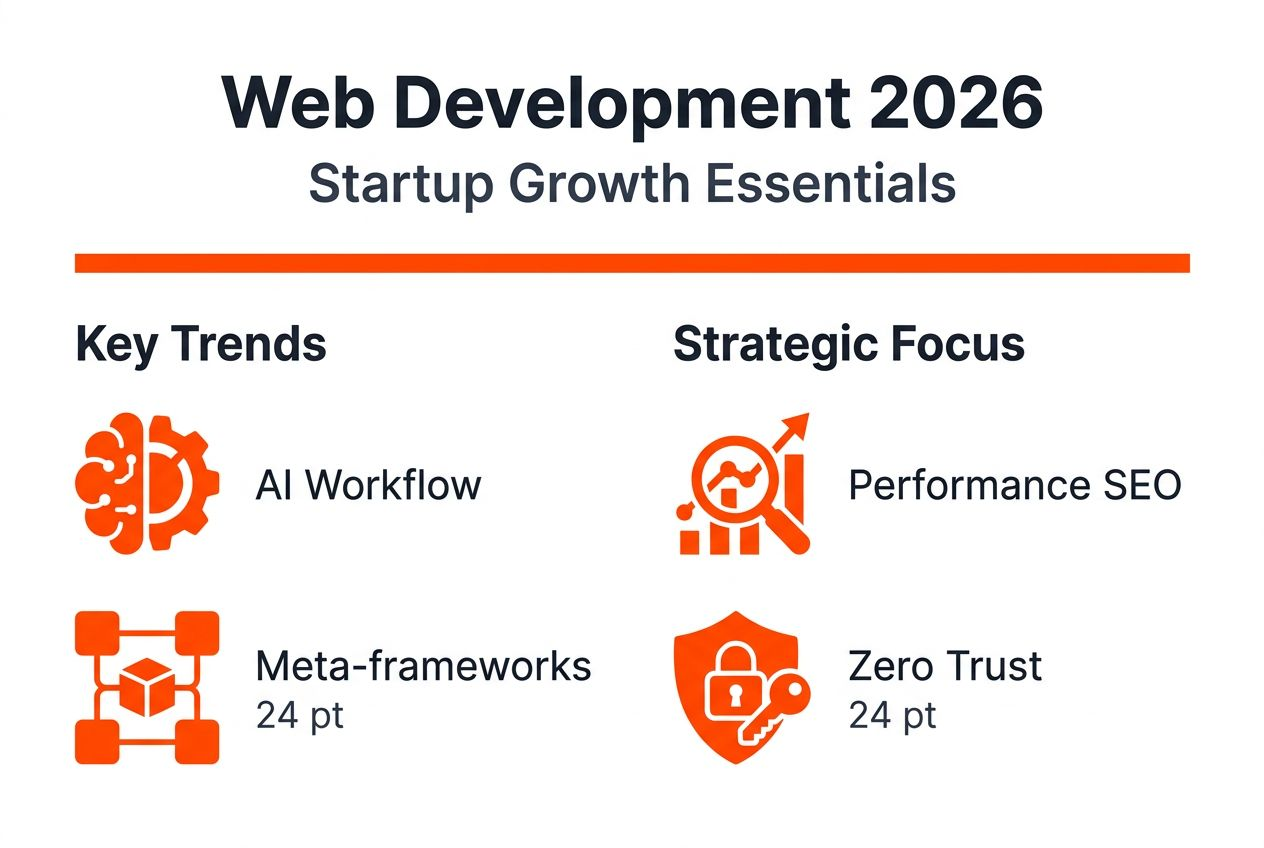
Adopting these 2026 web development trends positions your startup for sustainable, scalable growth. AI-first workflows accelerate development while meta-frameworks provide solid architectural foundations. Performance optimizations boost SEO and retention, while Zero Trust security protects valuable data.
Mobile-first design and accessibility expand your addressable market and improve engagement across user segments. Automated design-development handoffs reduce friction and speed delivery cycles. Together, these trends create competitive advantages that align technology investments with business expansion goals.
Implement these strategies through deliberate planning and phased adoption:
- Evaluate your current tech stack against 2026 meta-framework and AI tool options
- Establish performance budgets and security standards from project inception
- Adopt mobile-first design principles and accessibility compliance as baseline requirements
- Integrate automated design-development workflows to improve team collaboration
- Develop a strategic technology roadmap that aligns trends with business objectives
Explore examples of scalable digital solutions for startups to see how leading companies implement these trends successfully. Your technology choices today determine your ability to scale tomorrow.
Explore expert web development services for scalable growth
Transforming 2026 web development trends into working products requires specialized expertise and strategic execution. Ein-Des-Ein delivers tailored web development services that align AI-first workflows, meta-frameworks, performance optimization, and Zero Trust security with your startup’s growth trajectory.

Our team of over 80 professionals provides full-cycle development including custom web applications, complex UX/UI design, and native and cross-platform mobile app development. We specialize in enterprise application development that scales with your business while maintaining security and performance standards. Whether you need a dedicated offshore team or end-to-end product development, we help you leverage cutting-edge technology for measurable business expansion.
Frequently asked questions about web development trends in 2026
How do AI-assisted development workflows change developer roles in startups?
AI shifts developers from writing repetitive code to architectural design and strategic oversight. Your team focuses on system design, user experience, and business logic while AI handles boilerplate generation and routine tasks. This collaboration increases productivity by up to 30% and shortens onboarding time for new developers.
What are the main benefits of adopting meta-frameworks for startup web applications?
Meta-frameworks reduce configuration complexity, provide built-in SEO optimization through server-side rendering, and cut maintenance costs by 25% through component reusability. Startups deploy faster with standardized patterns that scale smoothly as teams and user bases grow. The structured approach prevents common architectural mistakes.
How does performance-first development impact SEO and user engagement?
Core Web Vitals optimizations reduce bounce rates by 20% and improve user retention by 15-25%, directly boosting Google rankings. Faster load times create better first impressions and increase conversions by up to 7% per second saved. Performance becomes a measurable growth driver, not just technical polish.
What security essentials should startups implement for web applications in 2026?
Adopt Zero Trust architecture with continuous access verification, reducing breach risk by 50%. Integrate DevSecOps practices throughout your development lifecycle, implement multi-factor authentication, encrypt data in transit and at rest, and conduct regular security audits. Early security investments prevent costly breaches as you scale.
Why is mobile-first design critical for startup success?
Mobile-first design increases user engagement by 30% because most users access applications primarily on mobile devices. Designing for constrained screens first ensures intuitive experiences across all devices. Combined with accessibility compliance, mobile-first expands your addressable market and meets diverse user needs effectively.