What is cross-platform development? A 2026 guide for tech startups


Think cross-platform development is a compromise? Think again. In 2026, cross-platform mobile development is no longer a fringe experiment but a strategic backbone for delivering digital experiences across devices. Major companies now rely on it to scale efficiently, and your startup can too. This guide explains what cross-platform development is, how leading frameworks compare, and how to choose the right approach to accelerate your growth without burning through your budget.
Table of Contents
- Understanding Cross-Platform Development: What It Means And Why It Matters
- Popular Cross-Platform Frameworks And How They Differ
- Benefits And Challenges Of Cross-Platform Development
- Choosing And Implementing The Right Cross-Platform Strategy For Your Startup
- How Ein-Des-Ein Supports Your Cross-Platform Development Journey
- Frequently Asked Questions
Key takeaways
| Point | Details |
|---|---|
| Single codebase advantage | Cross-platform app development allows developers to create apps that run similarly on different mobile platforms using a single codebase, saving time and resources compared to native app development. |
| Cost and time savings | Up to 90% code reuse is possible, leading to significant cost savings compared to native development. |
| Framework options matter | Flutter, React Native, .NET MAUI, and Kotlin Multiplatform each offer distinct advantages for different team skills and project goals. |
| UX requires attention | Neglecting platform-specific UI/UX nuances can reduce user satisfaction even if code is shared. |
| Strategic adoption | Over 60% of development teams now use some form of cross-platform technology. |
Understanding cross-platform development: what it means and why it matters
Cross-platform development means writing one codebase that runs on multiple mobile operating systems like iOS and Android. Instead of building separate native apps for each platform, you create a single application that adapts to different devices. This approach transforms how startups and SMEs deliver digital products.
The core advantage is efficiency. When developers write code once and deploy it everywhere, your team moves faster and costs drop dramatically. You launch your MVP quicker, iterate based on user feedback sooner, and scale your product without doubling your engineering resources.
In 2026, cross-platform technology has matured beyond early limitations. Modern frameworks deliver near-native performance and user experiences. The adoption numbers speak for themselves. This isn’t experimental anymore.
For startups and SMEs, this matters because resources are finite. You need to invest in mobile apps for growth without breaking the bank. Cross-platform development makes that possible by reducing the team size needed, shortening development cycles, and lowering maintenance overhead.
Key benefits include:
- Faster time to market with simultaneous iOS and Android launches
- Lower development costs from shared codebase and smaller team requirements
- Easier maintenance with updates pushed to all platforms at once
- Consistent user experience across devices without duplicating design work
- Access to native features through platform-specific plugins when needed
The strategic importance becomes clear when you consider product velocity. Your competitors are launching, testing, and iterating rapidly. Cross-platform development gives you the speed to keep pace while maintaining quality.
Popular cross-platform frameworks and how they differ
Choosing the right framework shapes your product’s future. Each leading option in 2026 brings distinct architectural approaches, language requirements, and trade-offs. Understanding these differences helps you align technology decisions with your team’s strengths and business goals.
Flutter owns the entire rendering stack and paints pixels directly to the screen using Skia. This gives you complete control over UI appearance across platforms. Flutter uses Dart, a language designed for client development. If your priority is pixel-perfect custom interfaces that look identical everywhere, Flutter excels. The framework includes a rich widget library and hot reload for rapid iteration.

React Native leverages web talent for mobile development using JavaScript or TypeScript. If your team already builds web applications with React, the learning curve flattens significantly. React Native bridges JavaScript code to native components, so your app feels more platform-native than Flutter’s approach. The vast npm ecosystem and active community make finding solutions easier.
.NET MAUI provides a single C# codebase for Android, iOS, macOS, and Windows using native UI controls. Microsoft’s framework suits teams already invested in the .NET ecosystem. MAUI emphasizes platform-native UI over uniform appearance, which can improve user experience but requires more platform-specific customization.
Kotlin Multiplatform allows sharing code while retaining native benefits and can share up to 100% of app code with Compose Multiplatform. If your team already uses Kotlin for Android, this reduces risk since there’s no need to introduce a new language. Kotlin Multiplatform focuses on sharing business logic while letting you write native UI code when needed.
| Framework | Primary Language | UI Approach | Best For |
|---|---|---|---|
| Flutter | Dart | Custom rendering | Pixel-perfect custom UIs |
| React Native | JavaScript/TypeScript | Native components via bridge | Teams with React experience |
| .NET MAUI | C# | Native UI controls | .NET ecosystem users |
| Kotlin Multiplatform | Kotlin | Shared logic, flexible UI | Android-first teams |
Framework choice impacts everything downstream. Consider your team’s existing skills, your app’s UI complexity, and long-term maintenance needs. A framework that matches your team’s expertise accelerates development and reduces bugs.
Pro Tip: Evaluate framework maturity by checking community size, library availability, and corporate backing. A framework with strong corporate support and an active community reduces long-term risk when you need to solve edge cases or find talent for your startup.
Benefits and challenges of cross-platform development
Cross-platform development delivers measurable advantages for startups and SMEs, but understanding the trade-offs helps you set realistic expectations and plan accordingly. Let’s examine both sides clearly.
The benefits start with economics. Studies confirm this approach leads to significant cost reductions compared to maintaining separate native codebases. Your team writes, tests, and maintains less code. This translates to smaller engineering teams and lower ongoing expenses.
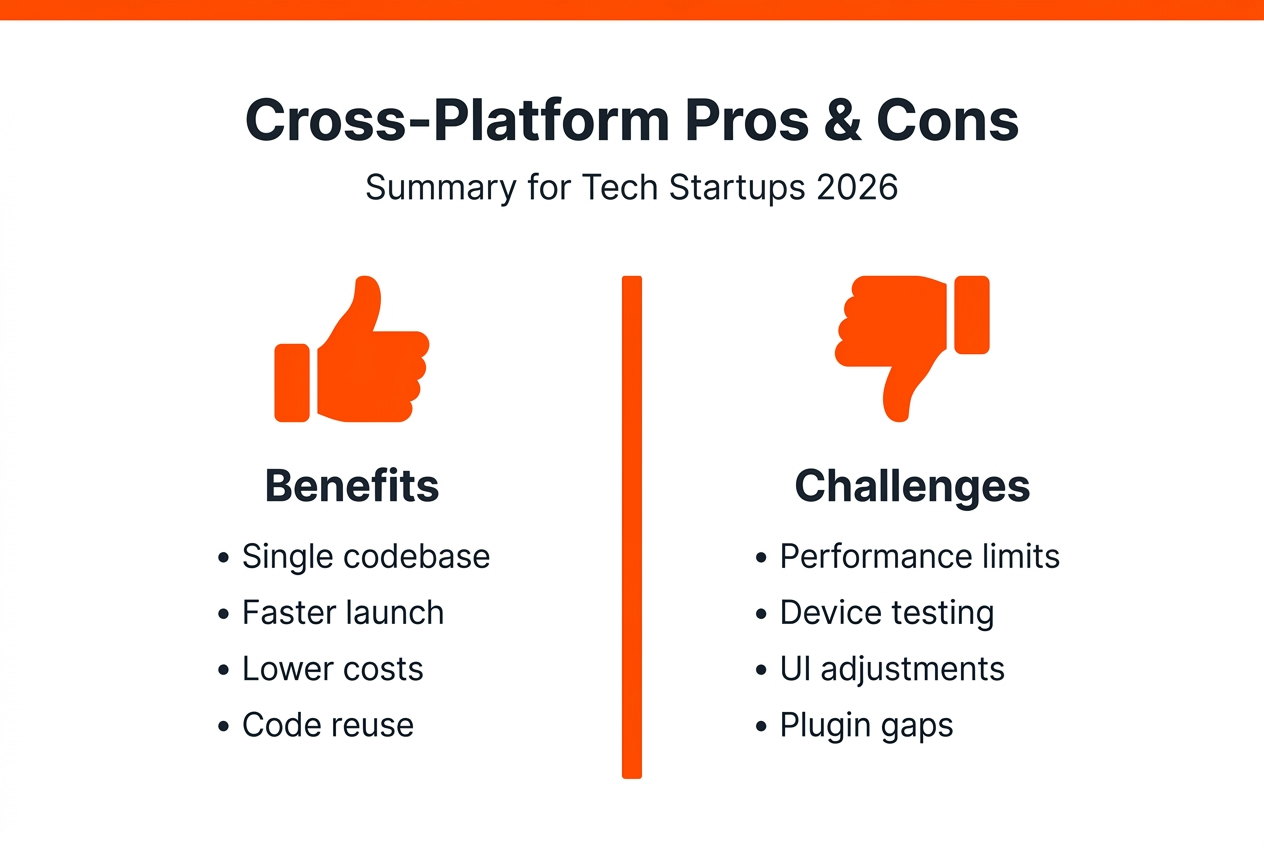
Time to market accelerates dramatically. You launch on iOS and Android simultaneously instead of staggering releases. Your MVP reaches users faster, you gather feedback sooner, and you iterate more rapidly. This speed advantage compounds over time as you add features and respond to market demands.
Code reuse extends beyond just the application layer. Shared business logic, API integrations, authentication systems, and data management all benefit from the single codebase approach. Updates and bug fixes propagate to all platforms at once, reducing coordination overhead.
However, challenges exist. Performance trade-offs compared to native apps can emerge, particularly for graphically intensive applications. Gaming, complex animations, and apps requiring heavy computation may notice the difference. The performance gap has narrowed significantly in 2026, but it still matters for specific use cases.
The bigger challenge often comes from UX expectations. iOS and Android users expect different interaction patterns, navigation structures, and visual conventions. A one-size-fits-all approach can feel foreign on both platforms. You need to balance code reuse with platform-appropriate design.
Key benefits:
- Reduced development costs from shared codebase
- Faster MVP delivery and iteration cycles
- Smaller team requirements for comparable output
- Consistent business logic across platforms
- Lower maintenance overhead
Common challenges:
- Potential performance gaps in graphics-heavy scenarios
- Platform-specific UX expectations requiring customization
- Third-party library availability varying by framework
- Learning curve for new frameworks and tooling
- Debugging complexity when issues are platform-specific
The strategic mindset matters most. Treat cross-platform development as a product portfolio operating system, not merely a shortcut. When you invest in understanding your chosen framework deeply, optimize for each platform’s strengths, and test thoroughly across devices, you maximize benefits while minimizing downsides.
Pro Tip: Budget 15-20% of development time for platform-specific refinements and testing. This ensures your shared codebase delivers excellent experiences on both iOS and Android without surprising delays near launch. Learn more about expert mobile app development tips to avoid common pitfalls.
Choosing and implementing the right cross-platform strategy for your startup
Selecting the right cross-platform approach requires evaluating your specific context rather than following trends. The choice of a framework depends largely on your project and goals. Here’s how to make an informed decision.
Start by defining your project priorities. Are you racing to launch an MVP, or building a long-term product platform? Do you need complex custom animations, or straightforward business functionality? Your answers shape framework selection because different tools optimize for different scenarios.
Assess your team’s existing capabilities honestly. If your developers already know JavaScript and React, React Native offers the fastest path to productivity. If you’re building on an existing Android app and your team uses Kotlin, Kotlin Multiplatform reduces risk. Fighting against your team’s strengths slows development and increases bugs.
Consider maintainability and velocity for sustainable growth. Framework selection impacts long-term adaptability, development velocity, maintainability, and product success. A framework with strong community support, regular updates, and abundant learning resources helps your team solve problems faster.
Implementation steps:
- Evaluate your MVP requirements and identify must-have native features
- Audit your team’s skills and language preferences
- Research framework communities and library ecosystems for your use case
- Build a small prototype to test development workflow and performance
- Plan for platform-specific customizations in critical user flows
- Establish testing protocols covering both platforms and multiple device sizes
- Monitor performance metrics post-launch and optimize bottlenecks
Tailoring UX for platform-specific nuances matters despite a shared codebase. iOS users expect swipe gestures and specific navigation patterns. Android users rely on back buttons and material design conventions. Respect these differences in your UI layer while keeping business logic unified.
Implement iterative testing throughout development, not just before launch. Test on real devices regularly, not just simulators. Performance characteristics, touch responsiveness, and visual rendering can differ significantly between emulated and physical environments.
Consider using mobile app development services to accelerate your implementation. Experienced teams navigate framework quirks faster and help you avoid costly architectural mistakes early.
Post-launch optimization:
- Monitor crash reports and performance metrics for each platform separately
- Gather user feedback specific to platform experiences
- Profile app performance under realistic network conditions
- Update dependencies regularly to benefit from framework improvements
- Invest in automated testing to catch platform-specific regressions
Pro Tip: Create a decision matrix scoring each framework against your specific criteria such as team skills, UI complexity, performance requirements, and long-term support. This objective approach prevents choosing based on hype or personal preference. Review your decision quarterly as frameworks evolve rapidly. Check out this strategic framework selection guide for deeper analysis.
How Ein-Des-Ein supports your cross-platform development journey
Understanding cross-platform development is one thing. Executing it successfully while running your startup is another. Ein-Des-Ein specializes in turning cross-platform strategies into production applications that drive business growth.
Our team of over 80 professionals brings deep expertise in Flutter, React Native, and other leading frameworks. We handle the full development cycle from architecture design through deployment and maintenance. Whether you need a rapid MVP launch or a scalable product platform, we align technology choices with your business objectives.
Beyond mobile development, we provide integrated web development services and UX and UI design services for cohesive digital experiences. Our dedicated team model helps you organize your own offshore development capacity when you need to scale rapidly. We handle the complexity so you can focus on growing your business.
Frequently asked questions
What is cross-platform development and how does it work?
Cross-platform development uses a single codebase to build applications that run on multiple operating systems like iOS and Android. Frameworks translate your code into platform-specific components or render custom UIs that work identically across devices, eliminating the need to write separate apps for each platform.
Is cross-platform development slower than native development?
Actually, cross-platform development is typically faster because you write code once instead of twice. While individual platform apps might have slight performance advantages in graphics-intensive scenarios, the time savings from shared code and simultaneous platform launches usually outweigh these considerations for most business applications.
Can cross-platform apps access native device features?
Yes, modern cross-platform frameworks provide plugins and APIs to access cameras, GPS, sensors, and other native capabilities. When a feature isn’t available through the framework, you can write platform-specific modules and integrate them with your shared codebase.
How much does cross-platform development cost compared to native?
Cross-platform development typically costs 30-40% less than building separate native apps because you’re maintaining one codebase instead of two. The exact savings depend on your app’s complexity, but the shared architecture always reduces development time, team size, and ongoing maintenance expenses.
Should startups always choose cross-platform over native development?
Not always, but often. Choose cross-platform when you need to launch quickly, have limited resources, or want to test ideas across platforms simultaneously. Consider native development if your app requires maximum performance, depends heavily on cutting-edge platform features, or targets only one operating system.
What happens if I need to switch from cross-platform to native later?
You can migrate, though it requires rebuilding your application. However, your business logic, API integrations, and UX insights transfer to native implementations. Many successful companies start cross-platform to validate their market, then selectively rebuild performance-critical components natively only if needed.