Why invest in mobile apps for scalable growth in 2026


Companies that invest in mobile apps see revenue increases of 15-30% within two years. For business leaders at startups and SMEs, mobile apps are no longer optional extras but essential tools driving scalable growth and customer engagement. As digital expectations rise in 2026, investing in mobile apps directly addresses market demands while enabling data-driven decision-making and operational efficiency. This article explores why mobile app investments deliver measurable ROI, how to choose the right development approach, and when to act for maximum competitive advantage.
Table of Contents
- How Mobile Apps Accelerate Scalability And Growth
- Roi And Business Growth With Mobile Apps
- Common Misconceptions About Mobile App Investments
- Technology Choices: Native Vs Cross-Platform Apps
- Digital Transformation And Data-Driven Scalability
- Real-World Case Studies Of Business Growth
- Decision Framework For Mobile App Investment Timing
- Explore Mobile App Development Services At Ein-Des-Ein
Key takeaways
| Point | Details |
|---|---|
| Mobile apps accelerate scalability | Apps provide real-time market access and data analytics that support agile strategic decisions and rapid business growth. |
| Investment boosts retention and revenue | Businesses typically see 30% better customer retention and 15-30% revenue growth within two years of app launch. |
| Native vs cross-platform impacts performance | Native apps deliver 30% better performance while cross-platform reduces development time by 40%, depending on priorities. |
| AI integration enhances decision-making | Analytics and AI in apps improve decision speed by 35% and enable personalized marketing that drives loyalty. |
| Early investment aligns with growth success | Startups deploying apps within the first two years scale approximately 50% faster than competitors without apps. |
How mobile apps accelerate scalability and growth
Mobile apps create direct pathways to global markets and diverse customer segments without geographic limitations. You gain instant access to users across time zones, enabling 24/7 engagement that traditional channels cannot match. This constant availability transforms how quickly you can test new markets and adjust offerings based on real-time feedback.
Data-driven decision making becomes significantly faster when apps collect user behavior, preferences, and transaction patterns automatically. Analytics dashboards show exactly which features drive engagement and which need improvement. You can pivot strategies within days instead of months, responding to market shifts before competitors recognize them.
Customer acquisition costs drop while retention rates climb when apps provide seamless, personalized experiences. Push notifications re-engage users at optimal moments, loyalty programs reward repeat business, and in-app support resolves issues instantly. These mechanisms create sticky customer relationships that compound over time.
Scalability gains multiply as your user base grows because app infrastructure handles increased load without proportional cost increases. Cloud-based backends scale automatically, and updates reach all users simultaneously. You can drive scalable growth by deploying new features to thousands of users as easily as to hundreds.
Key mechanisms that link apps to rapid scalability include:
- Automated customer onboarding reduces manual processes and accelerates user activation
- Real-time inventory and order management streamlines operations across locations
- Integrated payment systems decrease transaction friction and abandoned carts
- Analytics engines identify high-value customer segments for targeted campaigns
- API connections sync data across business systems eliminating duplicate entry
Businesses implementing scalable digital solutions report faster time to market for new products and services. Your team spends less time on repetitive tasks and more on strategic initiatives that differentiate your brand.
ROI and business growth with mobile apps
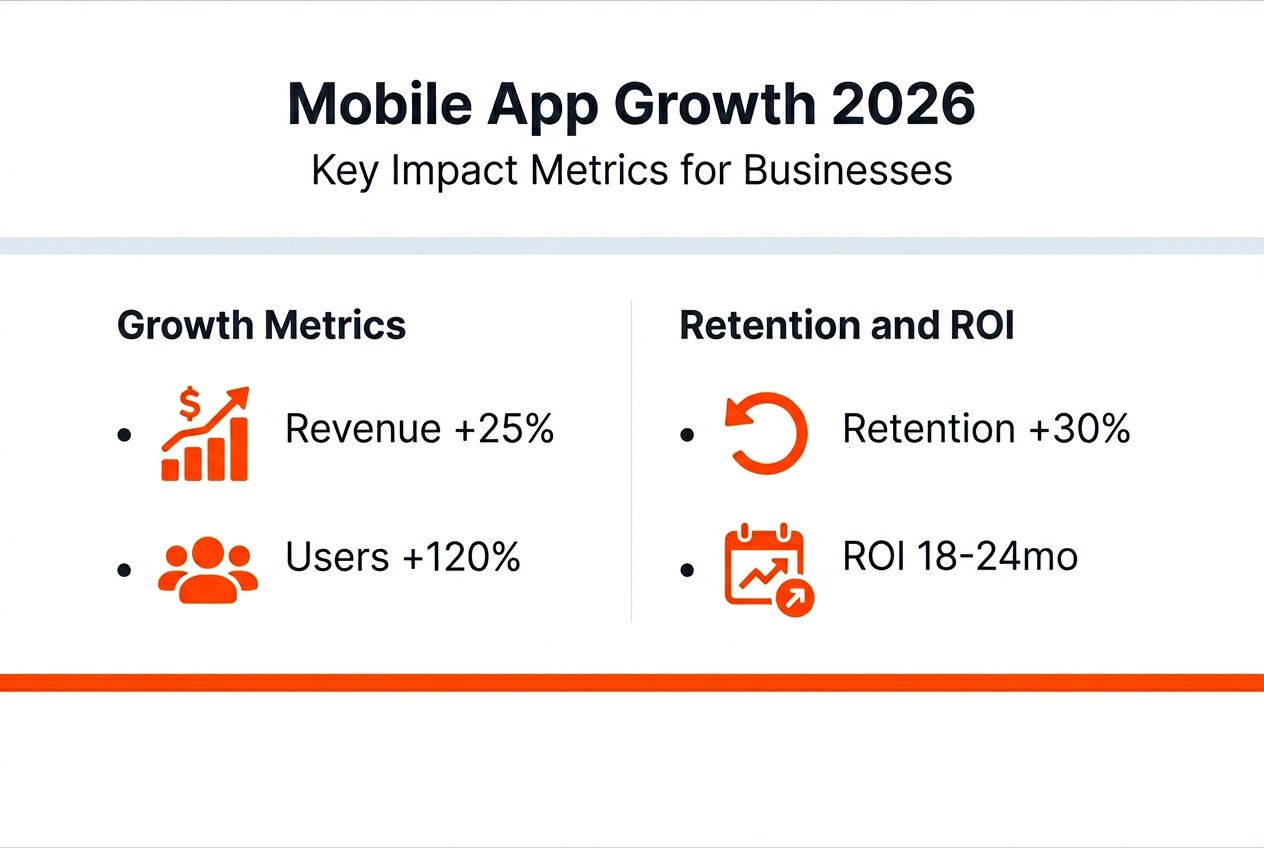
Financial returns from mobile app investments typically materialize within 18 to 24 months as user adoption accelerates. Companies tracking app performance see measurable improvements in key revenue metrics, customer lifetime value, and operational efficiency. Understanding these numbers helps you build realistic budgets and set achievable growth targets.

Revenue growth of 15-30% represents the average increase businesses experience after launching mobile apps. This boost comes from expanded market reach, improved conversion rates, and new monetization channels apps enable. E-commerce businesses see particularly strong gains as mobile shopping surpasses desktop in convenience and speed.
Customer retention improves by approximately 30% when businesses provide mobile app experiences compared to mobile web alone. Apps create habitual usage patterns through personalized content, saved preferences, and frictionless checkout. Retained customers spend 67% more over their lifetime than newly acquired ones, making retention gains especially valuable.
Startups leveraging mobile apps from early stages scale about 50% faster than peers relying solely on web platforms. Apps facilitate rapid user acquisition through app store discovery, social sharing features, and viral growth mechanics. This acceleration compounds as network effects take hold and early users become brand advocates.
| Metric | Without App | With App | Improvement |
|---|---|---|---|
| Revenue Growth (2 years) | 8-12% | 15-30% | +87% to +150% |
| Customer Retention Rate | 22% | 30% | +36% |
| Time to Scale (users) | 36 months | 24 months | +50% faster |
| Customer Acquisition Cost | $45 | $32 | -29% |
| Average Order Value | $67 | $89 | +33% |
These improvements reflect data from SMEs and startups across retail, services, and SaaS sectors during 2024-2026. Your specific results will vary based on industry, target market, and execution quality. However, the directional benefits remain consistent across business models when apps align with customer needs.
Investing in app development delivers additional indirect benefits including improved brand perception, enhanced customer data collection, and increased operational agility. Users perceive app-enabled businesses as more modern and trustworthy, influencing purchase decisions beyond the app itself.
Common misconceptions about mobile app investments
Many business leaders delay app investments based on outdated assumptions about costs, complexity, and utility. These misconceptions prevent companies from capturing growth opportunities and leave them vulnerable to more agile competitors. Addressing these myths directly helps you make informed decisions aligned with current market realities.
The belief that apps are prohibitively expensive for SMEs and startups no longer reflects development economics in 2026. Cross-platform frameworks, cloud infrastructure, and no-code/low-code tools have reduced entry barriers significantly. Strategic planning and phased rollouts let you start with core features and expand based on user feedback and revenue growth.
Some leaders view apps purely as marketing channels rather than operational tools that transform business processes. Modern apps integrate inventory management, customer service, payment processing, and analytics into unified platforms. They become central nervous systems for your business, coordinating activities across departments and touchpoints.
Delaying investment until your business reaches a certain size creates competitive disadvantages that compound over time. Early adopters build user bases, refine features, and establish app store rankings before late entrants even launch. Customer expectations for app experiences exist regardless of company size, and delays risk losing market share to nimbler competitors.
Underestimating ongoing maintenance and update costs represents another common planning failure. Budget 15-20% of initial development costs annually for server hosting, security patches, OS updates, and feature enhancements. Proper financial planning prevents nasty surprises and ensures your app remains competitive as technology and user expectations evolve.
Key realities that counter common misconceptions include:
- Minimum viable apps can launch for $25,000-$50,000 using cross-platform approaches
- Apps generate direct revenue through transactions, subscriptions, and premium features
- Customer data from apps informs product development and marketing across all channels
- Startups need mobile apps to compete effectively regardless of current size
- Modular development allows incremental investment matching revenue growth
Pro Tip: Start with a focused MVP that solves one core customer problem exceptionally well rather than building a feature-rich app that launches late and confuses users.
Technology choices: native vs cross-platform apps
Choosing between native and cross-platform development impacts your app’s performance, development timeline, and long-term costs. Native apps built separately for iOS and Android deliver optimal speed and platform-specific features but require more time and budget. Cross-platform frameworks like React Native and Flutter write code once and deploy to both platforms, accelerating launches while accepting minor performance tradeoffs.
Native apps provide approximately 30% better performance in graphics-intensive operations, complex animations, and hardware integration. Users experience smoother scrolling, faster load times, and more responsive interactions. This advantage matters most for gaming, augmented reality, and apps with heavy media processing requirements.
Cross-platform development reduces time to market by roughly 40% compared to building separate native apps. You maintain one codebase, deploy updates simultaneously, and need fewer specialized developers. Initial development costs typically run 30-40% lower, making cross-platform attractive for budget-conscious startups testing market fit.
| Factor | Native Apps | Cross-Platform Apps |
|---|---|---|
| Performance | Excellent (30% faster) | Good (acceptable for most uses) |
| Development Time | 6-9 months | 3-5 months |
| Initial Cost | $80,000-$150,000 | $50,000-$90,000 |
| Maintenance Complexity | Higher (two codebases) | Lower (single codebase) |
| Access to Latest Features | Immediate | Slight delay (framework updates) |
| Best For | High-performance needs | Rapid MVP and budget constraints |
Your decision should align with specific business priorities and constraints. Startups needing rapid market validation benefit from cross-platform speed and cost savings. Established SMEs requiring premium user experiences and platform-specific features justify native development investments.
Pro Tip: Consider starting with cross-platform for your MVP to validate demand quickly, then selectively rebuild performance-critical features in native code as your user base and revenue grow.
Hybrid approaches combining both strategies are increasingly common. You might build core features cross-platform while developing high-performance modules natively. This balanced approach optimizes development efficiency without compromising user experience in critical areas.
Investing in the right development approach requires honest assessment of your technical requirements, timeline pressures, and available budget. Neither option is universally superior. The best choice matches your specific situation and growth objectives.
Digital transformation and data-driven scalability
Integrating AI and analytics capabilities into mobile apps accelerates decision-making by providing real-time insights into customer behavior and business performance. These intelligent systems process vast data volumes instantly, identifying patterns and opportunities humans might miss. Decision-making speed improves by 35% when businesses leverage AI-powered analytics in their apps.
Personalized marketing becomes dramatically more effective when apps collect granular user data and apply machine learning algorithms. You can segment audiences with precision, deliver targeted offers at optimal moments, and adjust messaging based on individual preferences. Conversion rates typically double or triple compared to generic campaigns because recommendations feel helpful rather than intrusive.
Operational costs decrease as app automation reduces manual processes and eliminates inefficiencies. Inventory management systems predict demand and trigger reorders automatically. Customer service chatbots handle routine inquiries 24/7, freeing human agents for complex issues. These efficiency gains compound as your business scales, preventing headcount from growing proportionally with revenue.
Key ways AI and analytics multiply app investment value:
- Predictive analytics forecast customer churn before it happens, enabling proactive retention efforts
- Recommendation engines increase average order values by suggesting relevant products based on purchase history
- Dynamic pricing algorithms optimize revenue by adjusting prices based on demand, inventory, and competitor actions
- Sentiment analysis monitors customer feedback across channels, alerting teams to emerging issues
- Automated A/B testing continuously improves conversion funnels without manual intervention
- Fraud detection systems identify suspicious transactions in real-time, protecting revenue and customer trust
Businesses investing in app development with integrated analytics capabilities gain competitive advantages through superior market responsiveness. You spot trends earlier, adapt strategies faster, and allocate resources more effectively than competitors relying on intuition or delayed reports.
The benefits of AI in mobile apps extend beyond immediate operational improvements to strategic positioning. Machine learning models become more accurate over time as they ingest additional data, creating compounding advantages. Early investment in these capabilities builds moats competitors struggle to cross because they lack equivalent data foundations.
Real-world case studies of business growth
Concrete examples demonstrate how mobile app investments translate into measurable business outcomes across industries and company sizes. These success stories illustrate the transformational impact apps create when properly executed and aligned with business objectives. Real numbers from actual companies provide benchmarks for your own growth projections.
One fitness startup launched a mobile app connecting trainers with clients and achieved 120% active user growth within 18 months. The app’s booking system, progress tracking, and in-app messaging created sticky engagement that reduced churn by 40%. Monthly recurring revenue grew from $12,000 to $47,000 as the user base expanded and retention improved.
A retail SME specializing in sustainable home goods recorded 25% revenue growth in its first year after launching a mobile shopping app. Push notifications about new products and exclusive app-only discounts drove 35% of total sales through the mobile channel. Average order value increased by $18 as personalized recommendations suggested complementary items customers genuinely wanted.
Multiple B2B service companies reduced operational costs by approximately 20% through custom apps automating scheduling, invoicing, and customer communications. Field technicians accessed job details and customer histories instantly, eliminating office calls and paperwork. Administrative staff shifted focus from data entry to relationship building and strategic planning.
Key outcomes from successful app implementations:
- A food delivery startup captured 15% market share within two years by optimizing app UX based on real-time analytics
- An educational platform grew from 2,000 to 50,000 active learners after launching mobile apps with offline content access
- A local services marketplace reduced customer acquisition costs by 45% through viral referral features built into its app
- A healthcare provider improved patient satisfaction scores by 28 points after deploying a mobile app for appointment scheduling and telemedicine
These expert mobile app development examples share common elements including user-centric design, iterative improvement based on data, and strategic feature prioritization. Success rarely comes from building everything at once but rather from solving specific customer problems exceptionally well and expanding from that foundation.
Businesses also discover unexpected benefits beyond initial objectives. Apps create new data streams informing product development, reveal customer segments worth targeting, and generate partnership opportunities with complementary services. The top CRMs for small business often integrate directly with mobile apps, creating unified customer views that improve marketing and sales effectiveness.
Decision framework for mobile app investment timing
Determining the optimal moment to invest in mobile app development requires systematic assessment of your business stage, customer needs, and growth objectives. This framework guides you through key considerations and helps align app investments with strategic priorities. Following these steps increases your likelihood of positive ROI and competitive advantage.
-
Assess your current growth stage and customer engagement needs by analyzing where customers interact with your business most frequently and what friction points exist. If mobile web traffic exceeds 60% of total visits or customers repeatedly request app features, market demand clearly exists. Early-stage startups should focus on validating business models before app investment, while growth-stage companies benefit from apps that scale existing success.
-
Evaluate native versus cross-platform development based on your specific performance requirements, budget constraints, and time to market pressures. High-performance needs or platform-specific features justify native development despite higher costs and longer timelines. Rapid market entry and budget limitations favor cross-platform approaches that deliver 80-90% of native performance at significantly lower investment.
-
Calculate expected ROI by projecting revenue increases from improved conversion rates, expanded market reach, and new monetization channels against total development and maintenance costs. Include both direct revenue from app transactions and indirect benefits like reduced customer acquisition costs and improved retention. Realistic projections show positive ROI within 18-24 months for most business models.
-
Integrate AI and analytics capabilities from launch to enable personalized user experiences and data-driven optimization. These features cost 15-20% more initially but multiply long-term value by improving decision speed and marketing effectiveness. Start with basic analytics and add advanced AI features as your user base and data volume grow.
-
Plan deployment timing to maximize retention and scaling by launching during periods of high customer engagement or ahead of seasonal demand spikes. Coordinate with marketing campaigns that drive initial downloads and establish usage habits. Build 8-12 weeks of buffer time for app store review processes and unexpected technical issues.
-
Establish clear success metrics and monitoring systems before launch so you can measure progress objectively and adjust strategies quickly. Track downloads, active users, retention rates, revenue per user, and customer satisfaction scores weekly. Set milestone targets for 30, 90, and 180 days post-launch to maintain momentum and accountability.
This framework helps you move from abstract interest in mobile apps to concrete action plans aligned with business realities. Driving scalable growth through custom app development requires strategic timing and thoughtful execution, not just technical capability.
Explore mobile app development services at Ein-Des-Ein
Transforming mobile app insights into reality requires experienced development partners who understand both technology and business strategy. Ein-Des-Ein specializes in mobile app development tailored for startups and SMEs seeking scalable growth solutions. Our team of over 80 professionals brings expertise across native and cross-platform development, ensuring your app aligns with specific business objectives and customer needs.

Our UX and UI design services create intuitive interfaces that maximize customer engagement and reduce onboarding friction. We combine user research, prototyping, and iterative testing to deliver experiences users love and recommend. Beyond mobile apps, our web development capabilities support comprehensive digital ecosystems connecting all customer touchpoints. Whether you need a focused MVP or a feature-rich platform, we help you navigate technology choices and deliver solutions that drive measurable business results.
Frequently asked questions
What are the main benefits of investing in a mobile app for my business?
Mobile apps drive measurable revenue growth of 15-30% within two years while improving customer retention by approximately 30% compared to web-only experiences. They enable scalable operations through automated processes, real-time data insights, and personalized marketing that increases customer lifetime value. Apps also provide competitive advantages by improving brand perception, reducing acquisition costs, and facilitating rapid market expansion without geographic limitations.
When is the best time for startups and SMEs to invest in mobile apps?
Invest in mobile apps within your first two years of operation to capture maximum growth and retention benefits, particularly if mobile web traffic exceeds 60% of total visits. Align timing with operational capacity to support app users and coordinate launches with marketing campaigns or seasonal demand peaks. Early investment enables faster scaling and prevents competitive disadvantages that compound when rivals establish app presence first.
How do I decide between native and cross-platform app development?
Choose native development when your app requires high performance for graphics-intensive features, complex animations, or immediate access to latest platform capabilities. Select cross-platform approaches when rapid market entry, budget constraints, or MVP validation takes priority over maximum performance. Consider hybrid strategies that build core features cross-platform while developing performance-critical modules natively as your business scales.
What are common mistakes businesses make when investing in mobile apps?
Businesses often fail to budget for ongoing maintenance costs of 15-20% annually, leading to technical debt and security vulnerabilities. Ignoring user experience design results in poor adoption rates and wasted development investment. Delaying app investment until reaching arbitrary size milestones costs market share and growth momentum while enabling competitors to establish dominant positions.