Drive scalable growth with custom app development


Most decision-makers assume custom app development is prohibitively expensive and reserved for tech giants. In reality, businesses of all sizes leverage tailored apps to solve unique workflow challenges, accelerate growth, and outpace competitors in 2026. This article clarifies the true role of custom app development, debunks cost myths, and reveals how strategic investment in custom solutions drives measurable business outcomes.
Table of Contents
- Introduction To Custom App Development In Business
- Core Benefits Of Custom App Development For Businesses
- Common Misconceptions About Custom App Development
- Comparing Custom Apps With Off-The-Shelf Solutions
- Implementing Custom App Development: Practical Steps And Strategic Considerations
- Conclusion: Aligning Custom Apps To Business Growth Objectives
- Explore Tailored Development Solutions With Ein-Des-Ein
- Frequently Asked Questions
Key takeaways
| Point | Details |
|---|---|
| Custom apps align with unique workflows | Tailored solutions fit business processes precisely, eliminating inefficiencies from generic software. |
| Enhanced customer engagement and data insights | Custom apps enable personalized communication and actionable analytics for smarter decisions. |
| Cost myths are often overstated | Scalable development approaches deliver ROI within 1-2 years for many businesses. |
| Superior integration and scalability | Custom apps connect seamlessly with existing systems and grow with your business needs. |
| Strategic frameworks guide investment | Clear steps help decision-makers assess needs, select partners, and implement solutions confidently. |
Introduction to custom app development in business
Custom app development involves designing and building software tailored specifically to a company’s workflows, goals, and user needs. Unlike off-the-shelf products that serve broad audiences with generic features, custom apps address unique business challenges. In 2026, digital transformation continues accelerating across industries. Companies recognize that standardized software often creates friction, forcing teams to adapt their processes rather than the technology serving them.
Businesses increasingly invest in custom apps because they need solutions that integrate smoothly with existing systems, scale as operations expand, and deliver competitive advantages. Custom development supports unique workflows by automating specific tasks, providing data visibility exactly where needed, and enabling customer experiences aligned with brand identity. These apps become strategic assets rather than mere productivity tools.
Key reasons businesses prioritize custom app development include:
- Precise alignment with operational requirements and industry regulations
- Ability to innovate faster than competitors relying on generic platforms
- Enhanced security and data control tailored to company standards
- Flexibility to pivot and adapt features as market conditions evolve
Core benefits of custom app development for businesses
Custom apps improve customer engagement by enabling tailored communication channels that reflect your brand voice and customer preferences. Whether through personalized notifications, intuitive interfaces, or integrated support features, these apps create experiences that enhance customer communication and loyalty. Customers appreciate when technology anticipates their needs rather than forcing them through generic workflows.
Automation through custom apps leads to streamlined, more efficient processes by eliminating repetitive manual tasks. Teams spend less time on data entry, report generation, or coordinating between disconnected systems. Improving efficiency with custom web apps frees resources for strategic initiatives that drive growth.

Custom apps provide actionable business intelligence through tailored data analytics. Instead of sifting through irrelevant metrics in generic dashboards, you access insights specific to your KPIs and decision-making needs. Real-time visibility into operations, sales trends, or customer behavior empowers faster, smarter choices.
Tailored features give companies a competitive edge not possible with generic software. When your app includes functionality designed around your unique value proposition, competitors using standard tools cannot replicate your customer experience or operational advantages. This differentiation becomes a strategic moat protecting market position.
Pro Tip: Focus on user experience customization to maximize customer retention. Small touches like personalized workflows or adaptive interfaces significantly impact satisfaction and long-term loyalty.
Additional advantages include:
- Full ownership and control over features, updates, and roadmap
- Elimination of recurring licensing fees that drain budgets over time
- Seamless integration reducing data silos and improving collaboration
- Scalability that grows with your business without platform limitations
Common misconceptions about custom app development
Many believe custom apps are too expensive and only for large enterprises with deep pockets. This myth ignores the reality that development costs vary widely based on scope, complexity, and chosen approach. Startups and mid-sized businesses successfully deploy custom solutions by focusing on core features first, then iterating based on user feedback and business growth. Long-term savings offset initial development costs within 1-2 years through efficiency gains, reduced licensing fees, and improved customer retention.
Another common misconception claims custom app development always takes too long to deliver value. Agile methods and experienced teams enable timely rollouts by breaking projects into manageable phases. You can launch a minimal viable product quickly, gather real-world feedback, and enhance features incrementally. This approach balances speed with quality, ensuring you capture market opportunities without lengthy delays.
Decision-makers often assume off-the-shelf software is sufficient for business needs because it appears faster and cheaper upfront. Generic options frequently cause workflow mismatches and inefficiencies as teams struggle to adapt processes to rigid software constraints. Custom apps eliminate workflow mismatch causing inefficiencies by aligning technology with how your business actually operates. The initial savings from generic software evaporate when productivity suffers and workarounds multiply.
Businesses using custom apps report 30-40% efficiency improvements within the first year, demonstrating tangible ROI that justifies upfront investment.
Reality shows that custom software advantages extend beyond immediate functionality. Long-term flexibility, competitive differentiation, and strategic alignment deliver compounding value. When evaluating options, consider total cost of ownership including hidden expenses like integration challenges, feature limitations, and subscription fees that escalate over time.
Key truths to remember:
- ROI timelines for custom apps often beat expectations when efficiency gains are measured accurately
- Agile development reduces time-to-market risk through iterative delivery and feedback loops
- Generic software hidden costs accumulate through workarounds, integrations, and productivity losses
- Strategic value compounds as custom apps enable capabilities impossible with off-the-shelf tools
Comparing custom apps with off-the-shelf solutions
Understanding the trade-offs between custom and generic software helps you make informed decisions aligned with business goals. Each approach suits different scenarios, and recognizing when to invest in app development versus buying existing tools depends on your specific context, growth trajectory, and competitive landscape.
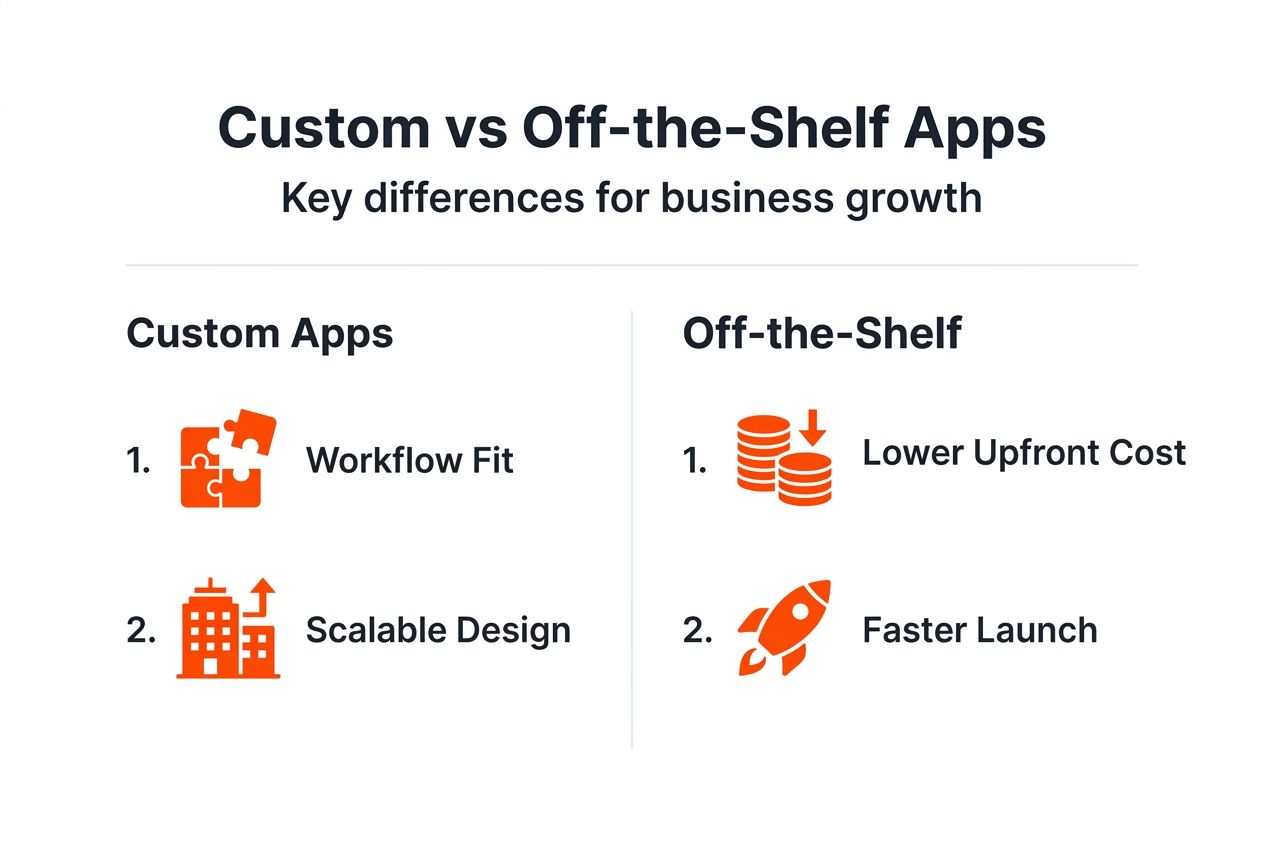
| Feature | Custom Apps | Off-the-Shelf Software |
|---|---|---|
| Workflow Alignment | Designed to match your exact processes and terminology | Generic workflows requiring adaptation and compromise |
| Integration | Seamless connections with existing systems and data sources | Limited APIs often creating data silos and manual transfers |
| Scalability | Built to grow with your business needs and user base | Constrained by vendor roadmap and platform limitations |
| User Experience | Tailored interfaces reflecting brand and user preferences | Standardized UX that may confuse or frustrate users |
| Cost Structure | Higher upfront investment with predictable long-term expenses | Lower initial cost but recurring fees that escalate over time |
| Maintenance | Full control over updates, security, and feature priorities | Dependent on vendor timeline and priorities |
| Competitive Edge | Unique capabilities differentiate your offering | Competitors access identical features and experiences |
When choosing between these options, consider several key criteria. First, assess how closely the software needs to match your unique workflows. If standard processes work fine, off-the-shelf may suffice. However, if your competitive advantage relies on specific operational approaches, custom development becomes essential.
Evaluate integration requirements carefully. Businesses with complex technology ecosystems benefit enormously from custom apps that connect smoothly with existing systems. Generic software often creates frustrating gaps requiring manual data transfers or expensive middleware.
Consider your growth trajectory and scalability needs. Rapidly expanding businesses often outgrow off-the-shelf platforms, facing migration headaches and disruption. Custom apps scale naturally as you add users, features, or geographic markets.
Final decision factors include:
- Budget flexibility and ability to view software as strategic investment versus operational expense
- Timeline urgency balanced against long-term value and competitive positioning
- Internal technical expertise for managing custom solutions or reliance on vendor support
- Brand differentiation importance and customer experience as competitive advantage
Implementing custom app development: Practical steps and strategic considerations
Successful custom app projects follow a structured process that balances technical execution with business strategy. Breaking the journey into clear phases helps manage complexity, reduce risk, and ensure the final product delivers expected value.
-
Conduct thorough business requirement analysis by involving stakeholders across departments. Document current pain points, workflow inefficiencies, and desired outcomes with specific, measurable goals. This foundation prevents scope creep and ensures development efforts target real business needs.
-
Evaluate existing software and identify gaps where current tools fail to support critical processes. Map data flows, integration points, and user interactions to understand how a custom app fits within your technology ecosystem. This assessment reveals opportunities for consolidation and efficiency gains.
-
Choose a development partner with technical and domain expertise matching your industry and project complexity. Review portfolios for similar projects, assess team capabilities across frontend, backend, and UX design, and evaluate their communication style. Cultural fit matters as much as technical skills for successful collaboration.
-
Implement iterative agile development with regular user feedback cycles. Start with core features in a minimal viable product, then enhance based on real-world usage patterns. This approach reduces risk, enables faster time-to-value, and ensures the final product meets actual needs rather than initial assumptions.
-
Plan and execute integration with existing systems early in the development cycle. Address authentication, data synchronization, and API connections as foundational elements rather than afterthoughts. Smooth integration prevents data silos and maximizes the app’s value across your organization.
Pro Tip: Involve end users early to avoid costly redesigns. Regular feedback sessions during development catch usability issues before they become entrenched, saving time and budget while improving adoption rates.
Additional strategic considerations include establishing clear success metrics before development begins. Define how you’ll measure efficiency gains, user adoption, or revenue impact. These metrics guide prioritization decisions and provide objective evidence of ROI.
Consider how expert app development tips can accelerate your project. Experienced teams bring best practices around architecture, security, and user experience that prevent common pitfalls. Their insights often save months of trial and error.
Plan for ongoing evolution and maintenance from the start. Custom apps require updates for security patches, platform changes, and feature enhancements. Budget and resource allocation should account for continuous improvement, not just initial delivery. This mindset ensures your app remains a valuable asset rather than becoming technical debt.
Finally, building scalable apps requires architectural decisions made early that accommodate growth. Choose technologies and design patterns that support increasing user loads, feature complexity, and data volumes without requiring complete rewrites.
Conclusion: Aligning custom apps to business growth objectives
Custom app development represents a strategic investment that aligns technology precisely with unique growth goals. Rather than forcing your business to adapt to generic software constraints, tailored solutions enable you to compete on your terms with differentiated customer experiences and optimized operations.
The measurable improvements in efficiency, engagement, and competitive positioning justify upfront investment when approached strategically. Businesses that view custom apps as growth enablers rather than IT expenses see faster ROI and sustained advantages. Decision-makers should leverage the frameworks and steps outlined here to maximize success with tailored solutions.
Your next steps include assessing current technology gaps, defining clear business outcomes, and selecting development partners with proven expertise in your industry. Starting the development journey confidently requires understanding that custom apps deliver compounding value as your business scales and evolves.
Explore tailored development solutions with Ein-Des-Ein
Ready to transform your business operations with custom app solutions designed specifically for your growth objectives? Ein-Des-Ein brings over 80 skilled professionals across full-cycle web development services and mobile app development to create digital products that drive measurable results.
Our team specializes in building scalable applications that align with your unique workflows, integrate seamlessly with existing systems, and deliver the competitive advantages discussed throughout this article. Whether you need complex UX/UI design, native iOS and Android apps, or custom web applications, we provide the technical expertise and strategic guidance to accelerate your digital transformation.
Partner with experienced developers who understand that successful custom web applications require balancing technical excellence with business objectives. Our agile approach ensures faster delivery cycles, continuous user feedback integration, and transparent communication throughout your project.
Pro Tip: Partnering with experienced developers accelerates your ROI and growth trajectory by avoiding common pitfalls and implementing proven best practices from day one.
Key advantages of working with Ein-Des-Ein include:
- Scalable solutions architected for growth from startups to enterprise
- Expert teams with deep technical proficiency across modern development stacks
- Industry insights that inform strategic decisions and feature prioritization
- Dedicated team options for businesses seeking offshore development partnerships
Frequently asked questions
What is the main difference between custom app development and off-the-shelf software?
Custom apps are tailored to a business’s unique needs, workflows, and competitive requirements. Off-the-shelf software provides generic functionality designed for broad audiences. They differ fundamentally in customization depth, integration flexibility, scalability options, and alignment with specific business processes.
How does custom app development improve operational efficiency?
Custom apps automate repetitive tasks, reduce manual errors, and streamline workflows tailored to specific business processes. This precise alignment minimizes inefficiencies common in generic software that forces workarounds. Teams spend less time on administrative tasks and more on strategic initiatives that drive growth.
What are the key factors to consider when choosing a custom app development partner?
Consider the partner’s domain expertise, technical skills across relevant technologies, and track record with similar projects. Evaluate their agile development capabilities and communication style. Effective collaboration, cultural fit, and shared understanding of business objectives are as essential as technical proficiency for successful outcomes.
Is custom app development suitable for startups with limited budgets?
Yes, startups can pursue minimal viable custom apps focusing on core functions with scalable architecture. This approach balances cost control with rapid market validation and growth potential. Many startups see ROI within 1-2 years through efficiency gains and competitive advantages that generic software cannot provide.
How long does it typically take to develop a custom business app?
Timelines vary by complexity but experienced teams using agile methods can deliver functional apps in a few months. Breaking projects into phases with iterative releases accelerates time-to-value. Continuous iteration with user feedback helps meet deadlines aligned with business priorities while maintaining quality and usability standards.