Web development trends 2026: key insights for startup tech leaders


Many tech leaders still believe legacy frameworks dominate web development in 2026, but they’re missing critical shifts in architecture and tooling that directly impact product scalability and market competitiveness. Understanding modern web development trends isn’t optional anymore for startups and SMEs aiming to build future-proof digital products. This article explores the core architectural evolutions, progressive web application advancements, AI integration in workflows, and practical scalability strategies that define web development in 2026. You’ll gain actionable insights to inform strategic decisions and enhance your product’s technical foundation.
Table of Contents
- Emerging Web Development Architectures And Frameworks In 2026
- Progressive Web Applications Advancements And User Experience
- AI And Automation Shaping Web Development Workflows
- Scalability Strategies And Future-Proofing Web Products
- Transform Your Web Projects With Expert Development Services
- Frequently Asked Questions
Key takeaways
| Point | Details |
|---|---|
| Modern architectures dominate | Jamstack, serverless, and micro frontends enable faster deployment and independent scaling for startup products. |
| PWAs deliver native experiences | Enhanced offline capabilities and responsive design boost user engagement without native app overhead. |
| AI accelerates development | Automation tools reduce time-to-market while enabling dynamic personalization at scale. |
| Scalability requires early planning | Proactive architecture decisions and performance monitoring prevent costly failures as products grow. |
Emerging web development architectures and frameworks in 2026
The shift from monolithic frameworks to decoupled architectures has fundamentally changed how startups build and scale web products. Modern architectures like Jamstack and micro frontends enhance scalability and developer efficiency, allowing teams to deploy updates independently without risking system-wide failures. Jamstack separates the frontend from backend services, serving pre-rendered content through CDNs for lightning-fast load times. Serverless computing eliminates infrastructure management, letting developers focus on code while automatically scaling based on demand.
Micro frontends extend microservices principles to the client side, enabling different teams to own discrete interface sections. This architectural pattern proves especially valuable for startups experiencing rapid growth, as new features can ship without coordinating massive deployments across the entire codebase. Each micro frontend operates independently, reducing bottlenecks and accelerating iteration cycles.
Comparison of legacy versus modern frameworks:
| Approach | Strengths | Limitations | Best For |
|---|---|---|---|
| Legacy monoliths | Familiar patterns, extensive documentation | Slower deployments, scaling challenges | Stable products with infrequent updates |
| Jamstack | Superior performance, enhanced security | Learning curve for traditional teams | Content-heavy sites needing speed |
| Serverless | Auto-scaling, reduced ops overhead | Cold start latency, vendor lock-in | Event-driven apps with variable traffic |
| Micro frontends | Team autonomy, independent releases | Coordination complexity, larger bundles | Large products with multiple feature teams |
Frameworks leading adoption in 2026 include Next.js for its hybrid rendering capabilities, Remix for its data-loading optimizations, and Astro for content-focused sites requiring minimal JavaScript. These tools prioritize developer experience while delivering exceptional performance metrics that directly impact user retention and conversion rates.
Key benefits driving this architectural evolution:
- Decoupled development allows frontend and backend teams to work simultaneously without blocking each other
- CDN distribution reduces latency for global users, improving engagement across geographic markets
- Incremental adoption lets teams migrate gradually rather than requiring risky big-bang rewrites
- Enhanced security through reduced attack surface area and static content delivery
Pro Tip: Optimize your continuous integration pipelines to leverage serverless benefits by implementing automated testing and deployment workflows that trigger on every commit, ensuring rapid feedback cycles and reducing integration issues.
Progressive web applications advancements and user experience
Progressive web apps have matured significantly, offering capabilities that rival native applications while maintaining web accessibility and discoverability. Progressive web apps have evolved with advanced caching and offline support, boosting user engagement by delivering consistent experiences regardless of network conditions. In 2026, PWAs support push notifications, background sync, and hardware access that were previously exclusive to native apps.
The strategic value for startups centers on eliminating app store friction while maintaining high-quality user experiences. Users can install PWAs directly from browsers, bypassing lengthy approval processes and reducing acquisition costs. Updates deploy instantly without requiring user action, ensuring everyone accesses the latest features simultaneously.
Improving PWA offline functionality:
- Implement service workers to intercept network requests and serve cached content when connectivity fails, ensuring core features remain accessible.
- Design a clear offline UI that communicates network status and queues user actions for automatic sync when connection restores.
- Cache critical assets and API responses strategically, prioritizing frequently accessed content while managing storage limits.
- Test offline scenarios rigorously across devices and network conditions to identify edge cases before users encounter them.
- Implement background sync APIs to handle form submissions and data updates that occur while offline, preventing data loss.
PWAs significantly impact user engagement metrics for startups. Faster load times reduce bounce rates, while offline capabilities keep users productive during connectivity interruptions. The installation prompt creates a persistent presence on user devices without the commitment barrier of traditional app downloads. For SMEs with limited resources, PWAs offer a cost-effective path to mobile presence without maintaining separate native codebases.
Enhancements in 2026 focus on bridging the remaining gaps with native apps. File system access APIs enable document editing workflows, while advanced camera integrations support augmented reality features. Payment request APIs streamline checkout flows, reducing friction in e-commerce experiences. These capabilities empower startups to build sophisticated products using web technologies, accelerating development while maintaining cross-platform compatibility.
Pro Tip: Prioritize accessibility and responsive design in PWA development by testing with screen readers and keyboard navigation from the start, ensuring your application serves diverse user needs and complies with evolving accessibility standards.
AI and automation shaping web development workflows
Artificial intelligence has transitioned from experimental to essential in web development workflows, fundamentally changing how teams write code, test applications, and deploy updates. AI integration in web development accelerates delivery and enables dynamic personalization by automating repetitive tasks and providing intelligent suggestions that improve code quality. In 2026, AI-powered tools assist at every stage of the development lifecycle.

Code generation tools analyze requirements and produce boilerplate code, reducing manual effort for common patterns. These systems learn from your codebase, suggesting implementations that match your team’s style and architectural decisions. Automated testing frameworks use AI to generate test cases, identifying edge cases human developers might overlook. This comprehensive coverage catches bugs earlier, reducing costly fixes in production.
Deployment automation has evolved beyond simple continuous integration. AI systems analyze application performance, automatically scaling resources based on predicted traffic patterns. They detect anomalies in real time, triggering rollbacks before users experience issues. This proactive approach minimizes downtime and maintains consistent user experiences during traffic spikes.
Personalization represents AI’s most visible impact on user-facing features. Machine learning models analyze behavior patterns, dynamically adjusting content, layouts, and recommendations for individual users. This level of customization was previously feasible only for companies with massive data science teams. Now, startups can implement sophisticated personalization using accessible AI services.
Leading AI technologies in 2026 web development:
- GitHub Copilot and similar code assistants provide context-aware suggestions, accelerating feature development
- Automated accessibility testing tools scan interfaces for WCAG compliance issues, ensuring inclusive design
- Performance optimization engines analyze runtime behavior and suggest code improvements automatically
- Natural language interfaces let non-technical stakeholders query analytics and generate reports without developer intervention
- Predictive scaling systems adjust infrastructure resources before traffic patterns change, optimizing costs
Adopting AI workflows requires careful consideration. Teams must balance automation benefits against the need to understand underlying systems. Over-reliance on generated code can create technical debt if developers don’t review and refine suggestions. Privacy concerns emerge when AI systems process user data for personalization, requiring transparent data handling practices.
Successful AI integration starts small. Identify repetitive tasks consuming significant developer time, then introduce focused automation tools. Measure impact on velocity and code quality before expanding adoption. Train teams to work effectively with AI assistants, emphasizing critical evaluation of generated code rather than blind acceptance.
Scalability strategies and future-proofing web products
Scalability failures cost startups customers, revenue, and reputation when products can’t handle growth. Building scalable apps effectively reduces failure rates by 60% by addressing performance bottlenecks and architectural limitations before they impact users. Common pitfalls include database designs that don’t accommodate increased load, monolithic architectures that can’t scale components independently, and insufficient monitoring that hides problems until they become critical.
Many startups optimize prematurely, adding complexity for theoretical scale they may never reach. Others ignore scalability entirely, building prototypes that collapse under real-world usage. The optimal approach balances current needs with future flexibility, making architectural decisions that support growth without over-engineering.
Comparison of scaling approaches:
| Strategy | Implementation Effort | Cost Efficiency | Flexibility | Ideal Scenario |
|---|---|---|---|---|
| Vertical scaling | Low | Moderate | Limited | Predictable, gradual growth |
| Horizontal scaling | High | High | Excellent | Variable traffic, rapid growth |
| Database sharding | Very high | Moderate | Limited | Massive datasets, geographic distribution |
| Caching layers | Moderate | Very high | Good | Read-heavy workloads |
| Async processing | Moderate | High | Excellent | Background tasks, batch operations |
Roadmap to future-proof web app architecture:
- Design stateless application layers that store session data externally, enabling seamless horizontal scaling as traffic increases.
- Implement comprehensive logging and monitoring from day one, establishing baselines for normal behavior before problems emerge.
- Choose managed services for databases and infrastructure when possible, leveraging provider expertise for scaling and reliability.
- Build APIs with versioning from the start, allowing backward-compatible changes as your product evolves and client needs change.
- Establish performance budgets for page load times and API response latency, treating performance as a feature requirement.
- Plan data architecture for growth by normalizing appropriately and indexing strategically, avoiding costly migrations later.
- Implement feature flags to control rollouts and quickly disable problematic features without deploying code changes.
Performance monitoring reveals how real users experience your application, identifying bottlenecks invisible in development environments. Track core web vitals, API latency, and error rates continuously. Set alerts for degradation before metrics cross critical thresholds. This proactive stance prevents user-impacting incidents.
Cloud-native services provide building blocks for scalable architectures. Managed databases handle replication and failover automatically. Message queues enable asynchronous processing, preventing slow operations from blocking user requests. Content delivery networks cache static assets globally, reducing origin server load.
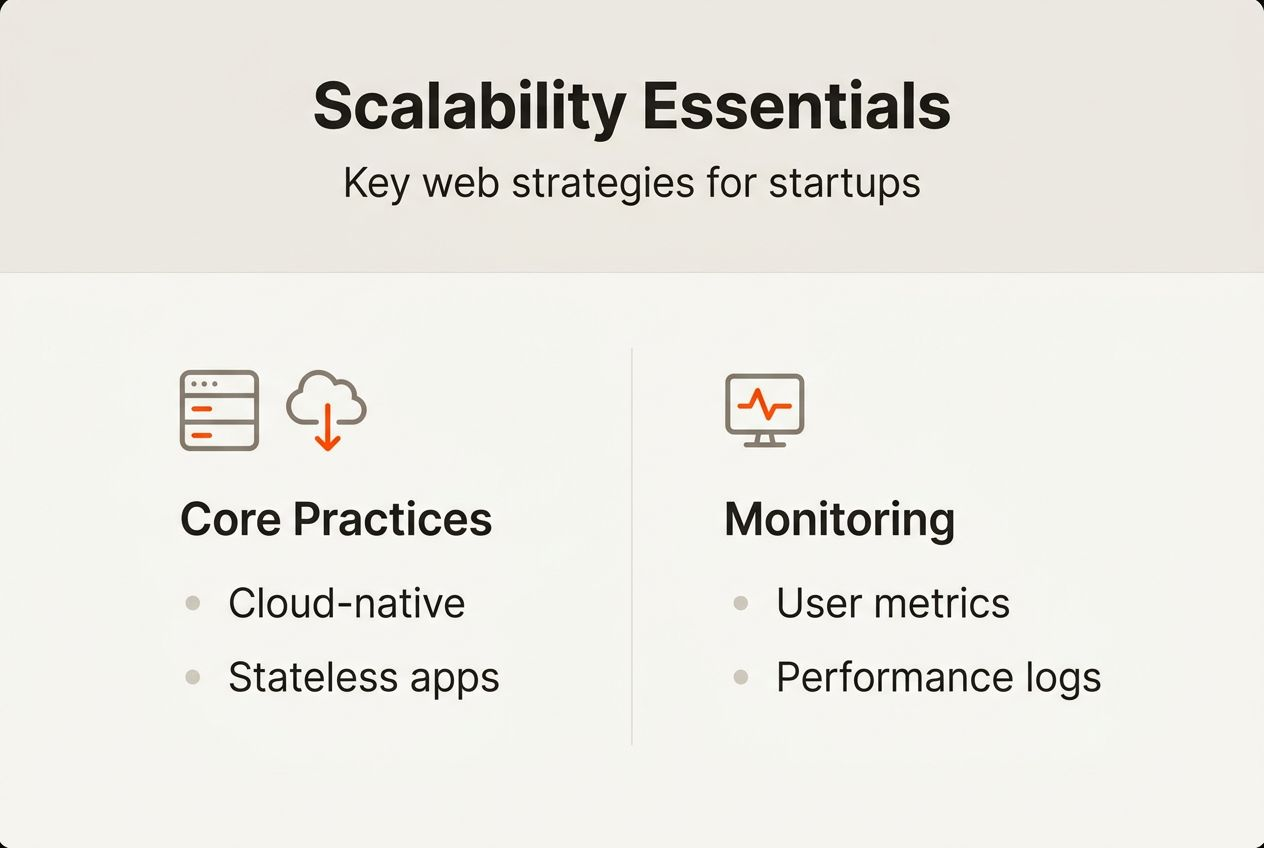
Pro Tip: Invest in performance monitoring and cloud-native services early, even when current traffic seems manageable, because establishing these foundations costs far less than retrofitting them during a scaling crisis when every minute of downtime damages your reputation.
Transform your web projects with expert development services

Implementing these 2026 web development trends requires specialized expertise across modern frameworks, progressive web applications, and scalable architectures. Ein-Des-Ein brings over 80 professionals with deep experience in web development services that align with current best practices and emerging technologies. Our team has successfully delivered custom applications for startups and SMEs, focusing on solutions that grow with your business.
We provide full-cycle development encompassing backend systems built with Node.js and Python, frontend experiences using React and modern frameworks, and comprehensive UX and UI design services that prioritize user engagement. Our mobile app development services extend your digital presence across platforms, ensuring consistent experiences whether users access your product via web or native apps. We also specialize in organizing dedicated offshore teams, giving you direct access to skilled developers who integrate seamlessly with your existing processes. Let’s discuss how we can help you leverage these trends to build scalable, future-proof digital products.
Frequently asked questions
What are the most impactful web development trends in 2026?
The most impactful trends include modern architectures like Jamstack and serverless computing that enhance scalability, progressive web applications delivering native-like experiences without app store friction, and AI integration automating development workflows while enabling sophisticated personalization. These trends collectively reduce time-to-market and improve product quality for startups and SMEs. Understanding and implementing these web development trends positions your products for competitive advantage.
How do progressive web apps benefit startups compared to native applications?
PWAs eliminate app store approval delays and reduce development costs by maintaining a single codebase for all platforms. Users can install them directly from browsers without download friction, while updates deploy instantly without requiring user action. This approach accelerates iteration cycles and reduces customer acquisition costs significantly. For resource-constrained startups, PWAs offer an efficient path to mobile presence without sacrificing user experience quality.
What should startups prioritize when adopting AI in development workflows?
Start by identifying repetitive tasks consuming significant developer time, then introduce focused automation tools for those specific pain points. Measure impact on velocity and code quality before expanding adoption across your workflow. Train teams to critically evaluate AI-generated code rather than accepting suggestions blindly, maintaining code quality standards. Balance automation benefits against the need for developers to understand underlying systems and architectural decisions.
How can SMEs build scalable web applications without over-engineering?
Focus on stateless application design and managed cloud services that handle scaling automatically as your needs grow. Implement comprehensive monitoring from the start to identify actual bottlenecks rather than optimizing theoretical problems. Choose architectures that support incremental enhancement, allowing you to add complexity only when metrics justify the investment. This balanced approach prevents both premature optimization and scaling crises.
What architectural decisions most impact long-term product scalability?
Designing stateless application layers, implementing proper database indexing strategies, and choosing managed services for infrastructure create the strongest foundation for growth. Early investment in monitoring and performance tracking prevents costly retrofits later. Building APIs with versioning support and using feature flags for controlled rollouts provide flexibility as requirements evolve. These decisions compound over time, making future scaling significantly easier and less risky.