What is custom app development? A 2026 business guide


Nearly 70% of businesses struggle with off-the-shelf software that cannot adapt to their unique workflows, forcing teams into inefficient workarounds that slow growth. Custom app development offers a solution by creating tailored digital tools designed specifically for your business needs. For startups and SMEs seeking scalable online presence and operational efficiency, understanding custom app development is essential. This guide explains what custom app development is, how architecture choices impact your project, and why the right technology decisions can transform your business operations.
Table of Contents
- What Is Custom App Development? Understanding The Basics
- Choosing The Right Architecture: Monolith Vs Microservices
- Key Benefits Of Custom App Development For Startups And SMEs
- Critical Technology Choices: Building A Scalable, Maintainable App
- Explore Custom App Development Services With Ein-Des-Ein
- Frequently Asked Questions
Key takeaways
| Point | Details |
|---|---|
| Tailored solutions | Custom app development creates digital tools designed specifically for your business workflows and goals. |
| Architecture matters | Choosing between monolith and microservices affects scalability, costs, and maintenance complexity. |
| Efficiency gains | Custom apps improve operational efficiency by up to 30% through automation and workflow optimization. |
| Technology selection | Picking the right tech stack based on team skills and project scope ensures long-term maintainability. |
| Real cost savings | Strategic architecture choices, like Amazon’s monolith shift, can reduce infrastructure costs by over 90%. |
What is custom app development? Understanding the basics
Custom app development means building unique software tailored to your specific business workflows and goals rather than adapting your operations to fit generic tools. Unlike off-the-shelf software that serves broad markets with standardized features, custom software development allows businesses to create solutions addressing their exact pain points and competitive needs. This approach delivers increased efficiency and competitive advantage by aligning technology precisely with how your team works.
The difference between custom apps and standard websites goes beyond visual design. Custom applications include sophisticated authentication systems, complex business logic, real-time data processing, and integrations with existing tools. A standard website might display information and collect leads, while a custom app actively manages inventory, automates approval workflows, or generates analytics dashboards tailored to your KPIs. These capabilities transform how teams operate daily.
Benefits of custom app development include:
- Seamless integration with existing business processes and legacy systems
- Scalability designed around your growth trajectory and user base
- Competitive differentiation through unique features unavailable in generic software
- Complete control over data security, compliance, and privacy measures
- Flexibility to pivot and add features as market conditions change
Consider how a custom web app might automate your client onboarding process. Instead of manually copying data between spreadsheets and CRM systems, a tailored solution could capture information once, validate it automatically, trigger welcome emails, assign team members, and create project timelines without human intervention. This level of workflow optimization simply is not possible with generic tools built for mass markets.
Mobile-first design has become crucial for user experience. Your customers and employees increasingly access business tools from smartphones and tablets, expecting responsive interfaces that work flawlessly across devices. Custom app development lets you prioritize mobile experiences from day one, ensuring your solution meets users where they already spend their time rather than forcing desktop-only workflows.
Choosing the right architecture: monolith vs microservices
Architecture decisions shape everything about your custom app, from development speed to long-term costs and scalability potential. The two primary approaches are monolithic architecture, where all components exist in a single codebase, and microservices architecture, which splits functionality into independent services that communicate through APIs. Understanding trade-offs helps you choose wisely based on your business context and team capabilities.
Microservices architecture offers compelling advantages for certain scenarios. Independent scaling and technology flexibility let teams choose the best tool for each service and scale only the components experiencing high demand. A payment processing service might need different resources than a reporting dashboard, and microservices let you optimize each separately. Faster deployment becomes possible when small teams own specific services and can update them without coordinating across the entire application.
However, microservices introduce significant challenges that many businesses underestimate. Distributed systems complexity means you are now managing network calls, service discovery, data consistency across services, and failure modes that do not exist in simpler architectures. Debugging becomes harder when a single user request touches five different services, each with its own logs and monitoring. Latency increases as services communicate over networks instead of in-process function calls. Operational overhead grows with separate deployment pipelines, monitoring systems, and infrastructure for each service.
Modular monoliths provide an often-overlooked middle ground. Well-structured monoliths organize code into clear module boundaries with defined interfaces, delivering organizational benefits without distributed systems complexity. Simpler deployment means one application to test, version, and release rather than coordinating multiple services. Easier refactoring lets you move code between modules without changing network protocols or managing backward compatibility across service boundaries. Lower initial costs matter enormously for startups watching every dollar.
Real-world evidence challenges the microservices hype. Amazon Prime Video reduced costs by over 90% by consolidating their audio-video monitoring from microservices into a monolith, eliminating network overhead and simplifying operations. This dramatic improvement came from a company with world-class engineering talent and unlimited resources, suggesting smaller teams should think carefully before choosing distributed architectures.
| Architecture | Best for | Challenges |
|---|---|---|
| Microservices | Large teams, independent scaling needs, polyglot requirements | High complexity, debugging difficulty, network latency, operational overhead |
| Modular monolith | Startups, small teams, evolving requirements, cost-conscious projects | Potential scaling limits, deployment coordination, shared database constraints |
| Hybrid approach | Growing businesses transitioning from monolith | Managing both architectures, migration complexity, skill requirements |
Pro Tip: Start with a well-designed modular monolith unless you have specific evidence that microservices solve a real problem you face today. You can always extract services later when genuine scaling needs emerge, but premature distribution creates complexity you will fight for years. Consider your team’s experience with distributed systems honestly before committing to microservices architecture.
Choosing architecture based on scalable growth needs means evaluating your actual business trajectory, not theoretical future scenarios. A startup with 100 users has radically different needs than an enterprise with millions of transactions daily. Match your architecture to your current reality with room to evolve, rather than over-engineering for problems you might never face.
Key benefits of custom app development for startups and SMEs
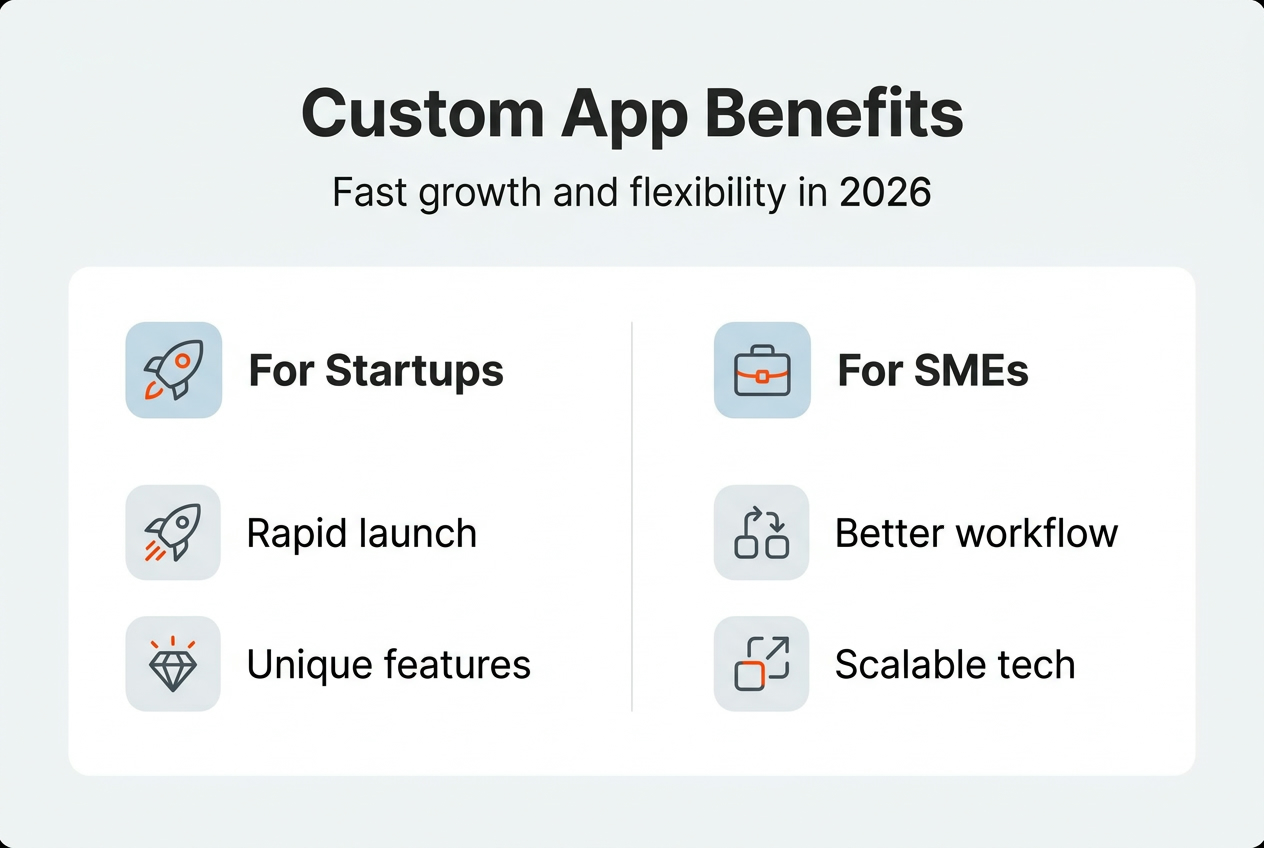
Custom app development delivers measurable business advantages that directly impact your bottom line and competitive position. Operational efficiency increases of 20-30% come from tailored workflows that eliminate manual data entry, reduce errors, and automate repetitive tasks your team currently handles by hand. When software matches exactly how your business operates, employees spend time on high-value activities instead of fighting generic tools that almost fit your needs.

Scalability improvements through custom architecture mean your digital infrastructure grows alongside your business without expensive platform migrations or painful rewrites. You design data models, API structures, and system integrations with your growth trajectory in mind from day one. A retail startup planning international expansion can build multi-currency support and localization into their custom app initially, avoiding the costly retrofitting required when outgrowing off-the-shelf e-commerce platforms.
Enhanced online presence and customer satisfaction emerge from mobile-first, user-centric designs that prioritize your specific audience needs over generic user experiences. Custom apps let you create unique customer journeys, personalized dashboards, and branded interactions that differentiate your business in crowded markets. Your competitors using the same generic SaaS tools all look alike, while your custom solution reflects your brand identity and service philosophy.
AI-powered automation in custom software dramatically reduces manual tasks and improves data accuracy beyond what generic tools offer. Consider automated mileage tracking that uses GPS data to generate expense reports without employees manually logging trips. Or invoice processing that extracts line items, matches them to purchase orders, and routes approvals based on your specific business rules. These tailored automations eliminate entire categories of administrative overhead.
Specific benefits include:
- Competitive advantage through unique features unavailable to competitors using standard software
- Better data accuracy from validation rules matching your exact business requirements
- Flexibility to adapt quickly when market conditions or regulations change
- Complete ownership of your technology stack and intellectual property
- Integration capabilities connecting all your business systems seamlessly
- Custom reporting and analytics aligned with your specific KPIs and decision-making needs
The financial impact becomes clear when you calculate time saved across your entire team. If custom automation saves each of 20 employees just 30 minutes daily, that is 10 hours recovered every day or roughly 2,600 hours annually. At an average fully-loaded cost of $50 per hour, you have created $130,000 in annual value. This calculation does not even account for error reduction, faster customer response times, or improved decision-making from better data.
For startups and SMEs, custom software advantages extend beyond immediate efficiency to strategic positioning. Your custom app becomes a moat that competitors cannot easily replicate, especially when it encodes deep knowledge of your market, customer needs, and operational processes. Generic software levels the playing field, while custom solutions let you pull ahead.
Deciding to invest in app development requires weighing upfront costs against long-term value creation. The key is matching investment to genuine business needs rather than building features you hope might be useful someday. Start with core workflows causing the most pain or offering the biggest efficiency gains, then expand as you prove value and generate returns.
Critical technology choices: building a scalable, maintainable app
Selecting the right technology stack determines whether your custom app remains flexible and cost-effective or becomes a maintenance nightmare requiring constant firefighting. Scalable, maintainable technologies aligned with your team’s capabilities and business goals create a foundation for sustainable growth. Poor technology choices, even with good intentions, can lock you into expensive rewrites or force you to hire rare specialists for basic updates.
Evaluating technology requires balancing multiple factors simultaneously. Start by defining clear project goals including performance requirements, expected user load, integration needs, and timeline constraints. Assess your development team’s expertise honestly because a brilliant technology your team cannot maintain creates long-term problems. Investigate community support and ecosystem maturity since popular technologies offer more libraries, tools, and available talent. Consider future growth scenarios to ensure your stack can scale without fundamental rewrites.
Modular design principles and automated testing dramatically improve maintainability over time. Breaking your application into well-defined modules with clear interfaces lets you update components independently without cascading changes throughout the codebase. Automated test suites catch regressions before they reach production, giving teams confidence to refactor and improve code continuously. These practices matter more than specific technology choices for long-term success.
| Technology stack | Best for | Key considerations |
|---|---|---|
| Node.js + React | Real-time apps, JavaScript teams, rapid prototyping | Large ecosystem, potential callback complexity, memory management |
| Python + Django | Data-heavy apps, AI/ML integration, admin panels | Excellent libraries, slower runtime, strong community support |
| .NET Core + Angular | Enterprise apps, Microsoft ecosystem, complex business logic | Robust tooling, steeper learning curve, excellent performance |
| Ruby on Rails | Startups, rapid development, conventional over configuration | Fast initial development, scaling challenges, smaller talent pool |
Pro Tip: Resist the temptation to choose cutting-edge technologies just because they are exciting or mentioned in tech blogs. Proven, boring technologies with large communities and extensive documentation reduce risk dramatically. You want to solve business problems, not become an early adopter debugging framework issues. Save experimentation for non-critical components where failure has limited impact.
Action steps to pick and validate your tech stack:
- List your must-have requirements including performance targets, integration needs, and compliance requirements specific to your industry.
- Inventory your team’s current skills and realistic learning capacity given project timelines and business pressures.
- Research 3-5 candidate stacks that match your requirements and team capabilities, focusing on proven combinations used successfully in similar projects.
- Build small proof-of-concept prototypes testing critical technical risks like third-party integrations or performance bottlenecks before committing.
- Evaluate long-term costs including hosting, licensing, and talent availability for ongoing maintenance and feature development.
- Make a decision based on evidence from prototypes and team feedback rather than theoretical advantages or personal preferences.
Choosing the right technology stack requires considering scalability, maintainability, and your development team’s skills as equal priorities. A stack that scales brilliantly but your team cannot maintain creates different problems than one that is easy to work with but cannot handle growth. The best choice balances these factors for your specific situation.
Building complex web applications successfully means accepting that technology is a means to business ends, not an end in itself. Your customers care about whether your app solves their problems reliably and quickly, not which framework you chose. Pick technologies that let you deliver value consistently while keeping costs reasonable and your team productive.
Explore custom app development services with Ein-Des-Ein
Transforming your business through custom app development requires experienced partners who understand both technology and business strategy. Ein-Des-Ein specializes in creating tailored digital solutions for startups and SMEs seeking scalable growth and enhanced online presence. With over 80 professionals skilled in full-cycle development, the team delivers custom web applications, mobile apps, and enterprise solutions aligned with your specific business objectives.

Whether you need web development services to build complex business applications, mobile app development for iOS and Android platforms, or enterprise app development integrating with existing systems, Ein-Des-Ein’s expertise spans the technologies and methodologies discussed in this guide. The agency also helps you organize dedicated offshore development teams, giving you access to specialized talent while maintaining control over your project direction and priorities.
Frequently asked questions
What is the typical cost of custom app development?
Cost varies widely based on project scope, complexity, and chosen architecture, typically ranging from $50,000 for simple applications to $500,000+ for enterprise solutions. Custom apps require higher upfront investment than off-the-shelf software but deliver better ROI through efficiency gains and competitive advantages. Budget for ongoing maintenance and feature development, usually 15-20% of initial development costs annually. Hidden costs emerge from poor planning, so invest time in detailed requirements and architecture decisions before coding begins.
How long does it take to develop a custom app?
Development timelines range from 8-12 weeks for minimum viable products to 6-12 months for complex enterprise applications depending on scope and team size. Iterative development processes with regular stakeholder feedback help speed delivery and reduce costly revisions from misunderstood requirements. Clear, detailed requirements gathered upfront prevent scope creep and timeline extensions. Phased releases let you launch core functionality quickly while building advanced features based on real user feedback.
Can startups afford custom app development?
Custom development becomes cost-effective when aligned with growth plans and long-term ROI expectations rather than viewed as pure expense. Startups should focus on building minimum viable products that solve core problems, then expand features as revenue grows and needs become clearer. Phased development and MVP approaches help control costs while validating business assumptions before major investment. Many startups find custom apps pay for themselves within 12-18 months through efficiency gains and revenue growth enabled by better tools.
What are the key factors to choose a development partner?
Consider technical expertise in your required technologies, portfolio demonstrating similar project complexity, and communication style matching your preferences. Cultural fit matters enormously for long-term partnerships since you will work closely through challenges and changes. Check for specific experience in your industry since domain knowledge accelerates development and reduces misunderstandings. Verify their approach to testing, documentation, and knowledge transfer so you are not locked into a single vendor forever.