Build a business growth workflow that scales in 2026


Many small to medium-sized businesses and tech startups struggle to organize effective growth workflows that leverage digital tools and teams. Misalignment between business goals and technology causes nearly 60% of digital growth projects to fail due to inefficient resource use and poor strategic alignment. This guide offers a practical roadmap to build scalable workflows tailored to your business, helping you coordinate teams, tools, and objectives to drive sustainable growth in 2026 and beyond.
Table of Contents
- Understanding Business Growth Workflows
- Prerequisites And What You Need
- Core Steps To Build A Growth Workflow
- Organizing A Dedicated Development Team
- Troubleshooting Common Mistakes
- Cost And Timeline Considerations
- Alternative Approaches And Tradeoffs
- Expected Results And Outcomes
- Explore Custom Development Services For Your Growth
Key takeaways
| Point | Details |
|---|---|
| Core workflow components | Effective growth workflows integrate clear goals, aligned teams, appropriate tools, and structured processes to connect business strategy with technology execution. |
| Team organization options | Dedicated offshore teams reduce costs by 40% while enabling frequent development cycles, compared to traditional in-house setups. |
| Common failure points | Over 60% of project failures stem from business-technology misalignment, poor communication, and skipping prerequisite planning steps. |
| Cost and timeline planning | Typical SMB digital projects range from $30,000 to $150,000 with 3 to 6 month timelines to initial rollout. |
| Custom vs off-the-shelf tradeoffs | Off-the-shelf software may reduce scalability potential by up to 60% compared to custom solutions built for your specific growth needs. |
Understanding business growth workflows
A business growth workflow represents the structured process that aligns your strategic objectives with digital technology execution. It encompasses four core components: clearly defined growth goals, organized teams with appropriate skill sets, tailored digital tools and platforms, and documented processes that connect everything together. These workflows serve as the operational framework for successful digital transformations.
For SMBs and startups, workflows bridge the gap between ambitious business strategy and practical technology implementation. Without this connection, teams work in silos, tools remain underutilized, and resources get wasted on initiatives that don’t drive measurable growth. Aligning business objectives with digital workflows significantly improves project success rates by ensuring every technical decision supports your broader business goals.
Effective workflows create accountability and transparency across your organization. They establish clear ownership for tasks, define communication protocols between business and technology teams, and provide metrics to measure progress. This structure becomes especially critical as you scale, allowing you to replicate successful processes and avoid repeating past mistakes.
Key workflow components include:
- Strategic goal definition tied to measurable business outcomes
- Team structure with defined roles and responsibilities
- Technology stack selection based on scalability requirements
- Communication protocols between stakeholders
- Iterative development cycles with feedback loops
- Performance monitoring and optimization processes
Prerequisites and what you need
Before building growth workflows, you need foundational elements in place. Start with your technology stack decisions. Modern scalable applications typically leverage technologies like Node.js for backend services, React for frontend interfaces, and TypeScript for type-safe code that reduces errors. Your specific stack depends on your product requirements, but choosing proven technologies with strong community support reduces risk.
Your team requires diverse skill sets beyond pure development. You need technical developers comfortable with your chosen stack, UX/UI designers who understand user behavior, and project managers who can translate business requirements into technical specifications. This cross-functional composition ensures your workflow addresses both technical feasibility and business viability. Clear business objectives and technology alignment reduces project rework and delays by ensuring everyone understands priorities from day one.
Business-technology alignment stands as the most critical prerequisite. Your leadership team must articulate specific growth targets like revenue increases, market expansion, or customer retention improvements. Technology teams then map these goals to technical capabilities, identifying which features deliver the highest business impact. This alignment prevents the common scenario where development teams build technically impressive products that fail to move business metrics.
Communication protocols deserve deliberate design before workflow execution begins. Establish regular touchpoints between business stakeholders and technical teams, define escalation paths for blockers, and create shared documentation that both groups can reference. Tools like project management platforms, collaborative design software, and version control systems form the infrastructure for effective communication.
Essential prerequisites checklist:
- Documented business growth objectives with specific metrics
- Selected technology stack aligned with scalability needs
- Cross-functional team with development, design, and management skills
- Communication tools and protocols established
- Budget allocation for development, infrastructure, and ongoing maintenance
- Timeline expectations based on realistic development cycles
Pro Tip: Start with a minimum viable product scope that addresses one core business objective rather than trying to build everything at once. This focused approach lets you validate assumptions quickly and adjust your workflow based on real user feedback.
Consider how scalable web applications require thoughtful architecture from the start to avoid costly rebuilds as you grow.
Core steps to build a growth workflow
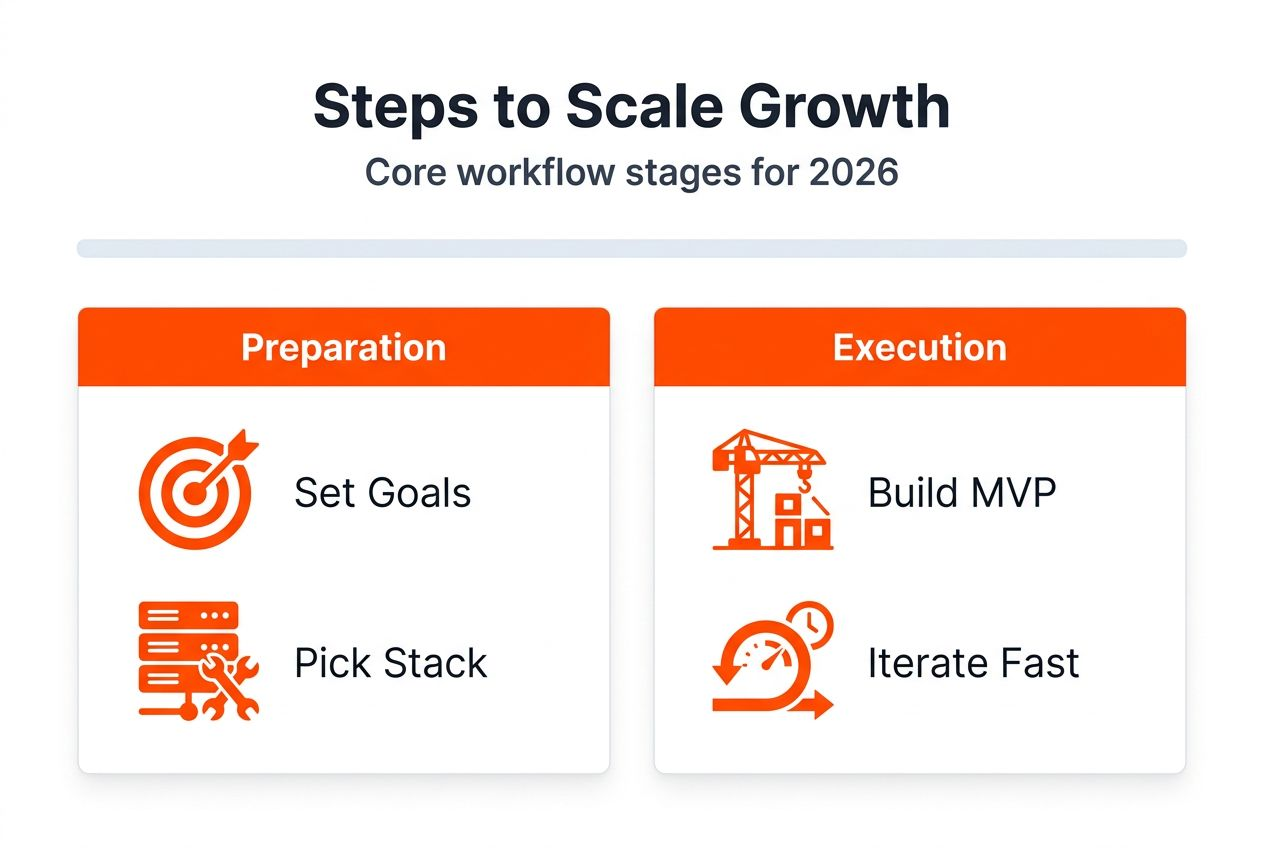
Building an effective growth workflow follows a structured sequence that moves from strategy to execution. These steps provide a proven framework that adapts to different business contexts while maintaining core principles that drive success.
-
Define measurable growth objectives aligned with business strategy. Identify specific metrics like customer acquisition cost reduction, revenue per user increase, or market share expansion. Translate these into technical requirements that development teams can address.
-
Select digital tools and platforms tailored to your objectives. Choose technologies that support your specific use case rather than adopting trendy tools. Consider factors like scalability, integration capabilities, development speed, and long-term maintenance requirements.
-
Organize your team structure based on project scope and timeline. Decide whether dedicated internal teams, offshore development partners, or hybrid models best serve your needs. Factor in budget constraints, required expertise, and communication preferences.
-
Establish iterative development cycles with continuous feedback. Break large initiatives into smaller releases that deliver incremental value. This approach lets you validate assumptions, gather user feedback, and adjust direction without wasting resources on wrong assumptions.
-
Implement monitoring and optimization processes from day one. Define key performance indicators that connect technical metrics to business outcomes. Track both leading indicators like deployment frequency and lagging indicators like customer retention.
-
Create documentation that captures decisions, processes, and learnings. This knowledge base becomes invaluable as your team grows, helping new members understand context and preventing repeated mistakes.
Iterative development and continuous improvement accelerate time-to-market and adaptability by allowing course corrections based on real-world data rather than assumptions.
Pro Tip: Schedule weekly alignment meetings between business and technology leaders during initial workflow setup. These sessions surface misunderstandings early and build shared context that prevents costly misalignment down the road.
The sequence matters because each step builds on previous foundations. Jumping directly to tool selection without clear objectives leads to technology choices that don’t serve business needs. Similarly, organizing teams before defining scope results in mismatched capabilities. Follow the sequence while remaining flexible enough to iterate based on what you learn. Understanding how to build scalable workflows from the ground up prevents technical debt that slows future growth.
Organizing a dedicated development team
Team organization significantly impacts both workflow effectiveness and project economics. You face three primary models: dedicated internal teams, offshore development teams, and hybrid approaches that combine both. Each offers distinct advantages depending on your situation.
Dedicated internal teams provide maximum control and cultural alignment. Team members work exclusively on your projects, understand your business deeply, and integrate seamlessly with other departments. However, this model carries the highest costs including salaries, benefits, office space, and equipment. Timeline to build effective internal teams often spans 6 to 12 months when accounting for recruiting, onboarding, and team formation.

Offshore dedicated teams offer cost advantages while maintaining the dedicated focus of internal teams. Dedicated offshore teams reduce costs by 40% and improve update frequency by providing access to skilled developers at lower hourly rates. This model works especially well for SMBs and startups needing specialized expertise without the overhead of full-time employees. Setup timelines run shorter at 2 to 4 months since you leverage existing talent pools.
Hybrid models combine strategic internal leadership with offshore execution capacity. You might maintain internal product managers and architects while partnering with offshore teams for implementation. This approach balances control with cost efficiency, though it requires strong communication processes to coordinate across locations and time zones.
| Team Model | Average Cost | Setup Timeline | Best For |
|---|---|---|---|
| Dedicated Internal | $120,000 to $180,000 per developer annually | 6 to 12 months | Companies with complex IP requirements and high margins |
| Offshore Dedicated | $40,000 to $70,000 per developer annually | 2 to 4 months | SMBs and startups prioritizing cost efficiency and speed |
| Hybrid Model | $70,000 to $120,000 blended rate | 3 to 6 months | Organizations needing strategic control with execution scalability |
Successful team organization regardless of model requires:
- Clear role definitions and responsibilities
- Established communication rhythms across time zones
- Shared tools for collaboration and code management
- Cultural integration efforts to build team cohesion
- Performance metrics aligned with business outcomes
Learn more about offshore team setup strategies that improve collaboration by 35% through structured communication protocols. Consider how dedicated development teams enable scalability by providing flexible capacity that grows with your needs.
Troubleshooting common mistakes
Understanding failure patterns helps you avoid expensive mistakes that derail growth workflows. Over 60% of failures result from business-technology misalignment where teams build solutions that don’t address actual business needs. This happens when technical teams work in isolation without regular business stakeholder input.
Poor communication practices create information silos that slow progress and multiply errors. When developers don’t understand business context, they make architectural decisions that limit future capabilities. When business leaders don’t grasp technical constraints, they set unrealistic expectations that frustrate teams and waste budget. Establish regular cross-functional meetings where both groups share updates in accessible language.
Skipping prerequisite setups tempts teams eager to show fast progress. Jumping into development without clear objectives, agreed technology choices, or team alignment creates technical debt that compounds over time. You might ship features quickly at first, but soon face performance issues, security vulnerabilities, or architectural limitations that require expensive rebuilds.
Neglecting iterative improvement processes leads to outdated workflows that don’t adapt to changing market conditions. Your initial workflow design won’t be perfect, and business needs evolve as you grow. Without regular retrospectives and optimization cycles, you accumulate inefficiencies that slow execution and frustrate team members.
Common mistakes to avoid:
- Launching without documented business objectives tied to metrics
- Choosing technologies based on trends rather than requirements
- Underestimating communication needs across distributed teams
- Skipping user research and validation before building features
- Failing to monitor performance and optimize based on data
- Neglecting team feedback about process improvements
“The biggest workflow failures I’ve seen come from treating technology as separate from business strategy. When you integrate technical planning into strategic discussions from day one, you catch misalignment before it becomes expensive.” – Common sentiment from experienced CTOs
Address mistakes quickly when you spot them. Misalignment issues require restructuring communication protocols and possibly reorganizing team responsibilities. Communication gaps need new tools, clearer documentation, or additional touchpoints. Technical debt from skipped prerequisites demands deliberate refactoring sprints that clean up code and architecture.
Cost and timeline considerations
Realistic budgeting and timeline planning prevent the disappointment that comes from unrealistic expectations. Digital growth projects for SMBs typically range from $30,000 for basic implementations to $150,000 for sophisticated platforms with custom features. Your specific costs depend on project scope, technology complexity, team composition, and timeline urgency.
Development timelines from project kickoff to minimum viable product usually span 3 to 6 months. This includes requirements gathering, design, development, testing, and initial deployment. Projects requiring extensive integrations, complex user interfaces, or specialized functionality may extend to 8 or 12 months. Rush timelines often increase costs by 30% to 50% as teams work overtime or add resources to meet deadlines.
Using dedicated offshore teams reduces costs by 40% compared to equivalent internal hiring, creating significant budget flexibility for SMBs. This saving comes primarily from lower hourly rates in offshore markets while maintaining comparable skill levels and dedication.
Budget planning should account for multiple cost categories beyond pure development. Infrastructure costs for cloud hosting, third-party services, and software licenses add 10% to 20% to project budgets. Ongoing maintenance and updates require 15% to 25% of initial development costs annually. Marketing and user acquisition to drive adoption of your new digital solution deserves separate budget allocation.
| Project Scope | Estimated Cost | Timeline | Team Size |
|---|---|---|---|
| Basic web application | $30,000 to $60,000 | 3 to 4 months | 3 to 4 people |
| Mobile app with backend | $50,000 to $100,000 | 4 to 6 months | 4 to 6 people |
| Complex platform with integrations | $100,000 to $250,000 | 6 to 12 months | 6 to 10 people |
Cost-saving opportunities exist throughout workflow execution. Starting with focused MVP scope reduces initial investment while proving value before scaling. Leveraging existing frameworks and libraries instead of building everything custom saves development time. Choosing offshore or hybrid team models provides access to expertise at lower rates. Implementing automated testing and deployment reduces long-term maintenance costs.
Understand how digital transformation initiatives require strategic investment that pays returns through improved efficiency and market competitiveness.
Alternative approaches and tradeoffs
Choosing between custom digital solutions and off-the-shelf software represents a critical decision that impacts long-term scalability. Each approach offers distinct advantages and limitations depending on your specific situation and growth trajectory.
Custom solutions provide maximum flexibility tailored to your exact requirements. You control every feature, integration point, and user experience element. This approach delivers competitive differentiation when your workflow or business model differs significantly from competitors. Custom development also eliminates ongoing licensing fees to third-party vendors, though it requires higher upfront investment and ongoing maintenance responsibility.
Off-the-shelf software offers faster implementation and lower initial costs. You leverage pre-built functionality that vendors have refined based on many customer implementations. This approach works well for standardized business processes where differentiation comes from execution rather than unique technology. However, off-the-shelf software reduces scalability potential by 60% compared to custom-built solutions as your needs diverge from vendor roadmaps.
| Factor | Custom Solutions | Off-the-Shelf Software |
|---|---|---|
| Initial Cost | $50,000 to $250,000 | $5,000 to $50,000 |
| Implementation Timeline | 4 to 12 months | 1 to 3 months |
| Flexibility | Complete control over features | Limited to vendor capabilities |
| Scalability | Designed for your growth trajectory | Constrained by vendor architecture |
| Ongoing Costs | Maintenance and hosting only | Licensing fees plus customization |
| Competitive Advantage | High differentiation potential | Competitors access same tools |
Hybrid approaches combine both strategies strategically. You might use off-the-shelf solutions for commodity functions like accounting or email while building custom solutions for your core differentiating workflows. This balances speed and cost efficiency for standard needs with strategic investment in areas that drive competitive advantage.
Situational recommendations guide your decision:
- Choose custom when your workflow or business model diverges significantly from industry standards
- Select off-the-shelf for standardized processes where speed to market matters most
- Consider hybrid approaches that reserve custom development for differentiating capabilities
- Evaluate total cost of ownership over 3 to 5 years, not just initial implementation costs
- Factor in how quickly your needs may evolve beyond off-the-shelf vendor capabilities
Explore custom software advantages for startups that need competitive differentiation through unique user experiences. Review examples of scalable digital solutions that grew with their businesses. Understand how companies drive scalable growth through custom app development that adapts to changing market conditions.
Expected results and outcomes
Measuring workflow success requires tracking specific metrics that connect technical execution to business impact. Key performance indicators should span both operational efficiency and business outcomes to provide a complete picture of results.
Operational metrics track workflow health and team productivity. Monitor deployment frequency to measure how often you ship updates and improvements. Track lead time from idea to production to identify bottlenecks in your process. Measure change failure rate to understand quality and testing effectiveness. These technical metrics indicate whether your workflow operates efficiently.
Business outcome metrics connect technology to growth objectives. Customer acquisition cost shows how effectively your digital solutions attract new users. Conversion rates measure how well user experiences drive desired actions. Customer retention and lifetime value indicate whether your solutions deliver ongoing value that keeps users engaged. Revenue per user tracks monetization effectiveness.
Typical timeframes for initial growth impact span 3 to 6 months from workflow implementation to measurable business results. Early indicators like user engagement and feature adoption appear within weeks. Revenue impacts and customer retention improvements typically require full quarterly cycles to validate. Long-term scalability benefits compound over 12 to 24 months as optimized workflows enable faster iteration.
Realistic benchmarks based on industry data:
- 30% faster time-to-market for new features compared to pre-workflow implementation
- 40% cost savings when using offshore teams versus equivalent internal hiring
- 25% improved customer retention through better user experiences and faster issue resolution
- 20% to 35% reduction in development rework through improved alignment processes
These measurable outcomes including faster time-to-market and cost savings demonstrate workflow value through hard numbers rather than subjective assessments.
Expected outcomes by category:
- Speed: Reduced time from concept to launch, faster response to market changes
- Quality: Fewer bugs and issues, improved user satisfaction scores
- Cost: Lower development costs per feature, reduced maintenance overhead
- Scale: Ability to handle growth without proportional cost increases
- Team: Improved collaboration, reduced friction between business and technology
Monitor results continuously and adjust your workflow based on data. If deployment frequency remains low, investigate bottlenecks in your release process. If customer retention doesn’t improve, examine whether you’re building the right features. Regular retrospectives that review both successes and failures keep your workflow optimized as your business evolves.
Explore custom development services for your growth
Implementing growth workflows effectively requires both strategic planning and skilled execution. Your workflows will only deliver results when supported by talented teams building the right solutions.

Ein-des-ein specializes in creating digital solutions that enable business growth and scalability for SMBs and startups. Our team of over 80 professionals provides full-cycle web development including custom web applications built with modern technologies like Node.js, React, and TypeScript. We create native and cross-platform mobile applications for iOS and Android that deliver seamless user experiences. Our UX/UI design services focus on creating interfaces that improve customer retention and drive business metrics. We also help you organize dedicated offshore teams that reduce costs while maintaining quality and development velocity. Explore how our tailored approach aligns technology solutions with your specific business objectives to build workflows that scale with your growth.
FAQ
What is a business growth workflow?
A business growth workflow is a structured process that aligns your strategic business objectives with technology execution to enable scalable digital growth. It coordinates teams, tools, processes, and goals into a cohesive system that drives measurable business outcomes. Effective workflows create accountability, improve communication between business and technology stakeholders, and provide frameworks for continuous improvement as your business evolves.
How do dedicated offshore teams reduce costs?
Offshore teams provide access to skilled developers at lower hourly rates compared to equivalent internal hiring in higher-cost markets. Dedicated offshore teams reduce costs by 40% on average while maintaining comparable skill levels and dedication to your projects. This cost efficiency comes primarily from geographic wage differences, not quality compromises. Lower costs enable more frequent development cycles and feature releases within the same budget, accelerating your growth trajectory.
What are common mistakes that slow digital growth workflows?
Poor alignment between technology decisions and business strategy accounts for the majority of workflow failures. 60% of digital growth projects fail due to this misalignment where teams build solutions that don’t address actual business needs. Inadequate communication between business and technical stakeholders creates information silos that multiply errors and slow progress. Skipping prerequisite planning steps like clear objective definition and technology selection leads to technical debt that requires expensive rebuilds. Neglecting iterative improvement processes prevents workflows from adapting to changing market conditions and evolving business requirements.
How long does it typically take to see results from a growth workflow?
Initial rollout impact becomes visible within 3 to 6 months as improved processes start delivering measurable outcomes like faster feature releases and better team collaboration. Early operational indicators such as deployment frequency and development velocity improve within weeks of implementation. Business outcome metrics like customer retention and revenue per user typically require full quarterly cycles to validate since they depend on accumulated user behavior data. Long-term scalability benefits compound over 12 to 24 months as optimized workflows enable continuous iteration and market responsiveness that drives sustained competitive advantage.